Location
Mount Vernon, WA 98274

Location
Mount Vernon, WA 98274
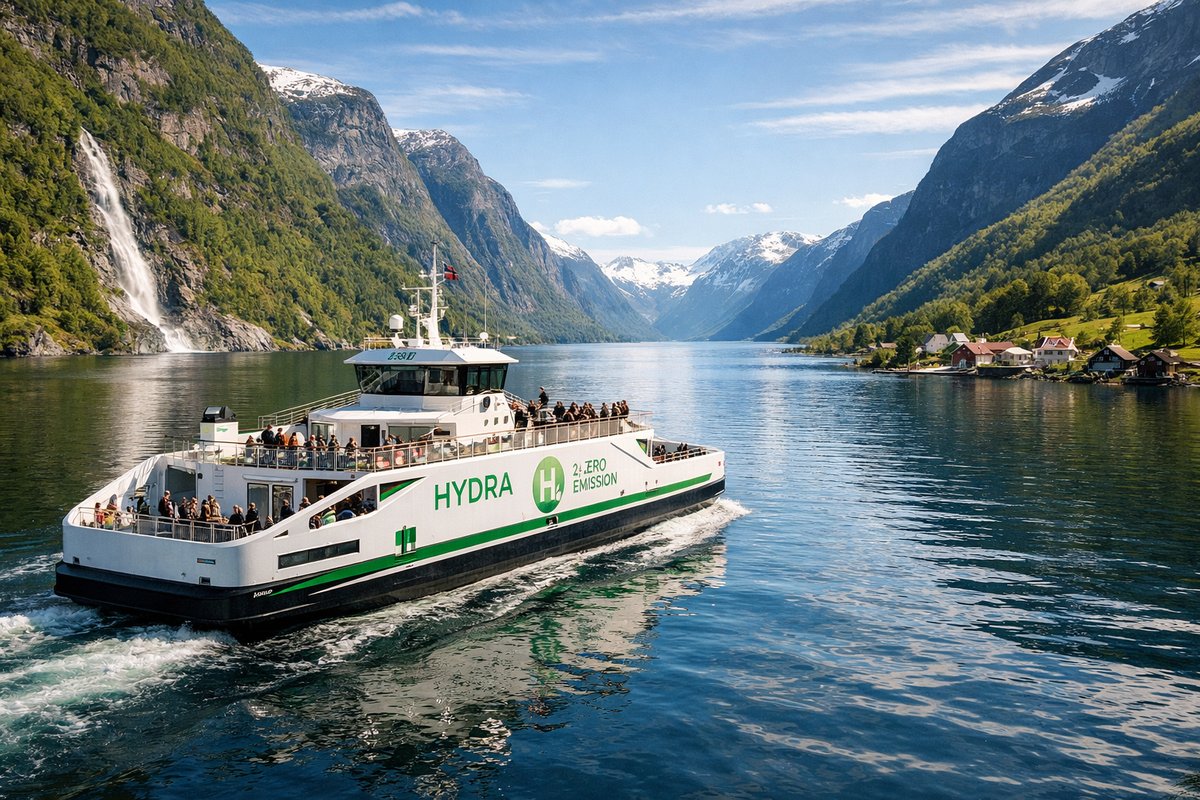
Aboard the MF Hydra, the world's first hydrogen-powered ferry, travelers glide through Norway's deepest fjords without a trace of exhaust. This breakthrough route is more than a scenic crossing-it signals a shift toward zero-emission maritime journeys that connect remote communities, inspire eco-friendly tourism and reshape our relationship with the seas.
The sun hovers low on the horizon as the ferry glides silently from the pier. Waves lap gently against the hull, but there is no drone of diesel engines-only the soft hum of electric motors powered by hydrogen fuel cells. Passengers stand on deck wrapped in layers against the cool air, scanning towering granite walls that plunge hundreds of meters into glass-calm water. This is the MF Hydra, the world’s first hydrogen-powered ferry, embarking from the tiny village of Lavik into Norway’s western fjordlands.
Across the water, a string of mountain peaks draped in spruce forests appears to float. The route between Lavik and Oppedal spans just under 40 nautical miles, but for many travelers, it is a revelation: a zero-emission voyage through a landscape that has rarely felt so untouched. Local officials partnered with shipbuilders and clean-energy firms to retrofit an existing hull with advanced hydrogen tanks, electric propulsion and a regenerative braking system that recaptures energy during deceleration. The result is a vessel that emits only water vapor and recycles up to 90 percent of its onboard energy.
Since its launch, the ferry has carried more than 45,000 passengers and replaced two diesel vessels that once steamed this waterway six times daily. Each round-trip saves an estimated 1,200 liters of diesel, cutting nearly 3,000 metric tons of carbon emissions per year. The project’s success has ignited interest among island communities across Scandinavia, where archipelagos often rely on ferries for basic connectivity. From the Lofoten Islands to the Shetlands, local councils are studying hydrogen and battery-powered models to reduce noise, air pollution and operating costs.
“I’ve lived here all my life, and the fjord always felt like an open highway,” says a regular commuter who works in a fisheries co-op on the opposite shore. “But this crossing-there’s a new kind of calm to it. No vibrations, no smell. Just the landscape and the water. It feels like traveling in glass.”
Tour operators have seized on this sense of tranquility. Guided kayaking tours now launch from the ferry docks, following narrow side inlets where seals laze on rocky ledges and seabirds wheel in thermals above steep ravines. Eco-guided hikes penetrate moss-laden forests to hidden waterfalls, with local naturalists narrating centuriesold folklore passed down by fjord dwellers. Each excursion is calibrated to leave minimal footprints: small groups carry lightweight tents made from recycled materials, solar-powered lights and composting toilets on wheels.
The ripple effect of sustainable ferry travel extends inland. Small villages along the route have embraced carbon-neutral practices, renovating historic guesthouses with geothermal heating and rooftop solar arrays. Artisans crafting wool blankets from indigenous sheep breeds now rely on battery-powered looms, while a microbrewery at Oppedal has introduced a “fjord series” of lagers fermented using glacier-melt water. Even the local bakery uses an electric oven charged by the ferry’s excess green energy at dockside.
For many visitors, the journey is as much inward as outward. With no engine roar breaking the hush, travelers report a heightened awareness of shifting light, drifting clouds and the infinite reflections on the water’s surface. A group of artists aboard recently sketched the scene in real time, trading brushes and charcoal while sipping herbal tea from insulated flasks. The absence of noise pollution turns every glance into an act of discovery: a solitary heron balancing on an islet, a ripple of fish breaking the mirror-like fjord, the faint scent of juniper and pine carried by the breeze.
This voyage is emblematic of a broader movement in travel-one that privileges slow, mindful passage over speed and spectacle. Across Europe, electric catamarans are launching on Mediterranean island routes, solar-hybrid yachts are ferrying adventurers through hidden coves, and hydrogen-powered trains are linking mountain villages once accessible only by winding roads. Each innovation shares a common purpose: to preserve fragile landscapes while reimagining the ordinary act of getting from A to B as an opportunity for connection.
On board the Hydra, crew members explain that hydrogen tanks are safely stored in reinforced compartments below deck, where sensors constantly monitor pressure and temperature. Fuel cells combine hydrogen with oxygen drawn from the air, creating electricity and heat with no carbon byproducts. Excess heat keeps passenger lounges warm on chill mornings, while the regenerated energy from braking powers interior lighting and digital displays highlighting current speed, remaining range and upcoming points of interest.
Over the next year, similar ferries are slated to enter service in the Westfjords of Iceland and between the Scottish Hebrides. Regional planners are eyeing routes that cross deep, narrow straits-places where diesel fumes once pooled like smog in steep valleys. In March, the first zero-emission train will begin shuttling hikers to Norway’s fjord-ringed city of Ålesund, running on batteries recharged by wind farms along the coast. It’s a network of innovations that elevates transit into an act of stewardship, encouraging travelers to think beyond tickets and timetables.
For anyone intrigued by this quiet revolution, a few practical steps will enhance the experience. A compact, high-capacity power bank keeps cameras and smartphones humming when outlets are scarce. A lightweight waterproof backpack-cover ensures gear stays dry during misty mornings on open decks. Insulated stainless steel flasks are essential for hot drinks that chase away sea breeze chills. Travelers who plan to camp or kayak can invest in an ultralight hammock made from recycled nylon and a bandana or buff crafted from moisture-wicking fibers.
Most importantly, allow time for unplanned pauses: moments when the world feels suspended between sky and sea. Sit on the deck ledge with knees drawn up to your chin, trace the contours of distant islands or simply watch the hydrogen tanks glimmer in the soft light. In these quiet instants, the voyage becomes more than a commute-it becomes a meditation on movement, place and possibility.
As the ferry approaches Oppedal, passengers prepare to disembark into a community remade by clean tech and environmental ambition. A fleet of electric minibuses awaits, ready to shuttle hikers to glacierfront trails or scenic waterfalls. Local cafés offer iodine-tinged pastries baked with fjord water. Artists open their studios next to solar-heated greenhouses. Every part of this journey-land, sea and mind-reflects a shared commitment to tread lightly.
The MF Hydra’s maiden crossings have already inspired other coastal regions around the globe to consider hydrogen and battery power for their ferries and small vessels. From the rugged coast of British Columbia to the archipelagos of Southeast Asia, remote communities see a path to connectivity that no longer demands a sacrifice of air quality or soundscapes. Travelers, in turn, find that the silence of clean energy reveals hidden layers of place: an ancient pine silhouette against a copper sky, the arch of a migrating goose, a whisper of pine needles underfoot. In that silence, there is room to wonder, to listen and to carry home a story powered not by fossil fuels, but by a collective imagination for a gentler future of travel.
Nearly everyone who steps off the Hydra speaks of the same thing: the ferry was never the destination, but it became the story they will share for years to come. In the age of speed and screens, that’s a rare and precious gift.