Location
Mount Vernon, WA 98274

Location
Mount Vernon, WA 98274
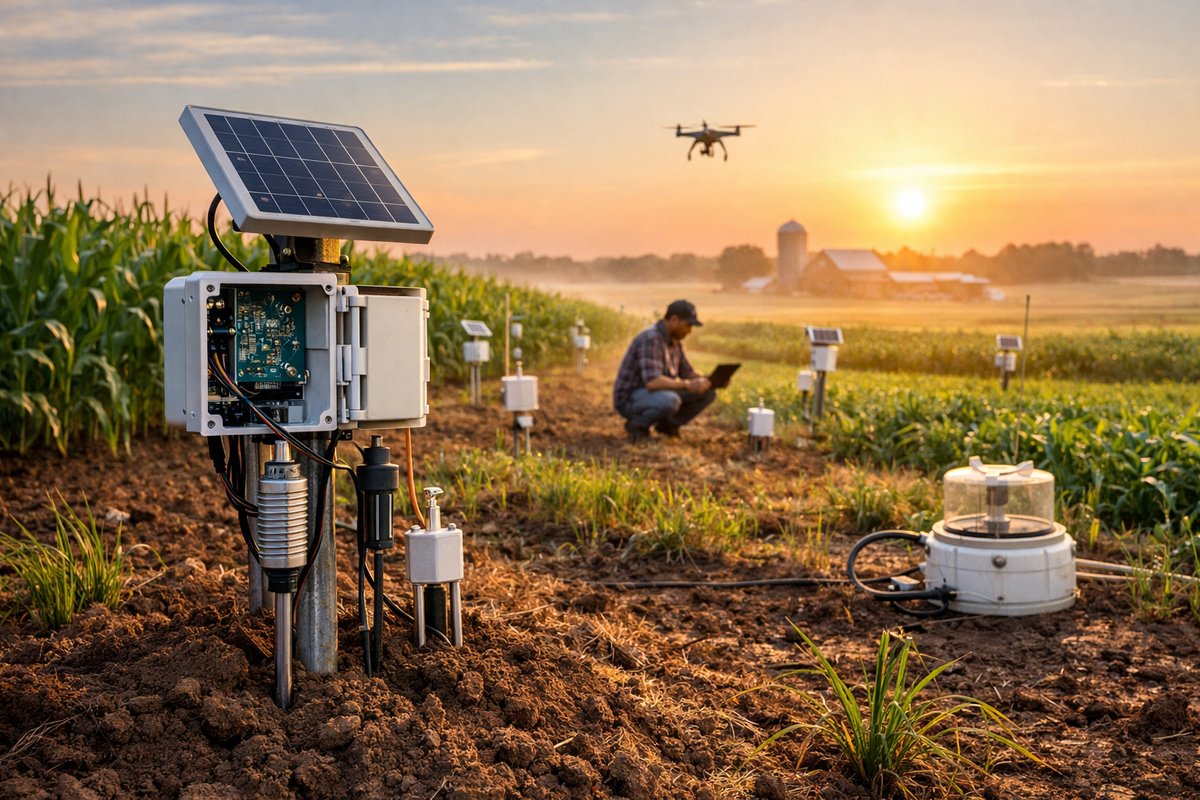
An open-source array of AI-linked soil sensors is transforming how farmers and researchers monitor carbon sequestration and water usage. Field trials in three Midwestern counties demonstrate unprecedented spatial resolution in soil data, promising smarter agricultural practices and new pathways for carbon credit markets.
In a quiet breakthrough for sustainable agriculture, researchers and farmers have teamed up to deploy an AI-powered soil sensor network that delivers high-resolution maps of carbon content and moisture dynamics across working fields. Rather than relying on periodic soil sampling or satellite proxies, this system combines low-cost, in-ground nodes with solar-powered gateways and cloud-based machine learning to reveal how tillage, cover crops, and irrigation influence soil health in real time.
The pilot installation-spread across three family farms in Iowa-marks one of the first large-scale demonstrations of a fully integrated, wide-area soil monitoring platform. Over 250 sensor nodes, each equipped with probes for moisture, temperature, and near-infrared carbon estimation, are embedded at multiple depths across 150 hectares. Data streams flow continuously through a mesh of solar-powered LoRaWAN gateways, feeding an AI analytics engine that stitches together individual readings into centimeter-scale maps of soil water retention and organic carbon storage.
Early feedback has been striking. In one field, sensors detected a moisture deficit in a low-lying interception zone days before nearby weather stations recorded rainfall surpluses. The predictive model, trained on historical irrigation and yield data, alerted the farm manager to adjust local water allocation, preventing potential crop stress without overwatering. In another plot, spatial patterns of soil organic carbon revealed pockets of unexpectedly high sequestration where perennial grasses had self-established along field margins. This insight has prompted a revision of cover cropping strategies, allowing farmers to allocate inputs more efficiently and potentially unlock voluntary carbon credits.
Despite its technical sophistication, the network is built entirely from commercially available components-open-source microcontrollers, off-the-shelf soil sensors, and solar-powered gateways that double as environmental data hubs. DIY documentation and modular software libraries allow farms of varying sizes to adapt the system without specialized engineering support. A user interface accessible on both desktop and mobile platforms visualizes near-real-time maps of key soil metrics, issue alerts when thresholds are exceeded, and archives data for long-term trend analysis.
This breakthrough arrives at a critical juncture. Agriculture accounts for nearly a quarter of global greenhouse gas emissions, yet it also holds immense potential as a natural carbon sink. Encouragingly, soil scientists estimate that thoughtful management practices-from reduced tillage to diversified rotations-could draw down up to two gigatons of CO₂ per year. However, the lack of high-resolution monitoring tools has hampered efforts to validate changes in soil carbon, leaving farmers and policy makers reliant on infrequent sampling or coarse-scale models.
By contrast, continuous sensor networks can capture the fine-scale heterogeneity of real fields, exposing the influence of microtopography, soil texture, and management history on carbon dynamics. With AI-driven predictive analytics, the platform not only measures current conditions but also forecasts how interventions-such as altering sowing dates or introducing legumes-might reshape long-term soil health. Early adopters envision new revenue streams from carbon markets, backed by verifiable, sensor-based evidence rather than table-top calculations.
Yet the system is not without challenges. Soil moisture sensors, though robust, require occasional recalibration to correct for drift over seasons. Gateways dependent on solar power must contend with periods of inclement weather, demanding backup battery solutions or hybrid energy inputs. And as data volumes grow, farms face choices around local server capacity versus cloud subscriptions-balancing privacy concerns against the scalability of remote computing.
Data governance is another point of discussion. Farmers understandably seek ownership of the raw measurements, while researchers and startups emphasize the value of aggregated datasets for training more accurate predictive models. To address these tensions, the project’s open-source license stipulates that individual farms retain full control over their data, with shared contributions anonymized before they enter a collective repository. This framework aims to foster collaboration without jeopardizing farmers’ autonomy or commercial interests.
Beyond the immediate benefits to water management and carbon accounting, the sensor network offers a platform for exploring broader ecological interactions. Future modules might incorporate dissolved nitrogen probes, soil respiration analyzers, or above-ground sensors that track plant spectral signatures. There are also plans to integrate drone-based multispectral imaging, linking aerial snapshots with ground truth for even richer datasets.
In parallel, software engineers are refining machine learning models to incorporate local weather forecasts, satellite leaf area indexes, and historic yield records. The goal is a decision support system that provides prescriptive advice-such as recommending optimal cover crop species or scheduling nitrogen applications-tailored to each microzone within a field.
Farmers involved in the pilot emphasize that even incremental improvements can yield substantial economic and environmental dividends. “I’ve been farming this land for three generations,” says one collaborator. “To see where we’re losing water, where the soil is richer or poorer, it’s like someone turned on the lights in a room we’ve been working in the dark. We’re making fewer trips with the tractor-saving fuel-and the crops look healthier.” As more data accumulate, the hope is that these real-world results will inspire policy incentives, grant programs, and carbon market frameworks that recognize on-farm innovation.
While this initial rollout focuses on row crops in temperate zones, the underlying design is adaptable to orchards, vineyards, and even tropical plantations. The open-source ethos invites researchers, extension agents, and farmers worldwide to replicate and refine the approach. Several pilot projects are already forming in Europe, South America, and Southeast Asia, exploring how the network performs across different climates, soil types, and management systems.
In the face of mounting climate challenges, equipping farmers with precise, actionable insights may be one of the most powerful tools at our disposal. By illuminating the hidden patterns beneath our feet, AI-driven soil sensor networks stand to reshape agricultural decision-making, bolster food security, and advance our collective goal of a more resilient, low-carbon future.
As the platform evolves, its stewards emphasize that the real achievement is not in any single technological component, but in the seamless integration of hardware, software, and human expertise. In the end, it’s a story of collaboration-between machines and people, labs and fields-and a reminder that solutions to global challenges often emerge from the ground up.