Location
Mount Vernon, WA 98274

Location
Mount Vernon, WA 98274
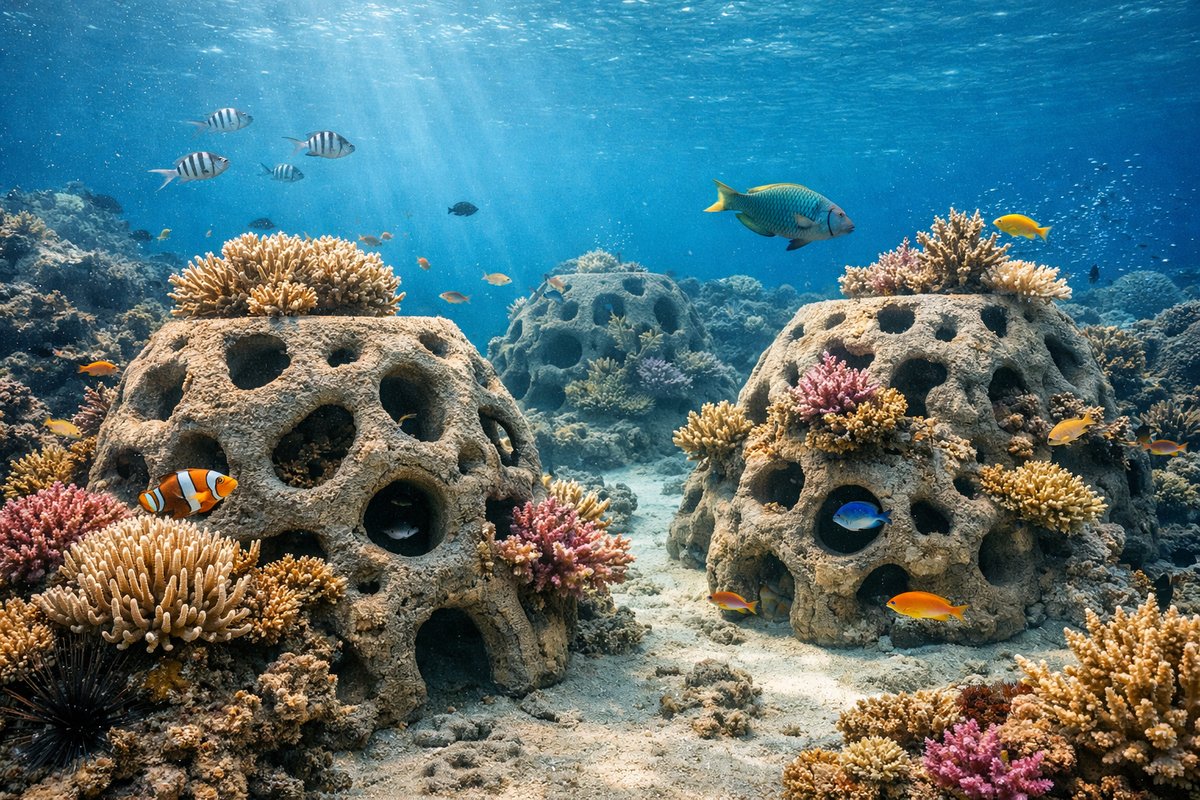
A pioneering project has deployed 3D-printed reef modules off a threatened coastline, combining materials science and marine biology to accelerate coral recovery. Field trials reveal that these synthetic skeletons not only survive harsh ocean conditions but also attract diverse marine life, pointing to a scalable model for reef conservation worldwide.
Coral reefs, often called the rainforests of the sea, support an estimated 25 percent of all marine species despite covering less than one percent of the ocean floor. Yet rising ocean temperatures, acidification, and human impacts have left many reef systems bleached, fragmented, or dead. In a groundbreaking effort to reverse this decline, an international team of researchers and engineers has turned to 3D printing, deploying custom-designed reef modules made from eco-friendly materials. Early results from field trials off the coast of Queensland show rapid colonization by corals and reef fish, offering fresh optimism for global restoration efforts.
The project builds on advances in additive manufacturing and biomimetic design. Using 3D printers to produce complex, lattice-like structures, the team can mimic the intricate geometry of natural reef skeletons while tailoring porosity, strength, and buoyancy. The synthetic modules are printed with a biodegradable polymer blend infused with calcium carbonate, providing a familiar substrate for coral larvae to attach and mineralize. Over several months underwater, sections of the polymer slowly dissolve, leaving behind a new reef made entirely of living organisms and their own secreted skeletons.
Designing the ideal reef unit began in the lab, where engineers used computational fluid dynamics to optimize each module’s shape. By simulating ocean currents at various depths, they identified geometries that promote nutrient flow and minimize sediment buildup-two critical factors for healthy coral growth. High-resolution resin printers crafted prototypes at a centimeter scale, which were then tested in flow tanks, measuring water velocity and particle deposition. Once the optimal design was finalized, larger models measuring up to two meters across were printed using industrial FDM machines and transported to the deployment site on custom cradles.
In early spring, marine biologists descended with SCUBA gear, underwater cameras, and handheld water quality meters to map the deployment area. Divers positioned more than fifty reef modules across a gradient of depths, from five meters down to twenty meters. Each placement was logged with GPS coordinates and cross-referenced to baseline surveys of coral cover, fish populations, and water chemistry. Over the next three months, citizen-science volunteers and research divers conducted weekly surveys, documenting changes in biodiversity and coral settlement rates.
The early data is striking. Within eight weeks, tiny coral polyps representing multiple species had encrusted over 40 percent of each module’s surface. By week twelve, juvenile fish schools, including damselfish and wrasses, were schooling among the lattice branches. Dr. Elena Morales, a marine ecologist on the project, noted that the synthetic reefs attracted species at rates comparable to nearby natural outcrops. “We’re seeing a level of ecological integration we only hoped for,” she said, “and it underscores the potential of material science to accelerate habitat recovery.”
Beyond coral and fish, the modules have become home to sponges, anemones, and crustaceans. Remotely operated underwater vehicles equipped with high-resolution cameras and environmental sensors have recorded fluctuations in temperature, salinity, and pH directly at the module surfaces. These data streams feed into a cloud-based platform where machine-learning algorithms detect anomalous spikes-signaling either bleaching stress or unusual sedimentation events. Near-real-time alerts allow scientists to dispatch divers armed with quick-response kits, including water test strips and pH meters, to verify conditions and, if necessary, perform targeted interventions.
Sustainability is a core value of the project. The polymer blend used for printing comprises up to 60 percent bio-based materials derived from agricultural byproducts, reducing reliance on petroleum feedstocks. After the designed dissolution period-typically 18 to 24 months-no synthetic debris remains on the reef. All that persists is living coral, calcified skeletons, and a renewed habitat complexity. The research team is also evaluating next-generation filaments that embed slow-release nutrients or probiotic bacteria known to enhance coral larval survival.
The cost per reef module currently ranges between $500 and $800, driven primarily by filament costs and printer runtime. However, mass production and local fabrication hubs near vulnerable coastlines could drive prices down by an order of magnitude. The project partners are in talks with conservation NGOs and government agencies to pilot community-run fabrication centers in the Caribbean and Southeast Asia. There, local youth might learn to operate 3D printers, collect baseline ecological data, and maintain long-term monitoring networks.
While the initial focus has been on tropical coral reefs, researchers believe the underlying approach applies to other marine habitats. Seagrass meadows, oyster beds, and kelp forests could each benefit from custom-printed substrates tailored to local conditions. Indeed, a sister project in California has started trialing 3D-printed oyster cages to boost shellfish populations and filter coastal waters. The modular nature of the design allows for rapid customization: printed reef scaffolds destined for deeper, colder waters can use stiffer materials and more open lattice to accommodate larger flow rates, while warm-water modules emphasize microhabitats for juvenile corals.
Critics caution that restoration should not distract from tackling root causes like greenhouse gas emissions and coastal development. “You can’t print your way out of a warming ocean,” says a marine policy expert unaffiliated with the project. The research team acknowledges this point, positioning the technology as a complement to, not a replacement for, broader conservation strategies. By buying time for reefs to adapt, synthetic structures may help preserve genetic diversity and ecosystem services while global emissions are brought under control.
Looking ahead, the team plans to integrate advanced sensors directly into printed modules. Tiny acoustic loggers could measure reef soundscapes, an emerging proxy for fish biomass. Microbial samplers might collect eDNA at critical junctions, tracking genetic shifts over time. In parallel, scientists are exploring photocatalytic coatings that convert sunlight into localized pH buffering, counteracting acidification hotspots. A test coating in the lab has shown promising results, maintaining neutral pH in small water chambers for days at a time.
Public engagement remains a pillar of the effort. Project videos showcasing time-lapse growth on 3D structures have gone viral on social media, reaching millions of viewers. Interactive exhibits at aquariums and science museums allow visitors to “print” virtual reef modules and see their impact simulated in real time. School programs invite students to design their own reef shapes using open-source software tools, then vote on the next generation of field prototypes.
If these initial successes scale globally, we could witness a new era in ecosystem restoration-one where human ingenuity and careful stewardship combine to mend the wounds of our planetary systems. As the ocean’s gardeners sharpen their printers, the question shifts from whether we can rebuild what’s been lost to how fast and well we can ensure reefs remain vibrant in the decades to come. The future of coral reefs may well be written in layers-printed layer by layer, polyps settling layer by layer, life itself building upon the scaffolds we once thought unnatural.
Innovations like these remind us that the boundary between technology and nature can blur, offering tools that work with, rather than against, the living world. In a time of rapid change and environmental uncertainty, that partnership may prove one of the most hopeful stories in science.