Location
Mount Vernon, WA 98274

Location
Mount Vernon, WA 98274
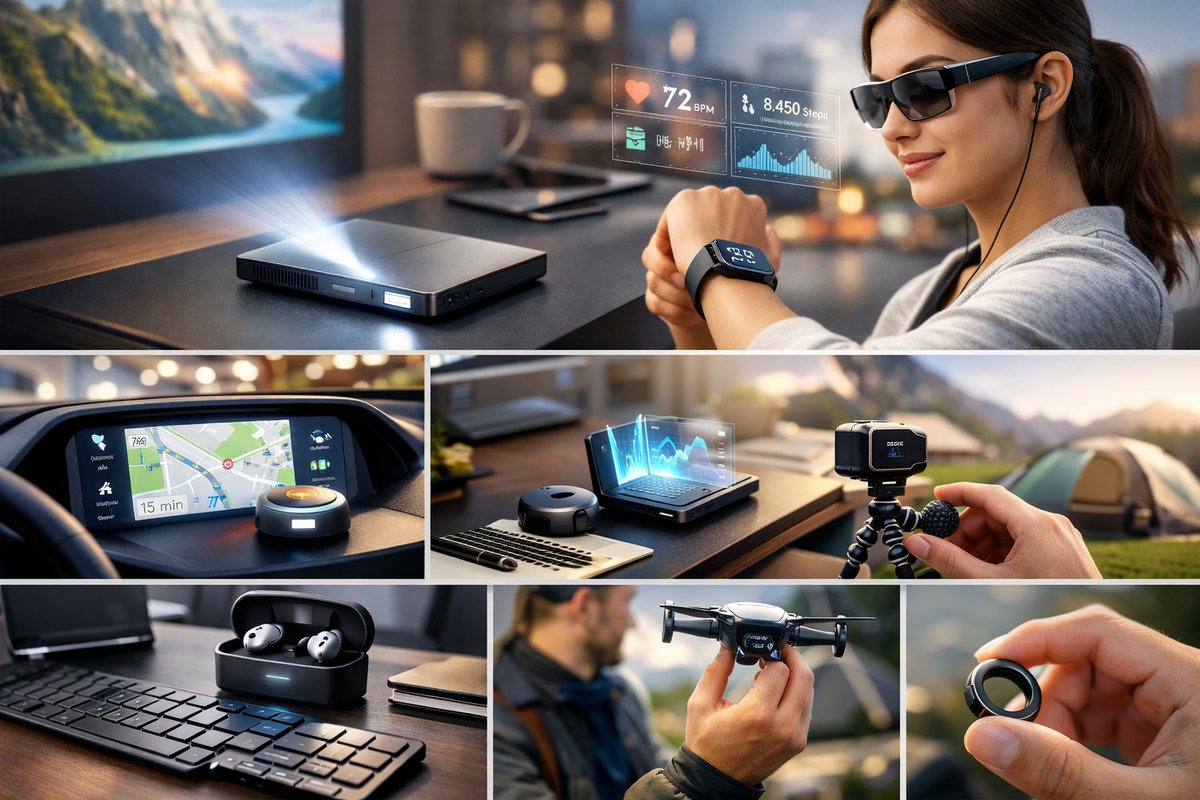
From credit-card-thin projectors to wearable health sensors, the latest wave of ultra-compact devices is turning everyday routines into seamless, data-driven experiences. These micro marvels pack advanced materials, ambient computing and AI-powered intelligence into palm-sized formats-transforming commutes, workspace setups and weekend adventures.
Advances in materials science and low-power electronics are ushering in a new era of microtech, where devices once the size of shoeboxes now fit inside a wallet or clip onto a keyring. These ultra-portable gadgets deliver core computing capabilities, high-fidelity audio, environmental sensing and cloud connectivity-all without sacrificing performance or battery life.
On a crowded subway platform, a commuter slips a credit-card-sized projector from her wallet, instantly transforming the station wall into her private screen for a work presentation. Moments later, she pulls a smart pen from a pocket, and her handwritten notes are digitized and synced to the cloud via an integrated AI engine. Across the way, another traveler clips a round, puck-like health sensor onto the collar of a jacket. Embedded optical and ECG sensors monitor heart rate variability and stress levels throughout the journey, prompting gentle reminders to breathe deeply when cortisol spikes.
What once seemed like science fiction is now commonplace thanks to breakthroughs in flexible printed circuits, foldable displays, micro-LED arrays and graphene-enhanced batteries. Designers are shrinking circuit components to sub-millimeter scales, weaving them into fabrics and laminating them onto plastic foils that can bend, fold and roll. Battery chemistries are following suit; ultra-thin lithium polymer and solid-state cells can now deliver hours of power in a form factor thinner than a credit card.
The evolution of microtech can be traced through several product categories:
• Pocket Projectors: Micro-LED and laser-based projection modules deliver bright, high-contrast images from devices no larger than a smartphone. These modules rely on micro-optical elements and folded light paths to bounce the beam through tiny prisms. The result is a portable cinema experience that can turn any wall, ceiling or tabletop into a 1080p or even 4K display.
• Wearable Environmental Sensors: Tiny sensor nodes can analyze air quality, UV levels and noise pollution in real time. Worn on a lapel or backpack, these gadgets provide data on particulate matter (PM2.5), volatile organic compounds, temperature and humidity. Mobile apps draw simple heat maps that visualize how conditions change over the course of a commute or run.
• Smart Pens and Notebooks: By embedding infrareddrive sensors and Bluetooth LE radios inside a pen barrel, manufacturers can capture handwriting strokes with millimeter accuracy. When paired with a special dot-pattern notebook, every scribble is captured, digitized and time-stamped. Cloud-connected note-taking apps then organize entries into searchable indexes and can even convert messy scrawls into typed text.
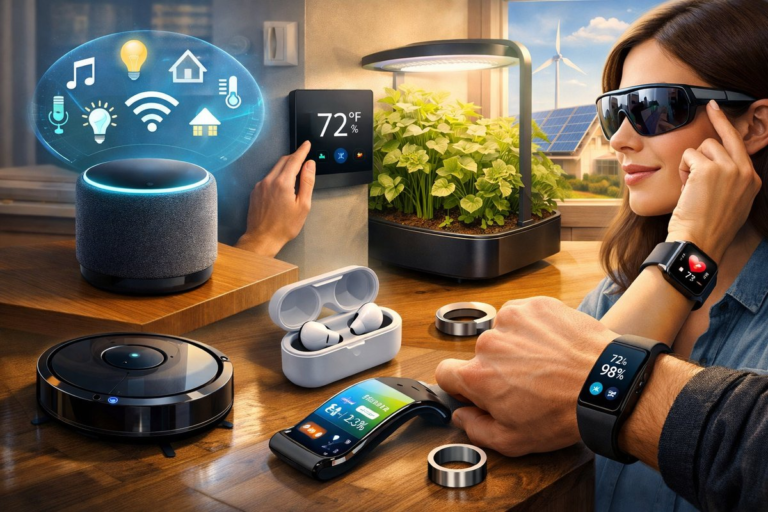
• Biometric Clips and Patches: Gone are the days when measuring heart rate or oxygen saturation required clunky wristbands. Ultra-compact optical sensors can be packaged into adhesive skin patches or magnetic shirt clips. Some models use multi-wavelength photoplethysmography to measure not only heart rate but also stress markers and hydration levels. Data flows continuously to smartphone dashboards, offering individualized wellness recommendations.
• Modular Charging and Power Cells: Battery modules have themselves shrunk into thumb-drive shapes, hooking together like building blocks to provide scalable capacity. Each module may offer 5,000-10,000 mAh in a block roughly the size of a car key fob. Magnetic connectors let users snap on multiple cells to match the day’s power demands, whether recharging a pair of wireless earbuds or topping up a laptop.
The seamless integration of these devices into daily life is driven by advances in ambient computing: tiny AI engines that run locally on microcontrollers, interpreting sensor data and triggering actions without a round trip to the cloud. On-device intelligence reduces latency, preserves privacy, and extends battery life by minimizing wireless transmissions. Ambient AI can identify spoken commands, detect anomalies in motion patterns, or suggest productivity tips based on calendar context-all within a handful of square millimeters of silicon.
Energy harvesting is another key enabler. Flexible solar cells, printed thermoelectric generators and micro piezoelectric elements can capture light, heat differentials and motion energy from the environment. When combined with supercapacitors, these harvesters can power low-rate data logging and simple machine-learning inferences indefinitely-ideal for sensors deployed on remote equipment or in consumer wearables that rarely see a charging cable.
Software ecosystems are evolving in parallel. Open-source frameworks for ultra-low-power AI, such as TinyML, let developers port models onto microcontrollers with as little as 64 KB of RAM. Cross-platform development kits simplify the creation of companion apps that visualize real-time data from dozens of devices. Meanwhile, standardized wireless protocols like Bluetooth LE Audio and Thread ensure reliable connectivity in busy home and office environments.
These innovations have real-world impacts:
• Better Urban Health Insights: Commuters equipped with air-quality sensors can build community maps of pollution hotspots. City planners then use aggregated, anonymized data to optimize bus routes, green corridors and building ventilation standards.
• On-Demand Learning Studios: Portable projectors and smart notebooks are democratizing education. Teachers can carry entire lesson plans in a single bag, projecting interactive quizzes onto any surface and capturing student responses digitally.
• Personalized Wellness Routines: Continuous biometrics enable personalized exercise, sleep and nutrition guidance. AI-driven apps adjust recommendations in real time based on stress levels and circadian trends, helping users maintain mental and physical balance.
• Disaster-Resilient Sensing: In areas prone to natural disasters, ultra-compact environmental monitors can be air-dropped to assess water quality, air toxins and radiation levels. The lightweight footprint and harvestable energy sources mean these units can operate for weeks without maintenance.
As the microtech wave continues, we’ll likely see even smaller neural interfaces, implantable micro sensors and fabric-woven displays that disappear into clothing. Foldable glass and polymer displays will allow devices to expand from a few square centimeters to several inches, creating modular tablets that snap together like puzzle pieces.
Ethical and environmental considerations must keep pace. Designing for minimal e-waste means prioritizing repairable modules, recyclable materials and long-term software support. Privacy demands that on-device AI handle sensitive health and location data, rather than sending raw streams to centralized servers.
Ultimately, these pocket powerhouses are more than novelty items. They represent a shift toward computing that adapts to our context-running quietly in the background, augmenting our perception and freeing us from screens and cables. As development kits and open ecosystems grow, we can expect a proliferation of niche gadgets customized to personal passions: music-analyzing lapel pins for audiophiles, micro drone-controller rings for hobby pilots, and digital wellness stickers that stick to any surface.
In this next chapter of ambient, ultra-portable tech, the boundary between device and user blurs. Our clothing, accessories and personal spaces become the stage for smart sensors and AI engines that listen, learn and react in real time. And in doing so, they amplify human potential-allowing us to work, learn and thrive without being tethered to a desk or a power outlet.
As you explore this frontier, consider the principles of sustainability and privacy. Seek devices built with modular components and open-source support. Embrace on-device intelligence and energy harvesting to minimize your reliance on charging cables and distant data centers. And above all, let curiosity guide you: the smallest gadget in your pocket may unlock the biggest leaps in everyday innovation.