Location
Mount Vernon, WA 98274

Location
Mount Vernon, WA 98274
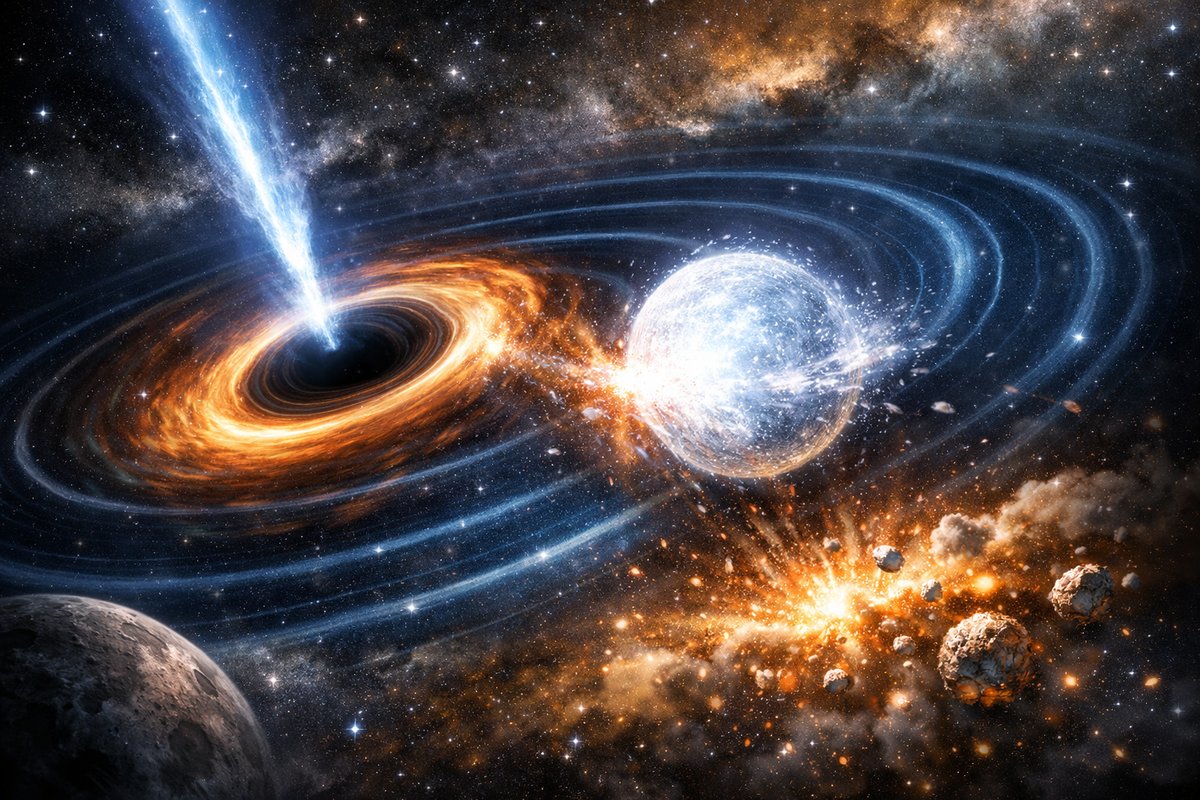
For the first time, gravitational waves from the violent embrace of a black hole and a neutron star have been recorded, opening a new chapter in multimessenger astronomy. This landmark discovery tests Einstein's theories under extreme conditions and hints at hidden processes forging the universe's heaviest elements.
On a quiet afternoon at observatories scattered across the globe, a ripple in spacetime quietly washed over Earth. Within fractions of a second, ultra-sensitive detectors in the United States, Europe, and Asia registered the unmistakable signature of a cosmic collision: a neutron star spiraling into a black hole. This unprecedented event marks the first confident detection of gravitational waves produced by the merger of two objects so fundamentally different yet bound by gravity’s unrelenting pull.
Since the landmark first detection of gravitational waves in 2015, which confirmed a key prediction of general relativity, scientists have chased echoes of colliding black holes and neutron stars. Each new detection deepens our grasp of fundamental physics and the life cycles of the universe’s most enigmatic objects. But a merger involving both a black hole and a neutron star carries unique promise. It allows researchers to probe matter at nuclear densities, test gravity in its most extreme regime, and explore whether such collisions seed the cosmos with the heavy elements that build planets and, ultimately, life.
The discovery was made possible by a coordinated network of kilometer-scale interferometers. High-power lasers were split into perpendicular beams, sent down evacuated tubes, and reflected off mirrors suspended by painstakingly engineered isolation systems. When a passing gravitational wave stretched one arm while squeezing the other, the change in distance-thousands of times smaller than a proton’s diameter-could be recorded in the interference pattern. By combining data from multiple observatories, scientists not only confirmed the cosmic origin of the signal but also triangulated its approximate location in the sky.
Analysis of the waveforms revealed a black hole roughly eight times the mass of our Sun spiraling with a neutron star about 1.6 times solar mass. Situated nearly 900 million light-years away, this system fell victim to its own gravitational dance. As the neutron star drew closer, tidal forces grew intense. In many scenarios, it would be torn apart before plunging into the black hole, flinging neutron-rich debris outward. This debris can power a kilonova-an electromagnetic flash rich in heavy elements like gold and platinum. Yet, in this case, telescopes scanning the region saw no bright optical or infrared flash, suggesting the neutron star may have been swallowed whole.
The absence of an electromagnetic counterpart offers crucial clues. By modeling how the neutron star deforms under the black hole’s gravity, scientists can constrain the neutron star’s internal structure-known as the equation of state. These insights complement earlier measurements from binary neutron star mergers, refining our understanding of how matter behaves at densities millions of times greater than an atomic nucleus.
Crucially, the mass ratio and spin of the merging bodies carry fingerprints of their formation history. Did they evolve together in a binary stellar system, or did they pair up later in a dense stellar cluster? Comparing event rates and properties across multiple detections will help astrophysicists piece together the environments where such exotic binaries form.
This observation also stretches the capabilities of general relativity. By fitting the incoming waveform to theoretical templates that include high-order corrections, researchers test whether gravity behaves as Einstein predicted, even under the most intense gravitational fields. So far, the data align with general relativity’s predictions, but each new event tightens the constraints on any potential deviations.
The successful detection underscores ongoing improvements in detector sensitivity. The latest observing run benefitted from upgrades that boosted laser power, reduced thermal noise in the mirror coatings, and enhanced seismic isolation. Engineers have also experimented with quantum-noise-reduction techniques, injecting specially prepared light to beat the limits imposed by quantum mechanics.
Looking ahead, the next generation of ground-based observatories-often dubbed Cosmic Explorer and Einstein Telescope-promise further leaps in range and precision. Plans for a space-based gravitational wave detector, known as LISA, will open a window onto lower-frequency signals from supermassive black hole inspirals and other exotic sources. Together, these facilities will transform gravitational astronomy from occasional detections into routine observations.
As gravitational wave catalogs swell, they will join forces with traditional electromagnetic telescopes and neutrino detectors to build a richer mosaic of the high-energy universe. A joint detection by a gravitational observatory and a gamma-ray detector could pinpoint the birthplace of cosmic rays. A coordinated campaign involving optical, X-ray, and radio telescopes could capture the evolving afterglow of a merger. These multimessenger studies will reveal how black holes and neutron stars shape their surroundings, enrich interstellar space with heavy elements, and even influence galaxy evolution.
Beyond pure science, the emergence of gravitational wave astronomy has inspired novel educational initiatives and public engagement efforts. Amateur astronomy clubs are hosting listening parties where citizens can hear sonified versions of spacetime ripples. Educational kits allow students to build tabletop interferometers, offering a hands-on glimpse of the same principles that underpin the world’s most advanced detectors.
In laboratories worldwide, researchers are racing to harness related technologies. Ultra-precise lasers and mirror suspensions developed for gravitational wave observatories are finding new applications in quantum information science, precision metrology, and even geological surveys. The drive to minimize noise and push the boundaries of measurement sensitivity is fueling innovation across physics and engineering.
This landmark black hole-neutron star detection is not only a triumph of international collaboration but also a testament to human curiosity. It reminds us that even in the most extreme corners of the universe, we can listen, learn, and weave a narrative that links our laboratories on Earth to the spectacular forces at play billions of light-years away. As gravitational wave astronomy matures, every new signal will deepen our sense of wonder and our understanding of the cosmic orchestra of which we are a part.
In the coming decades, a steady stream of detections will map the population of compact binaries across cosmic history. We will trace how the universe’s most massive stars live and die, how galaxies assemble, and how the building blocks of matter are forged. And somewhere in that ever-growing catalog of spacetime ripples, we may glimpse phenomena we can scarcely imagine today-opening the next frontier in our quest to decipher the fundamental workings of reality.