Location
Mount Vernon, WA 98274

Location
Mount Vernon, WA 98274
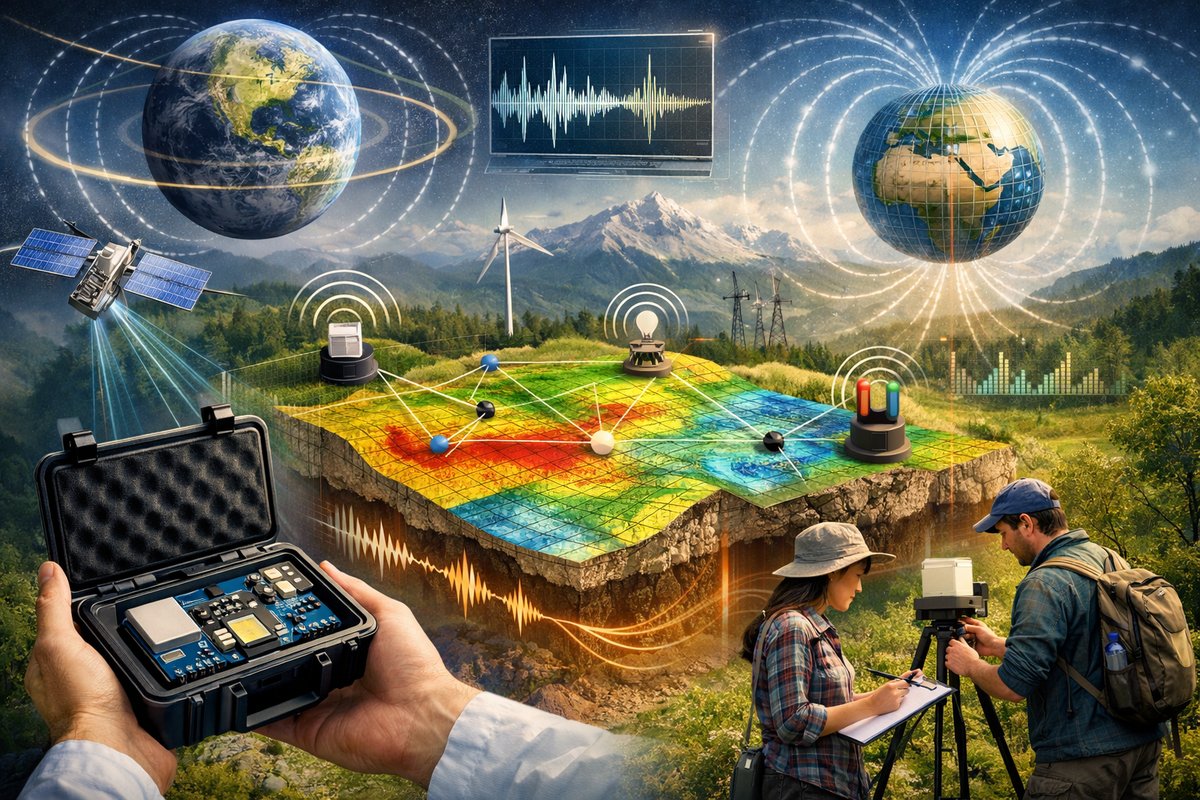
A new initiative leverages low-cost sensor kits and citizen science to chart Earth's gravity anomalies, microseismic hums, and magnetic fluctuations. Researchers hope the integrated network will reveal hidden patterns in the planet's subtle signals.
Early this year, a team of geophysicists and systems engineers launched EarthSense, a distributed network of low-cost sensor nodes designed to capture the planet’s faintest whispers-from minute shifts in gravity to subtle magnetic murmurs and microseismic hums. Unlike previous efforts that focused on a single type of signal, EarthSense merges three distinct streams of data into a unified platform, creating a new window into emergent natural patterns.
Each sensor node consists of a miniature geophone to detect ground motion, a fluxgate magnetometer to record magnetic field intensity, and a compact gravimeter module sensitive enough to register tiny fluctuations in gravitational pull caused by subsurface mass movements. Paired with an inertial measurement unit for orientation and an open-source single-board computer running custom data-logging software, these nodes transmit real-time measurements via Wi-Fi, cellular, or satellite links to a centralized cloud database.
In just six months, over 1,200 nodes have gone live across six continents, installed by universities, community science groups, and individual enthusiasts. The result is an unprecedented map of invisible forces. “For the first time, we can compare gravity anomalies, seismic microtremors, and magnetic variations on a common timescale and spatial grid,” says Dr. Lina Ortega, lead investigator for EarthSense. “This multi-modal approach is revealing correlations we never knew existed.”
One of the earliest surprises came from a remote highland site in South America. Data showed a daily gravity fluctuation of just a few microgals coinciding with microseismic waves generated by ocean swell thousands of miles away. Simultaneously, the magnetometer recorded tiny diurnal magnetic oscillations tied to movements in the ionosphere. Together, these patterns form a dynamic signature of the planet’s rhythmic interplay between land, sea, and sky.
The gravity component builds on decades of satellite missions like GRACE and GOCE, which mapped large-scale variations in Earth’s gravity field. Ground-based gravimeters, however, can capture higher-frequency signals tied to groundwater flow, tidal loading, and tectonic stress accumulation. By integrating those data with microseismic and magnetic measurements, EarthSense aims to detect subtle precursors to landslides, volcanic unrest, and even localized aquifer depletion.
Microseisms-continuous ground vibrations typically at frequencies between 0.05 and 1.0 hertz-have long been studied by seismologists. They arise from wave-wave interactions in the ocean, wind coupling, and human activity. In coastal regions, ocean waves slamming into the shoreline generate standing waves that couple into the crust, producing a near-constant hum. When plotted over time, these microseisms form spectral bands that fluctuate with storm intensity and seasonal changes.
EarthSense nodes have captured a spike in microseismic energy during a recent North Atlantic storm season. In one station on the Irish coast, researchers noted a tenfold increase in amplitude, which then propagated through the network and helped refine models of wave-seafloor coupling dynamics. Such data could improve early warnings for coastal flooding and infrastructure stress.
Magnetic field fluctuations, or magnetic murmurs, stem from processes in the Earth’s core, crust, ionosphere, and magnetosphere. High-latitude nodes have recorded signatures of geomagnetic pulsations driven by solar wind interactions, while equatorial sites reveal subtle anomalies linked to subsurface mineral deposits. By comparing these records with gravity and seismic data, researchers hope to distinguish between natural and anthropogenic sources of magnetic noise.
Collecting high-quality magnetic data outside professional observatories has historically been difficult due to power requirements and susceptibility to local interference. EarthSense nodes address this with low-power fluxgate sensors, precision filters, and automated calibration routines. At night, when urban electromagnetic noise subsides, the network logs cleaner signatures, enabling a 24-hour portrait of the planet’s magnetic rhythms.
Data from all nodes stream into the EarthSense Cloud, where open-source algorithms perform continuous cross-correlation and spectral analysis. Anomaly detection routines flag unusual patterns-such as sudden spikes in microgravity noise or correlated shifts across multiple modalities-that may warrant closer investigation. Researchers can then deploy mobile survey teams or request additional data from nearby citizen scientists to validate events.
One such anomaly triggered an expedition in the Cascade Range. A cluster of nodes detected an unexpected gravity dip of 5 microgals over 48 hours, paired with a mild uptick in low-frequency microseismic tremors. Subsequent field visits uncovered minor ground deformation near a dormant vent, prompting further monitoring. While no eruption occurred, the episode demonstrated the network’s potential for hazard assessment at volcanic sites.
Citizen involvement is at the heart of EarthSense. Installing a node requires only basic electronics assembly skills and a stable internet connection. Volunteers mount the sensor array on a concrete slab or sturdy platform, connect the power module-solar or mains-and register the device on an online dashboard. Detailed guides walk participants through calibration steps and best practices to minimize local noise.
“We wanted this to be sustainable and accessible,” explains systems engineer Malik Johnson. “Each node consumes under five watts. Solar panels and a small battery pack keep it running in remote locales. By tapping into community networks-schools, makerspaces, amateur geology clubs-we’re building a resilient system that can grow organically.”
Privacy and environmental impact were key design considerations. All data are anonymized, and no audio or video is recorded. The hardware enclosures are made from recycled polymers, and end-of-life components are collected and refurbished. Every node carries an environmental footprint label, helping participants calculate the carbon cost of their contributions.
Looking ahead, EarthSense plans to integrate atmospheric pressure sensors and radio-frequency antennas to monitor infrasound waves and lightning-induced electromagnetic pulses. A pilot in the Pacific Northwest will test infrasound detectors sensitive to frequencies below 10 hertz, enabling real-time tracking of volcanic explosions, storms, and human-made blasts.
Machine learning teams are already training models on the multi-modal dataset to uncover hidden couplings between phenomena. Preliminary results suggest that certain magnetic fluctuations precede shifts in microseismic energy by several hours-a tantalizing hint of underlying geodynamic processes. If validated, such correlations could enhance early warning systems for earthquakes or volcanic unrest.
“Nature speaks in many voices,” reflects Dr. Ortega. “By listening with a chorus of sensors, we can begin to understand the harmonies and dissonances that shape our world. It’s not just about raw data; it’s about cultivating a sense of wonder and connection to the planet’s living systems.”
As EarthSense enters its next phase, researchers invite schools, research labs, and curious individuals to join the network. With every new node, the global mosaic of gravity, seismic, and magnetic patterns grows richer, offering deeper insights and sparking fresh questions about the invisible forces that animate our world.
From the hushed vibrations beneath our feet to the magnetic breezes that flow overhead, EarthSense is turning the planet’s subtle signals into a collective narrative-one that blends rigorous science with the spirit of exploration.