Location
Mount Vernon, WA 98274

Location
Mount Vernon, WA 98274
An international team of researchers has unleashed genetically engineered, light-emitting bacteria across Arctic continental shelves to trace methane seepage patterns in real time. Early findings reveal dynamic fluxes that could revise our understanding of greenhouse gas release and marine ecosystem resilience.
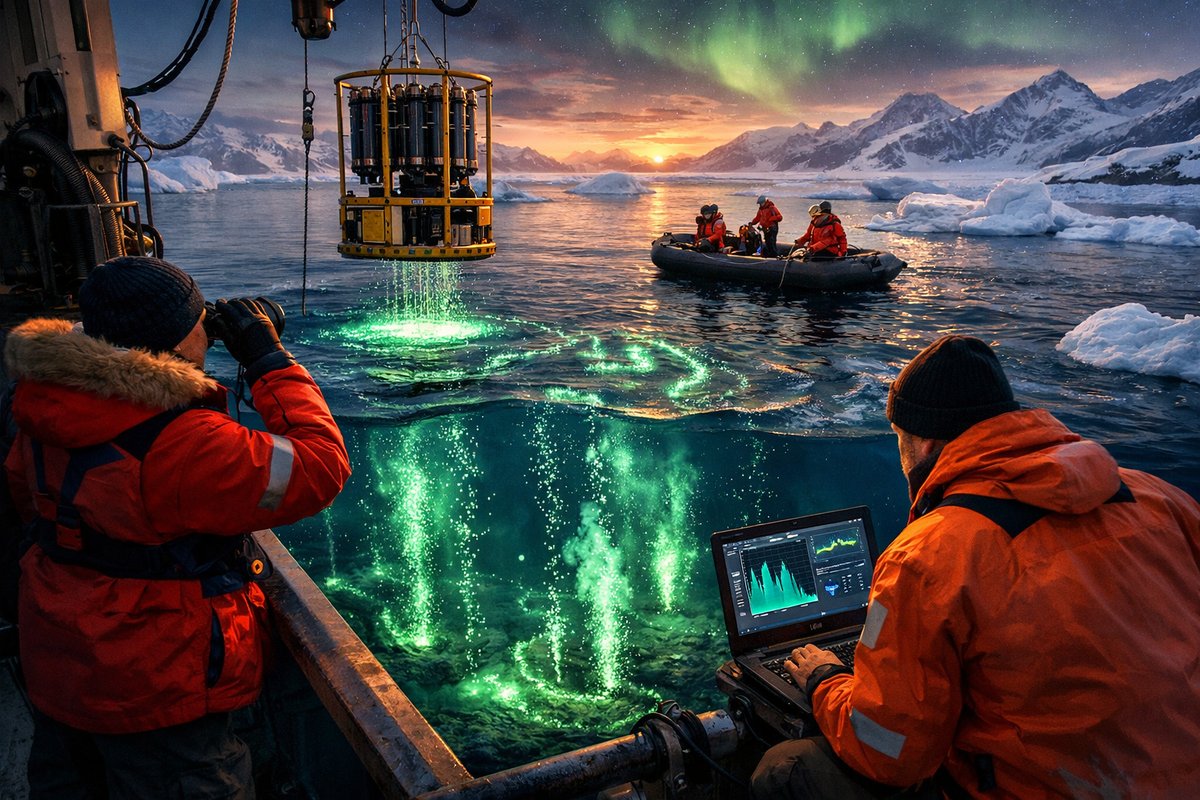
In a first-of-its-kind expedition, scientists have released bioluminescent microbes into the cold, dark waters off Norway’s Svalbard archipelago to map methane emissions from the seafloor. By equipping engineered bacteria with light-producing genetic circuits, researchers can now visualize undersea plumes as they drift, offering unprecedented insight into how methane-a potent greenhouse gas-escapes from deep sediments.
The project emerged from growing concerns over Arctic warming and thawing permafrost, which threaten to unleash vast quantities of methane trapped beneath the seabed. Traditional detection methods rely on discrete sampling or acoustic surveys that can miss transient leaks. This new approach uses living sentinels that glow in methane’s presence, providing continuous, high-resolution data without disturbing fragile benthic habitats.
Microbiologists spent over two years refining a strain of marine bacterium to link methane metabolism to a bioluminescent reaction. When these modified cells consume methane, they emit a faint blue-green glow detectable by ultra-sensitive cameras mounted on autonomous surface gliders. The gliders crisscross survey grids, streaming live video back to shore, where machine learning algorithms distinguish genuine microbial luminescence from background light.
On the vessel deck, the team cultured tens of billions of glowing microbes in custom bioreactor arrays before releasing them in targeted zones above known seep fields. Within hours, glider-mounted spectrometers began recording flickers of microbial light drifting outward. By stitching together thousands of images, scientists produced real-time maps showing methane plumes reaching hundreds of meters from their sources.
“The ability to watch methane plumes in motion changes everything,” said the project lead, an oceanographer specializing in polar systems. “We can now quantify flux rates, see how currents shape dispersion, and even detect brief, high-intensity bursts that conventional methods would miss.”
Preliminary results revealed that methane release fluctuates not only with tidal cycles but also with episodic shifts in bottom currents and local temperature anomalies. In one sector, a sudden warming of just 0.2 °C triggered a fourfold increase in plume intensity over a two-hour window. These transient events, previously hidden, may account for a significant fraction of total methane flux in Arctic marginal seas.
Beyond climate implications, the glowing microbes are revealing how chemosynthetic communities adapt to methane availability. Underwater video shows clusters of worms and crustaceans thriving at seep boundaries where microbial glow is brightest. By correlating luminescence intensity with animal distribution, ecologists gain new clues about food web dynamics in these extreme habitats.
All deployed microbes carry genetic “kill switches” that deactivate their luminescent function after several hours. This ensures that glowing cells do not proliferate indefinitely or alter native microbial ecosystems. Post-expedition surveys confirm that background microbial communities remain unchanged beyond natural variation, offering reassurance that the method is environmentally responsible.
Data from the glowing microbe network are fed into climate models to refine projections of Arctic methane emissions under different warming scenarios. Early model runs suggest that episodic seep events could raise regional methane outputs by up to 20 percent compared to estimates based on steady-state seepage assumptions.
Plans are already underway to expand the technology to other key regions, including the East Siberian Arctic Shelf and the Canadian Beaufort Sea. Researchers are also collaborating with electrical engineers to miniaturize photon detectors for seabed-mounted observatories, enabling long-term, continuous monitoring in remote areas.
The project exemplifies a new wave of bio-integrated sensing tools that blend synthetic biology with robotics and AI analytics. It underscores the transformative potential of living sensors to peer into hidden environmental processes, from soil carbon flux in tundra landscapes to nutrient cycles in forest canopies.
Challenges remain. Harsh polar conditions strain both microbial performance and glider endurance. Salt crystals and low temperatures can dull camera lenses and reduce sensor sensitivity. To overcome these hurdles, engineers are designing heated optical housings and advanced antifouling coatings that keep camera systems clear for extended deployments.
At the heart of this innovation lies a convergence of disciplines-marine microbiology, optical engineering, machine learning, and climate science. Funding agencies have hailed the effort as a model for interdisciplinary research that tackles pressing questions about Earth’s changing systems.
As the glowing microbe network grows, researchers envision a future where real-time bioluminescent tracking becomes a standard tool in ocean observatories worldwide. By making invisible gas flows visible, this approach opens a window into processes that shape our atmosphere and sustain deep-sea life.
In an era of rapid environmental change, the ability to watch methane as it bubbles from the seafloor provides a powerful lens on the complex feedbacks driving our planet’s climate. With each flicker of microbial light, scientists step closer to understanding-and perhaps mitigating-the hidden dynamics of greenhouse gas release beneath the waves.