Location
Mount Vernon, WA 98274

Location
Mount Vernon, WA 98274
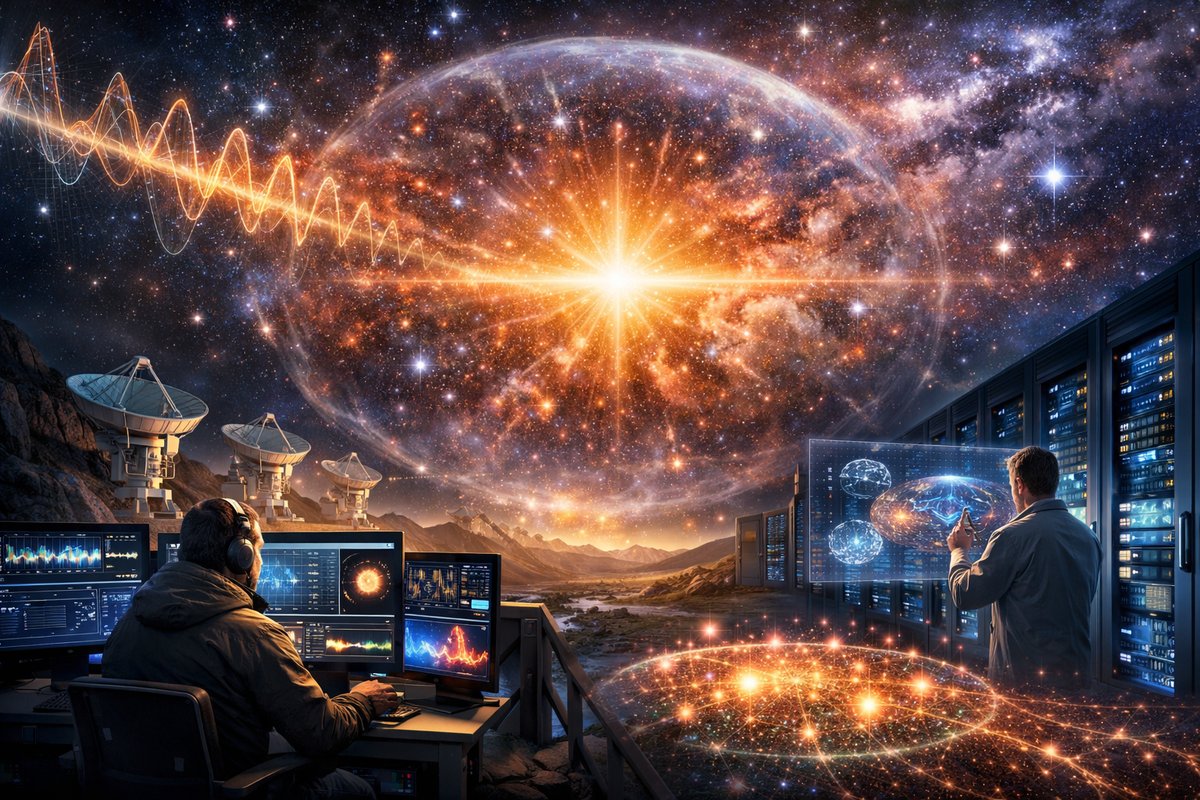
Scientists are deploying cutting-edge sensors and supercomputers to trace the faintest whispers from the universe's infancy. New findings hint at uncharted physics during cosmic dawn, offering a bridge between quantum fluctuations and the large-scale structure we see today.
The earliest seconds after the universe burst into being remain one of science’s most tantalizing mysteries. In a collaborative effort spanning multiple observatories, laboratories, and supercomputing centers, researchers have begun to stitch together a more detailed tapestry of the cosmos’s formative years than ever before. By combining novel quantum sensors, radio arrays, and neutrino detectors with advanced simulations running on exascale machines, teams are teasing out signals that predate the familiar cosmic microwave background-tracing events as close as a trillionth of a second after the Big Bang.
At the heart of this endeavor is the hunt for primordial fluctuations-tiny variations in density and temperature seeded by quantum jitter. Conventional measurements of the cosmic microwave background (CMB) have mapped these ripples with exquisite precision, revealing a universe that expanded and cooled in predictable ways. Yet new theoretical models suggest that a brief “pre-inflation” phase may have imprinted additional anomalies on the fabric of space-time. These anomalies could manifest as subtle distortions in polarization patterns or as nanokelvin-level temperature deviations in the CMB.
To detect these signatures, researchers are upgrading existing radio telescope networks. Facilities across four continents have linked their dishes and antennas into a synchronized interferometer, boosting sensitivity to long-wavelength modes once thought unreachable. Paired with innovative low-noise amplifiers cooled to just a few kelvins, the network is now sensitive to thermal fluctuations below one millionth of a degree. Early observations have already revealed slight asymmetries in the sky’s polarization map-departures from the standard inflationary model that, if confirmed, would open a door to physics beyond the current paradigm.
Parallel to the radio efforts, teams working on neutrino observatories deep under ice and rock are searching for high-energy relic neutrinos from the universe’s first heartbeat. These particles, born when the cosmic plasma was only a few seconds old, carry information about processes that shaped the very building blocks of matter. Although capturing such low-energy neutrinos is extraordinarily challenging, recent advances in sensor materials and photodetectors have improved detection efficiency by orders of magnitude. One collaboration operating beneath Antarctica’s ice sheet has already recorded candidate events consistent with theoretical predictions-an encouraging sign that the cosmic neutrino background may soon join the CMB as a direct probe of primordial conditions.
Meanwhile, theoretical physicists are racing to interpret these data through large-scale simulations. Exascale supercomputers are now modeling the interplay between quantum fields and gravity at energy scales far beyond what terrestrial particle accelerators can reach. By adjusting parameters such as the inflaton field’s potential or including hypothetical heavy particles that could have short-lived influences, researchers are generating synthetic universes that can be compared against observations. Intriguingly, some models predict a brief period of “early reheating,” where the universe’s temperature temporarily spiked, leaving a distinct mark on the CMB’s frequency spectrum.
These simulations also explore the possibility of phase transitions in the early cosmos-akin to water freezing into ice but occurring at unimaginable energies. If the primordial soup passed through such a transformation, it could have produced gravitational waves at frequencies just beyond current detectors’ range. Work is now underway to develop next-generation gravitational-wave observatories capable of probing the kilohertz to gigahertz band, filling the gap between ground-based laser interferometers and planned space missions. Detecting these high-frequency waves would confirm that dramatic phase transitions occurred and might even reveal new forces or symmetries.
All these threads converge on a single goal: to construct a coherent narrative of cosmic origins that spans from quantum uncertainty to the first neutral atoms, from subatomic precursors to the cosmic web of galaxies. As data pours in from diverse instruments and simulations grow ever more realistic, scientists are beginning to outline potential stories for how the universe transformed from a featureless quantum field to a cosmos filled with structure and complexity.
Yet challenges abound. Separating genuine primordial signals from foreground noise-emissions from our galaxy, distant radio sources, or terrestrial interference-requires meticulous calibration and cross-checks. Building global detector networks demands unprecedented coordination and data sharing across political and institutional boundaries. Even the most powerful computers still struggle to model the full range of physics involved, forcing theorists to make simplifying assumptions that may overlook subtle effects.
Despite these obstacles, the field is entering a golden era. Funding agencies and private foundations have recognized the scientific and inspirational power of uncovering the universe’s birth story. International consortia are now funding upgrades to radio dishes, cryogenic sensor arrays, and neutrino observatories. At the same time, public interest in cosmic origins continues to grow, fueled by popular science books, planetarium shows, and virtual reality experiences that let anyone explore the infant universe from their living room.
The stakes extend beyond pure curiosity. Understanding the mechanisms that governed the universe’s first moments could illuminate the nature of dark matter, dark energy, and perhaps even the elusive quantum theory of gravity. It may explain why matter prevailed over antimatter, why the cosmos appears so flat and uniform on large scales, and why the constants of nature have the values we observe. In short, by probing the dawn of time, we hope to unlock answers to some of humanity’s oldest questions: Where did we come from, and why is the universe the way it is?
Looking ahead, the next decade promises breakthrough discoveries. Planned observatories will push sensitivity limits by factors of ten or more. Machine-learning algorithms will assist in teasing out faint patterns from mountains of data. The synergy between theory, experiment, and computation will deepen, blurring the lines between disciplines. And as new windows onto the cosmic dawn open, we may find that our universe’s story is richer and more surprising than anyone ever imagined.
From the gentle hum of quantum fields to the thunderous roar of cosmic structures, the journey to the beginning is far from over. Each photon captured, each neutrino detected, and each simulation run brings us closer to witnessing the universe’s first heartbeat and understanding the forces that shaped everything we see today-and everything we have yet to imagine.