Location
Mount Vernon, WA 98274

Location
Mount Vernon, WA 98274
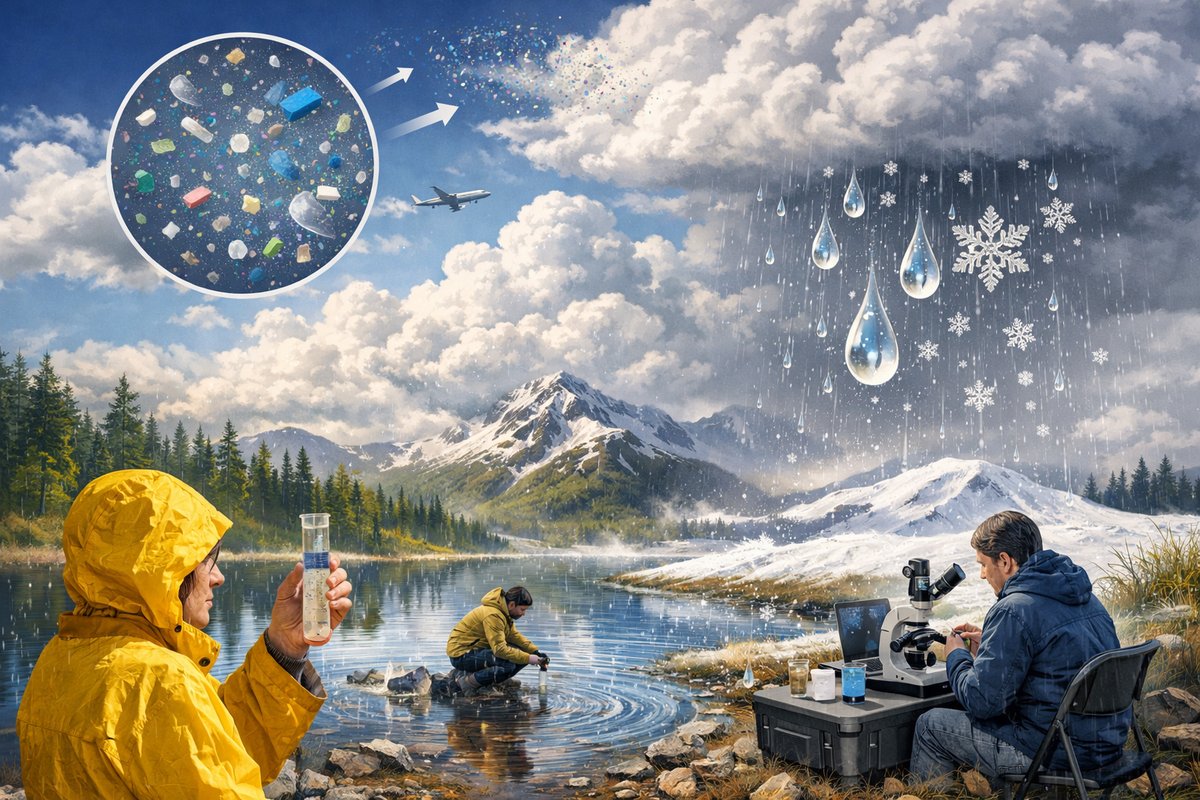
A pioneering study reveals how microplastics ascend to the skies, influencing cloud formation and returning to earth in rain and snow. This research illuminates the hidden cycles of plastic pollution and invites communities to engage in local monitoring efforts.
A team of atmospheric scientists recently published startling findings on the behavior of microplastics high in the sky. Using specially equipped research balloons and aircraft sampling missions, they detected fragments of synthetic polymers at altitudes approaching the lower stratosphere. This discovery challenges assumptions about the vertical reach of plastic pollution and raises questions about its role in weather systems and biogeochemical cycles. While microplastics have been documented in rivers, soils, and the deep sea, their presence in the high-altitude atmosphere reveals a largely invisible dimension of the plastic problem. As these particles drift among water droplets and ice crystals, they may alter precipitation patterns and carry chemical byproducts across continents.
To gather these airborne samples, scientists deployed high-altitude balloons outfitted with custom-designed filters that trap particles down to five micrometers in size. Flights launched from remote sites in the Alps, the Andes, and coastal plains collected air at various elevation bands. Onboard sensors measured temperature, humidity, and particulate concentration, while the filters were sealed and returned to laboratories for analysis. Advanced spectroscopy techniques then identified polymer types-polyethylene, polypropylene, and even fragments of polystyrene foam. The cross-continental approach allowed researchers to compare urban, rural, and polar air masses, revealing surprisingly uniform microplastic concentrations regardless of ground-level population density.
One of the study’s most compelling insights concerns the role of microplastics as cloud condensation nuclei (CCN). Under the right conditions, tiny fragments of polymer can attract water vapor, serving as the initial seed for cloud droplet formation. Laboratory simulations show that certain synthetic polymers have surface properties conducive to condensation, while fragments coated with organic matter can blend with natural aerosols. By participating in cloud microphysics, microplastics may subtly influence cloud albedo, droplet size distribution, and the likelihood of precipitation. These changes have implications for regional rainfall patterns, with potential feedback loops affecting agriculture, water availability, and even wildfire risk in drought-prone areas.
Beyond their atmospheric behavior, microplastics eventually return to earth through wet and dry deposition. It is no longer only coastal or urban regions receiving these particles. Snow cores extracted from mountain glaciers and ice caps have contained measurable plastic fibers and shards, sometimes in concentrations comparable to surface water samples from nearby lakes. In one study, snow from a remote Alpine peak registered more than 50 microplastic particles per liter after melting-astonishing evidence that airborne plastics travel thousands of kilometers. Even Antarctic research stations have identified synthetic fibers in snow pits, suggesting a global conveyor belt of plastic pollution reaching the planet’s most pristine environments.
As microplastics settle onto soils, vegetation, and open water, they introduce new stressors to ecosystems already grappling with climate change and habitat loss. Soil-dwelling organisms, from earthworms to microscopic nematodes, ingest or absorb polymer particles, which can disrupt nutrient cycling and soil structure. Aquatic insects that emerge from water bodies coated with microplastics carry them into terrestrial food webs. Plants growing in contaminated rainwater may absorb tiny fragments through leaf stomata or root systems, though the long-term effects of such uptake are still under investigation. The complex interactions between microplastics, microbes, and natural organic matter demand an interdisciplinary approach, blending ecology, chemistry, and atmospheric science.
In human communities, the realization that rain and snow can deliver microplastics to household water supplies underscores emerging public health concerns. Although most treatment plants remove larger debris, smaller particles often pass through conventional filters, raising questions about ingestion and inhalation risks. Recent medical studies have detected microplastic fibers in lung tissue and blood samples, though direct links to disease remain under study. Regions relying on rainwater harvesting for drinking and irrigation may face new contamination challenges that require updated filtration protocols. Public awareness campaigns and educational initiatives are vital to help citizens understand these risks and adopt protective measures, such as upgraded home filters and periodic water testing.
In response to this emerging challenge, citizen science programs have mobilized volunteers to collect local rain and air samples for microplastic analysis. Training workshops teach participants how to set up DIY rain gauges, use pre-sterilized sampling bottles, and follow contamination-minimizing protocols. Community labs and partnering universities offer access to microscopes and spectrometers, allowing volunteers to visualize and quantify plastic particles. Data from thousands of backyard collectors feed into open-access maps that highlight regional hotspots, seasonal trends, and correlations with nearby sources such as highways, factories, or coastlines. The grassroots effort empowers individuals to contribute to global monitoring efforts while sparking conversations about plastic reduction and sustainable alternatives.
For those eager to join these projects, a few simple tools can make sampling both accessible and reliable. A basic rain gauge mounted in an open area captures precipitation without interference. Sterile glass sampling bottles ensure that plastics measured come only from the environment. A portable field microscope with at least 200x magnification can reveal microfibers and fragments, while smartphone adapters enable participants to document images for remote expert validation. Clear labeling, precise timing, and contamination controls-such as wearing natural fiber clothing during collection-help maintain data integrity. With consistent methods, even small-scale sampling generates valuable insights into the global microplastic cycle.
Policy-makers and industry stakeholders are beginning to take notice. Some municipal governments now require quarterly testing of municipal water supplies for microplastic content. New standards in agriculture and food safety may emerge to address contamination in rain-fed crops. Meanwhile, materials scientists are developing biodegradable polymers and improved recycling techniques that aim to reduce synthetic fragments released into the air. Pilot programs in several European cities are retrofitting particulate filters on major highways, initially designed for soot and pollen, to capture lightweight plastic particles too. While regulatory frameworks lag behind the science, these early efforts signal a growing recognition that plastic pollution extends far beyond visible litter on beaches and roadways.
Looking ahead, researchers plan to expand high-altitude sampling networks and integrate satellite-based aerosol detection with ground observations. Artificial intelligence algorithms can sift through terabytes of meteorological and particulate data to trace microplastic plumes back to potential source regions. Combined with predictive climate models, this approach will help forecast where and when plastic-laden storms might occur, enabling proactive management of water resources. Meanwhile, laboratory studies continue to explore polymer behavior under different atmospheric conditions, including UV exposure, humidity cycles, and interactions with natural aerosols. Together, these efforts aim to illuminate the hidden paths of microplastics, transforming an out-of-sight problem into one that can be understood and, ultimately, addressed.
The revelations about atmospheric microplastics underscore a broader theme in environmental science: the interconnectedness of earth systems, from soil to sky. Pollutants we release at ground level do not remain confined to our immediate surroundings. They hitch rides on winds, travel across continents, and return in ways we are only beginning to understand. Recognizing these links challenges us to rethink linear models of pollution and embrace a more holistic perspective. It also invites a sense of wonder at the dynamic cycles of the planet-the flows of water, air, and matter that shape life’s resilience. In understanding the sky’s hidden particles, we deepen our appreciation of the planet’s fragile balance.
Ultimately, the study of microplastics in the sky is both a cautionary tale and a call to action. It urges us to question the durability of our synthetic creations and their footprints on distant mountaintops and remote isles. Yet it also shows how curiosity, ingenuity, and collective effort can reveal the unseen patterns that bind us to the living world. As communities monitor local rainfall under open skies, they become part of a global chorus seeking solutions. In that quiet act of gathering droplets and fibers, we find a way to notice, remember, and belong-to a planet whose smallest particles carry profound stories.