Location
Mount Vernon, WA 98274

Location
Mount Vernon, WA 98274
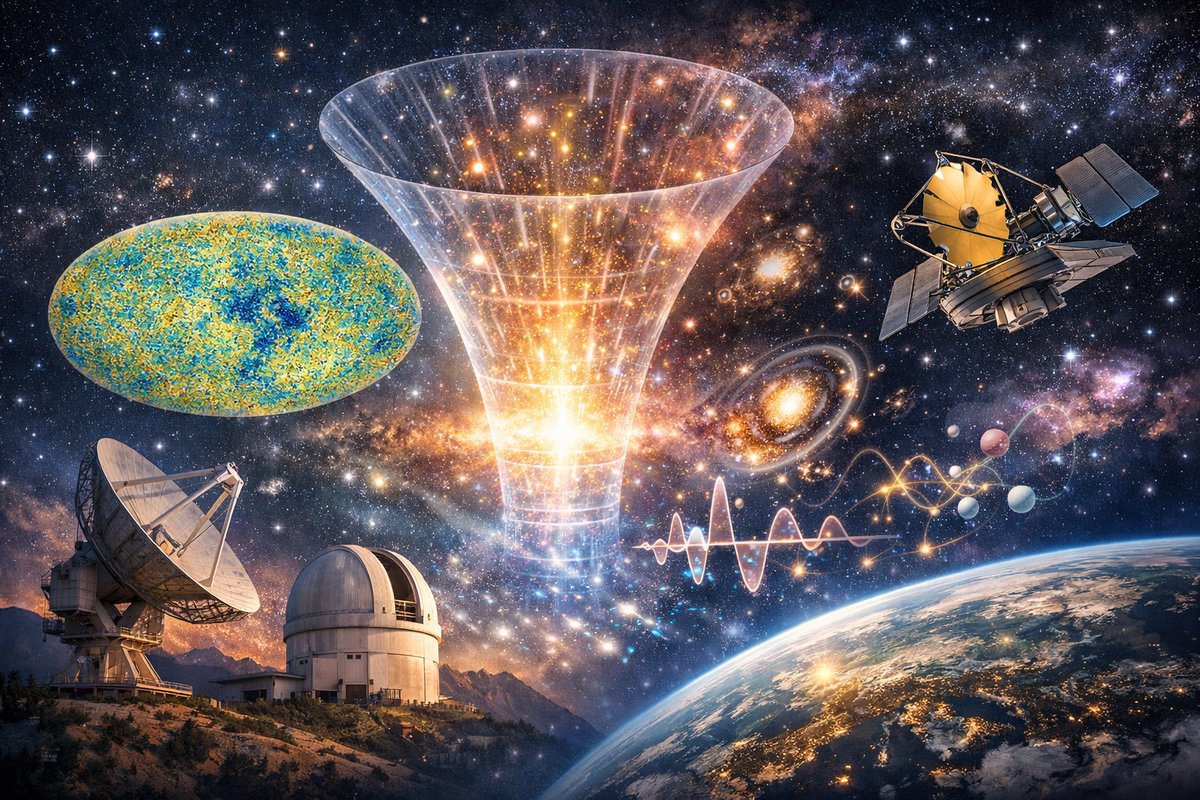
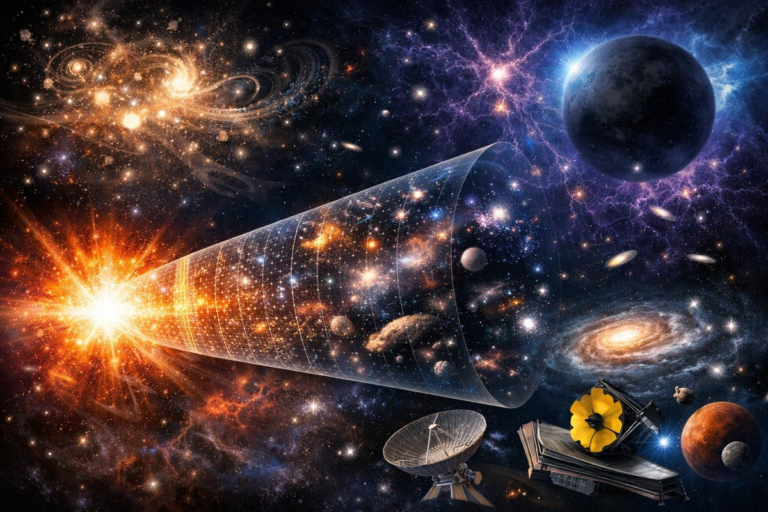
New measurements of the cosmic microwave background and combined observations deep into intergalactic space have uncovered subtle signals that challenge standard models of cosmic inflation. By weaving together data from terrestrial telescopes and space observatories, researchers are piecing together a clearer narrative of how particles, fields, and quantum fluctuations sculpted the universe's earliest moments.
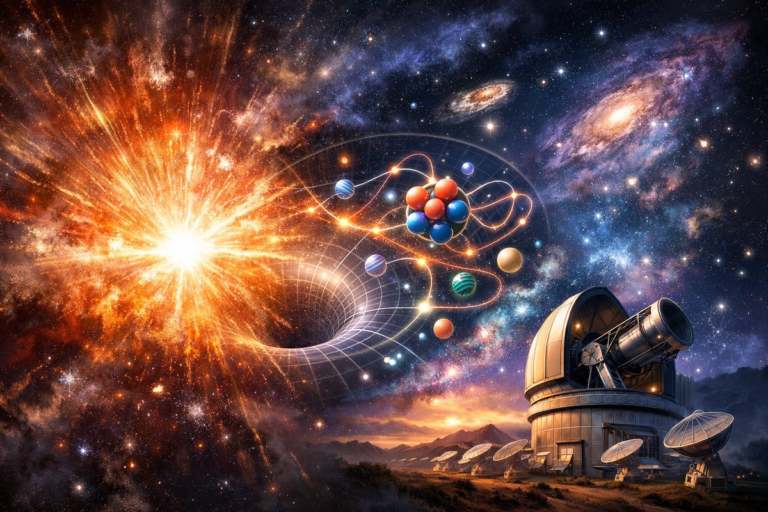
Scientists analyzing faint ripples in the afterglow of the Big Bang have announced the detection of previously unnoticed patterns in the cosmic microwave background. These patterns appear as subtle alignments of polarization threads stretching across the sky and may carry the imprint of primordial gravitational waves. If confirmed, this finding will mark a major advance in our understanding of how the infant universe underwent a fleeting burst of exponential expansion, known as inflation.
The research team combined data from multiple instruments: a ground-based observatory perched atop a high plateau, a balloon-borne detector floating in the stratosphere, and archival measurements from a space mission that charted temperature fluctuations with exquisite precision. By cross-correlating these datasets, analysts reduced noise and instrumental biases, isolating signals so faint that their discovery seemed impossible only a few years ago. This multi-messenger approach mirrors techniques used in other fields of astronomy, where combining light, gravitational waves, and particle tracers has revolutionized what we know about exotic cosmic events.
At the same time, deep observations with a powerful infrared space telescope have pushed the frontier of galaxy hunting back to within a few hundred million years of the Big Bang. Candidates for the first generation of star clusters have been identified, exhibiting spectral fingerprints that hint at low levels of heavy elements. These protogalaxies shine with an otherworldly glow, inviting astronomers to map how early starlight reionized surrounding hydrogen and sculpted the cosmic web.
According to inflationary theory, tiny quantum fluctuations were magnified to cosmic scales in a fraction of a second. The newly identified polarization alignments may encode the energy scale at which this amplification occurred, cutting away swaths of theoretical parameter space. Some popular scenarios involving exotic scalar fields or multiple inflationary epochs now face tighter constraints. Meanwhile, alternative proposals-such as a period of slow contraction before expansion-must contend with the emerging evidence.
However, anomalies persist. A cold patch spanning tens of degrees in the southern sky, long noted in earlier maps, shows a polarization signature that diverges from simple inflationary expectations. While this could be a statistical fluke, researchers are investigating whether it reflects an unaccounted foreground or perhaps hints at a nonstandard topology for space itself. If the cosmos wraps around in a specific way, distant regions may imprint repeating patterns on the microwave sky.
Beyond light, the cosmic neutrino background has become a target for next-generation detectors. These ultralow-energy particles decoupled from matter mere seconds after the Big Bang and could reveal details about the universe’s first phase transitions. A proposed observatory plans to use tritium nuclei to capture relic neutrinos, offering a direct window into conditions that shaped the ratio of matter to antimatter.
Theoretical physicists are using high-resolution simulations to trace how minute fluctuations in the quantum vacuum seeded the growth of all cosmic structure. By feeding sophisticated models with the latest observational constraints, they can test whether novel phenomena-such as primordial black hole formation or early cosmic strings-left detectable footprints. These simulations also explore how dark matter may have influenced the timing and efficiency of the first star-forming regions.
A complementary effort involves mapping the large-scale distribution of galaxies using spectroscopic surveys. By measuring minute distortions in the clustering of galaxies, cosmologists can reconstruct the geometry of the universe and infer the properties of dark energy. When tied together with the cosmic microwave background results, this strategy sharpens estimates for the universe’s curvature and its expansion history.
In labs around the world, experiments at particle accelerators and underground detectors search for signatures of dark matter and attempt to recreate conditions prevalent at the universe’s birth. While collider results have yet to produce direct evidence for new particles beyond the Standard Model, the latest runs at higher energies set more restrictive limits, guiding astrophysical searches and informing future facility designs.
Looking forward, a new generation of observatories promises even greater sensitivity. A planned satellite array will survey polarization across the entire sky at multiple frequencies, fully accounting for galactic dust contamination. Meanwhile, a coordinated network of ground instruments aims to detect inflation-generated gravitational waves at nanohertz frequencies by monitoring pulsars in distant galaxies. Success would constitute a crowning achievement for observational cosmology.
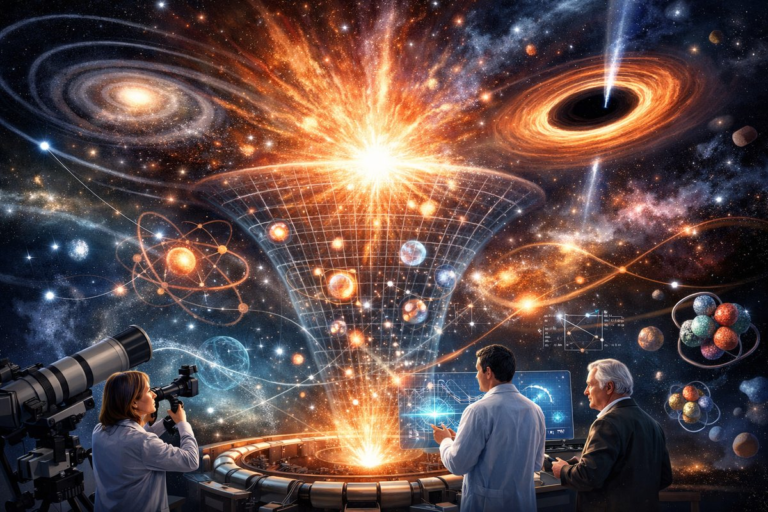
Despite the technical complexity, the effort remains a human story. Teams endure remote conditions at high-altitude sites, battling extreme cold and thin air to calibrate detectors. Engineers navigate power constraints and communication delays. Data analysts work odd shifts to align time-stamped streams from disparate facilities scattered across the globe. Their commitment underlines a shared curiosity to glimpse our cosmic origins firsthand.
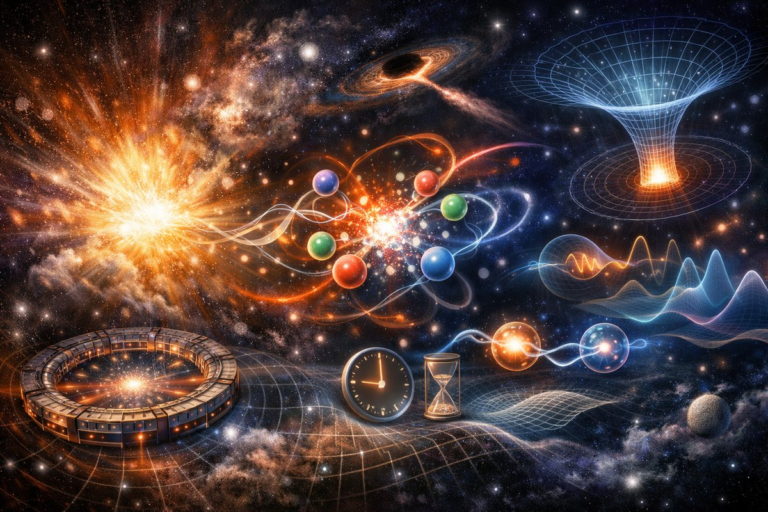
As these discoveries accumulate, they feed a deeper philosophical reflection on our place in the vast expanse of space and time. The fluctuations preserved in the microwave background trace a lineage from quantum foam to galaxies studded with planets. Every astronomical advance extends the narratives of science, art, and culture, inviting us to ponder how a handful of fundamental ingredients-particles and forces, energy and space-collaborated in a grand experiment that culminated in the universe we inhabit.
New insights into the universe’s birth will reshape textbooks and inspire a generation of learners. More precise measurements will refine estimates of fundamental constants, test quantum gravity proposals, and help pinpoint the nature of dark matter and dark energy. Ultimately, the quest to understand how everything began drives us to innovate, to build ever more sensitive instruments, and to embrace the unknown with a spirit of discovery.
Whether gazing through a backyard telescope or programming data pipelines to sift through petabytes of cosmic information, each contribution adds a brushstroke to the portrait of creation. The stories we tell about the universe’s first moments resonate far beyond academic journals. They connect to our collective sense of wonder and remind us that the journey to the beginning is also a journey into ourselves.