Location
Mount Vernon, WA 98274

Location
Mount Vernon, WA 98274
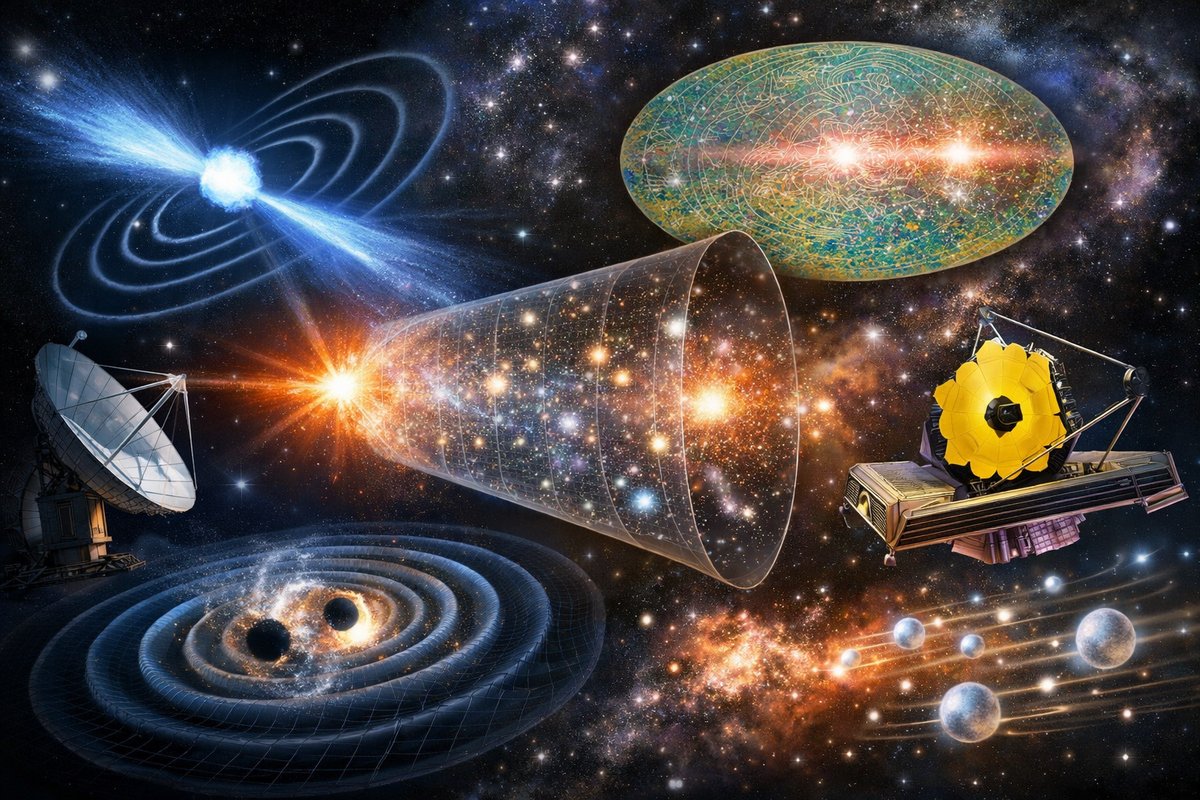
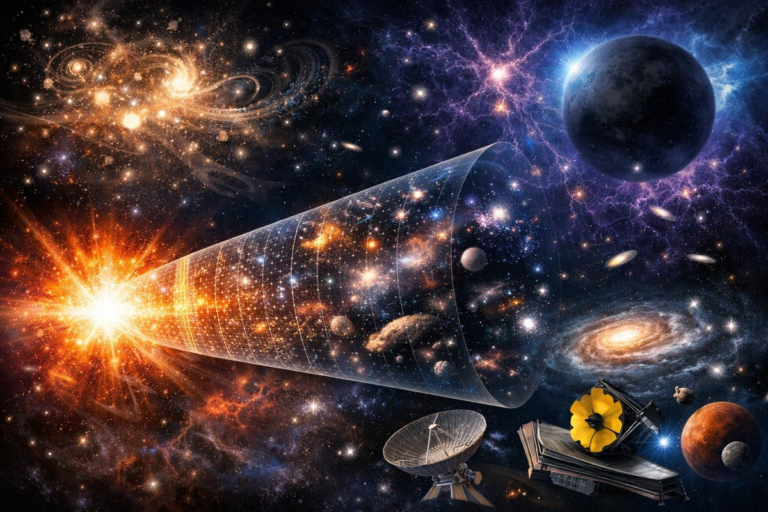
A convergence of signals-from pulsar timing arrays and cosmic microwave background polarization to early galaxy light captured by cutting-edge space telescopes-is rewriting the origin story of the cosmos. Researchers now chart a roadmap to the Big Bang's first heartbeat, blending gravitational waves, radio signatures, and primordial neutrino prospects in an integrated view of creation.
In a sweeping advance for cosmology, a consortium of international observatories has unveiled a mosaic of evidence illuminating the universe’s earliest moments. By weaving together data from pulsar timing arrays that hint at a gravitational wave background, refined measurements of the cosmic microwave background (CMB) polarization, deep radio observations of hydrogen’s 21-centimeter line, and the sharpest infrared glimpses of nascent galaxies, scientists are reconstructing a narrative of the Big Bang that rivals the fidelity of advanced particle experiments on Earth.
At the forefront lies the latest dataset from a leading pulsar timing array, which monitors millisecond pulsars scattered across the sky. These ultra-stable cosmic clocks have yielded a whisper of a stochastic gravitational wave background-a faint tremor believed to originate in the quantum foam of spacetime during inflation. Analysis of more than 15 years of timing residuals reveals a common low-frequency signal with quadrupolar spatial correlations consistent with a primordial origin. Although definitive proof of inflationary gravitational waves remains elusive, the significance of the pulsar timing anomaly has crossed conventional detection thresholds, hinting at a background that could carry a direct imprint of the universe’s first trillionth of a second.
In parallel, next-generation polarization mapping of the CMB has tightened constraints on the so-called B-mode patterns that arise from gravitational waves twisting the photon bath after recombination. Teams operating high-altitude telescopes have reduced instrumental noise by orders of magnitude, isolating potential primordial B-modes from the galactic dust that has bedeviled earlier searches. These measurements set new upper limits on the energy scale of inflation, suggesting it could have unfolded at energies near 1016 gigaelectronvolts-a realm where quantum gravity effects might ferment exotic phenomena like cosmic strings or phase transitions in the vacuum itself.
Beyond gravitational waves, cosmologists have resumed the hunt for the global 21-centimeter absorption signal, a dip in the radio background caused by neutral hydrogen gas interacting with the first radiation sources. Reanalysis of data from a desert-based radio array has confirmed a slight trough in the spectrum at frequencies corresponding to redshifts around 17, when the first stars and black holes bathed the intergalactic medium in ultraviolet light. Although the signal’s amplitude remains under debate, it opens a window onto the so-called Cosmic Dawn-a brief era when the universe switched on its first beacons after hundreds of millions of years of darkness.
Meanwhile, the most powerful infrared space telescope to date has pierced deeper into cosmic history, detecting candidate galaxies that formed just 300 million years after the Big Bang. The luminosity and distribution of these fledgling systems challenge certain models of star formation efficiency, implying that gas collapsed into stars more rapidly or that low-mass dark matter halos played a larger role than previously thought. Spectral fingerprints of ionized oxygen and carbon in these objects hint at vigorous stellar winds and supernova activity that would have reionized the surrounding medium, foreshadowing the end of the Dark Ages.
Complementing electromagnetic probes, particle physicists are gearing up for the first attempt to capture the elusive cosmic neutrino background-a sea of low-energy neutrinos decoupled mere seconds after the Big Bang. A prototype detector employing a novel target of atomic tritium aims to exploit neutrino capture reactions, offering a direct measure of the neutrino relic density. If successful, this experiment would open a new chapter in direct cosmological observations, delivering a snapshot of conditions when the universe was a billionth of a second old.
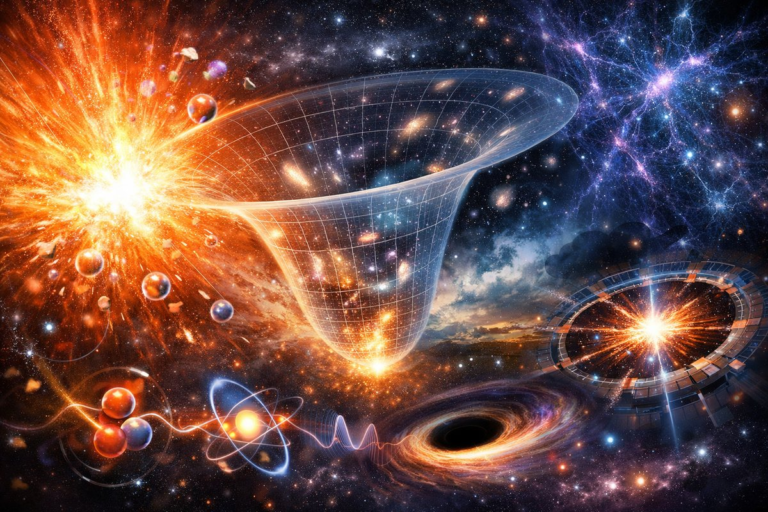
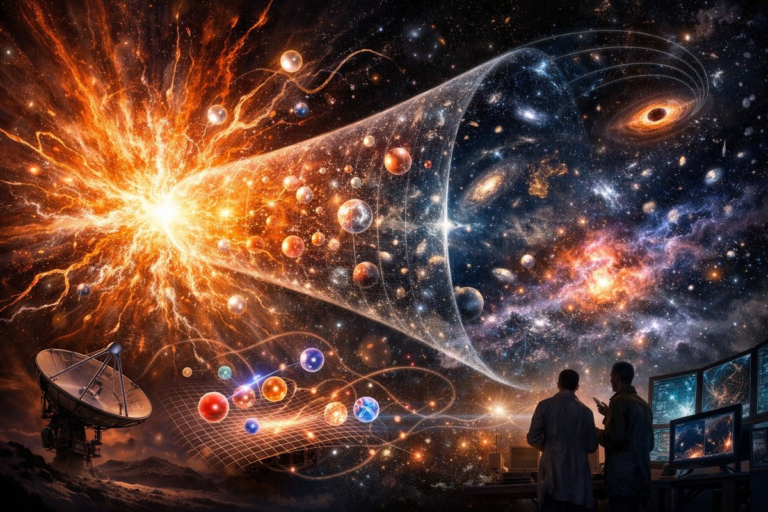
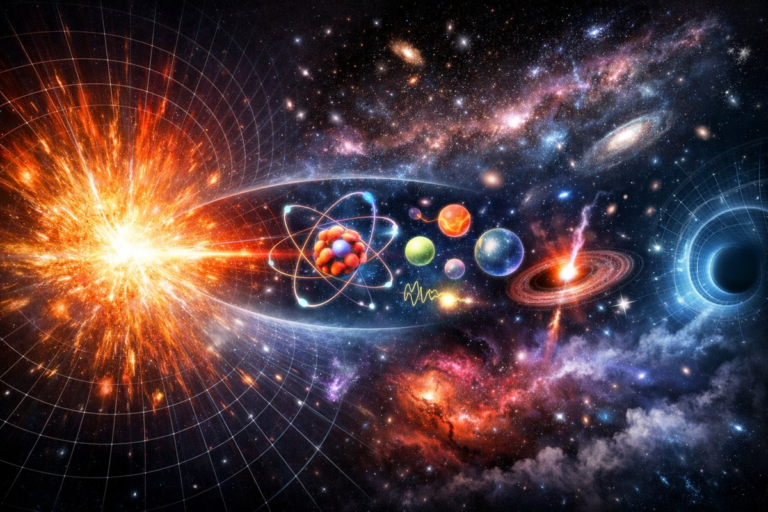
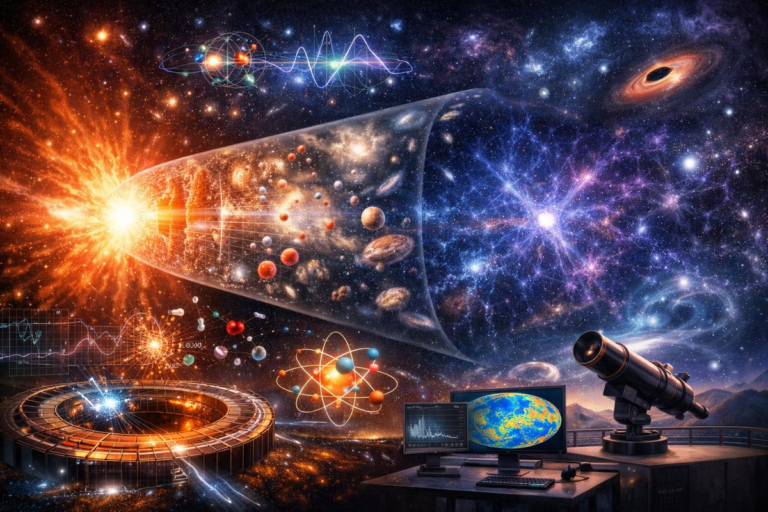
Taken together, these multi-messenger signals converge on a coherent picture: a universe born in an inflationary blaze, cooling into a dense plasma, then expanding and forming the first atoms, stars, and galaxies. Each observational pillar informs the others, refining theoretical models with concrete benchmarks. The gravitational wave background constrains inflationary potentials, the CMB polarization traces the universe’s geometry and particle content, the 21-centimeter signal illuminates the interplay between primordial gas and radiation sources, and the infrared surveys chart the dawn of structure formation.
The theoretical implications are profound. Cosmologists are revisiting scenarios that extend the simplest single-field inflation paradigm, exploring models with multiple scalar fields, higher-order kinetic terms, and transient features that could leave distinctive imprints in the CMB or gravitational wave spectrum. Speculative frameworks involving extra dimensions or discrete spacetime units are gaining new attention as researchers seek to reconcile quantum mechanics with gravity in the crucible of the early cosmos.
Observationally, the community is mobilizing an armada of next-generation facilities: a global network of upgraded radio telescopes to map the faint 21-centimeter fluctuations in three-dimensional detail, a successor to the current CMB polarization observatories to push sensitivity into unexplored regimes, space-based gravitational wave detectors sensitive to millihertz frequencies, and full-scale cosmic neutrino experiments. Together, they promise to chart an integrated timeline from 10−35 seconds to the epoch of reionization and beyond.
A growing roster of citizen science projects is also engaging stargazers worldwide, inviting volunteers to classify galaxy shapes, search for transient radio bursts, or help refine pulsar timing measurements. These initiatives highlight the democratization of cosmic archaeology, showing that breakthroughs often emerge from the synergy between professional facilities and the collective effort of enthusiasts armed with backyard telescopes, radios, and laptops.
As the boundaries between astrophysics, particle physics, and observational astronomy blur, a unified narrative of cosmic origins is taking shape. The coming decade may yield the first direct detection of primordial gravitational waves, a census of neutral hydrogen’s dark ages, and perhaps even the first snapshot of the cosmic neutrino sea. Each advance will not only illuminate the universe’s birth but also deepen humanity’s grasp of nature’s most profound laws, weaving a story that stretches from the quantum realm to the vast cosmic web that cradles every galaxy.
In this era of unprecedented observational synergy, the age-old questions about where we come from and how the cosmos began are finally meeting their match. With every new dataset, the universe whispers secrets from its youth, urging us to listen more closely, think more creatively, and dream more boldly about what lies beyond the horizon of our current understanding.