Location
Mount Vernon, WA 98274

Location
Mount Vernon, WA 98274
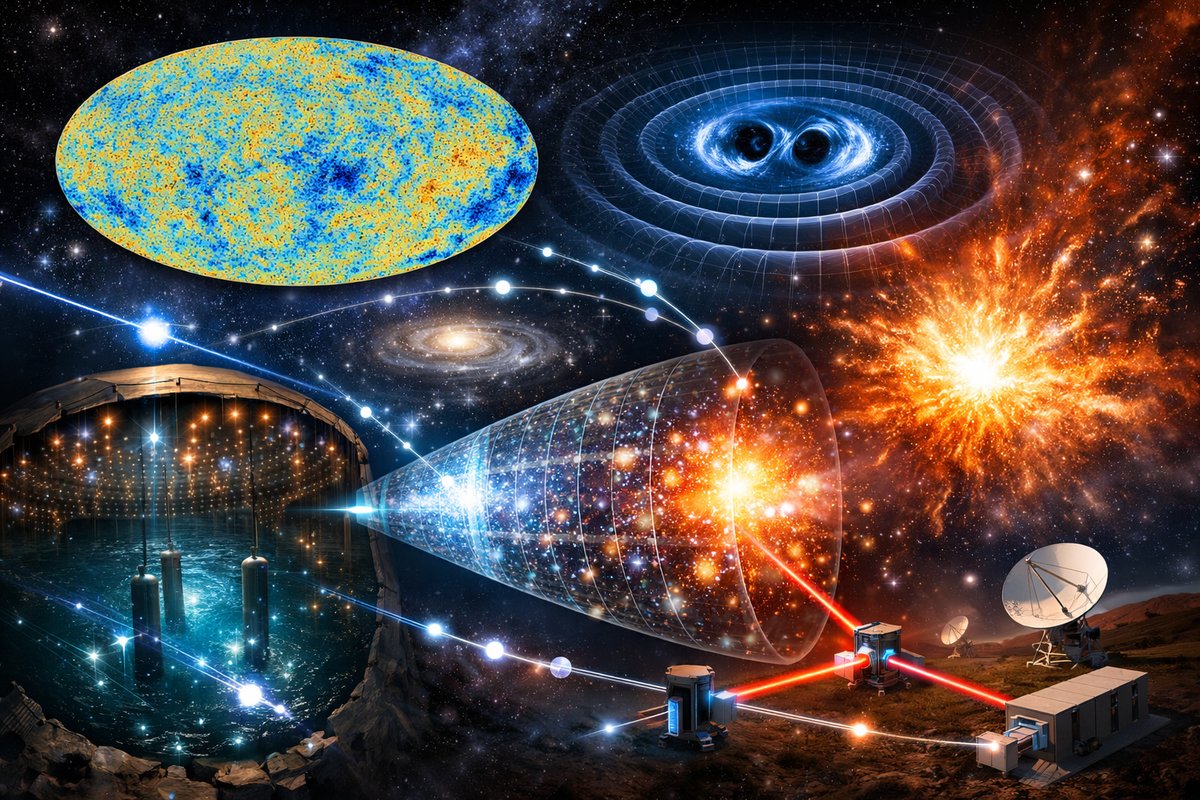
A convergence of cosmic microwave background maps, neutrino detections, and nascent gravitational wave observations is illuminating the universe's first instants. New multi-messenger data are challenging prevailing models of inflation and offering fresh insights into longstanding paradoxes of early-universe physics.
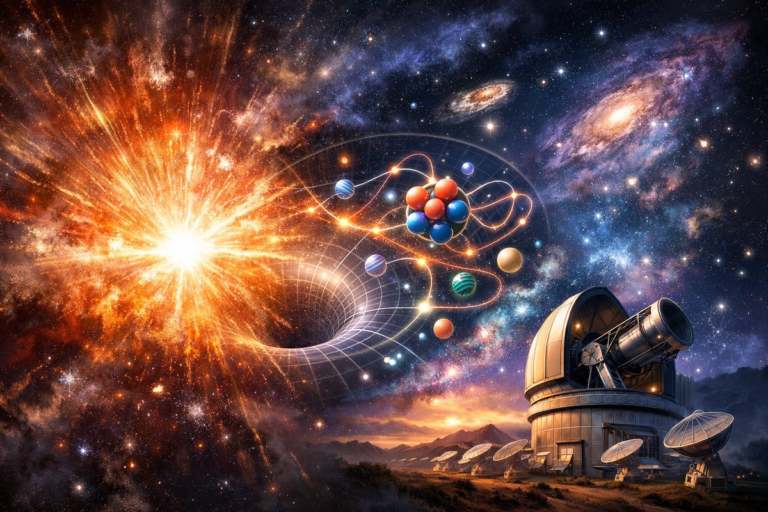
An unprecedented alliance of observatories operating across the electromagnetic spectrum, underground neutrino tunnels, and gravitational wave prototypes has produced the most detailed composite portrait yet of our universe’s birth. By weaving together information from microwave satellites, subterranean detectors, and laser interferometers still in their trial phases, scientists are peering back to moments trillionths of a second after the big bang, when the seeds of cosmic structure were first planted.
Polarization measurements of the cosmic microwave background have reached new heights of precision. The latest data patchwork, drawn from a high-altitude telescope array in the Atacama Desert and a polar-platform balloon mission, reveals subtle B-mode swirl patterns imprinted by primordial gravitational waves. These gentle twists of sub-microkelvin temperature fluctuations hold clues to the violent expansion, or inflation, that is believed to have stretched spacetime itself at speeds far exceeding light. Detecting these patterns has been a decades-long quest. Now, researchers are able to separate the telltale signature of an inflationary epoch from confounding foreground emissions generated by interstellar dust.
Deep beneath Antarctica’s ice, a lattice of photomultiplier tubes awaits faint neutrino bursts born in the cosmos’s earliest crucible. This network recently flagged a burst of high-energy neutrinos whose energy spectrum and arrival times hint at processes unfolding within the first microseconds of the universe’s life. Neutrinos, which barely interact with ordinary matter, escape unscathed from dense, high-energy environments. By triangulating their origins and studying their flavor oscillations, physicists hope to reconstruct conditions in the quark-gluon plasma that permeated space before protons and neutrons coalesced.
Meanwhile, gravitational wave observatories are moving beyond detections of black-hole and neutron-star mergers to hunt for a stochastic gravitational-wave background. Prototype detectors in underground caverns are already placing upper limits on the intensity of a primordial gravity-wave sea. These constraints feed directly into the debate over inflationary models: did spacetime undergo a smooth, single-phase expansion, or was it punctuated by violent bursts tied to phase transitions in the early cosmos? The interplay between gravitational wave limits and microwave background patterns is tightening the theoretical landscape.
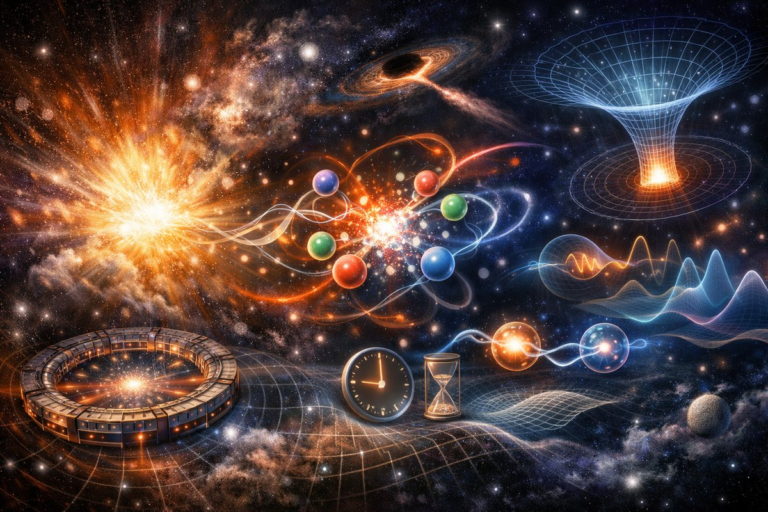
Closer to Earth, the world’s most powerful particle accelerators are turning out miniature recreations of the high-energy fireball that existed microseconds after the big bang. Collisions of heavy ions at record energies generate temperatures over a trillion degrees, producing a fleeting quark-gluon plasma. Precision measurements of particle yields and collective flow within this plasma are shedding light on how fundamental forces behaved under extreme conditions. These lab-scale experiments offer a complementary window into early-universe physics, testing predictions that connect particle interactions to cosmological observations.
One of the most enduring puzzles in cosmology is the origin of the universe’s matter-antimatter asymmetry. According to established theory, matter and antimatter should have been created in equal amounts during the big bang. Yet the cosmos today is overwhelmingly matter-dominated. Experiments at underground detectors and accelerator facilities are probing rare decays and charge-parity violation in subatomic particles to uncover subtle imbalances that could tip the scales. New measurements of neutrino oscillation parameters may also play a crucial role, as neutrino behavior could violate CP symmetry in ways that generated the excess of matter over antimatter.
Dark sectors remain equally enigmatic. Observations of galaxy rotation curves, gravitational lensing, and cosmic microwave background anisotropies consistently point toward dark matter and dark energy as dominant components of the cosmic inventory. Yet their nature eludes direct detection. Upcoming deep-field surveys with wide-field optical telescopes will map the distribution of billions of galaxies, tracing the influence of dark matter on large-scale structure. At the same time, precision measurements of cosmic expansion using gravitational wave “standard sirens” from merging neutron stars offer an independent path to constraining the properties of dark energy.
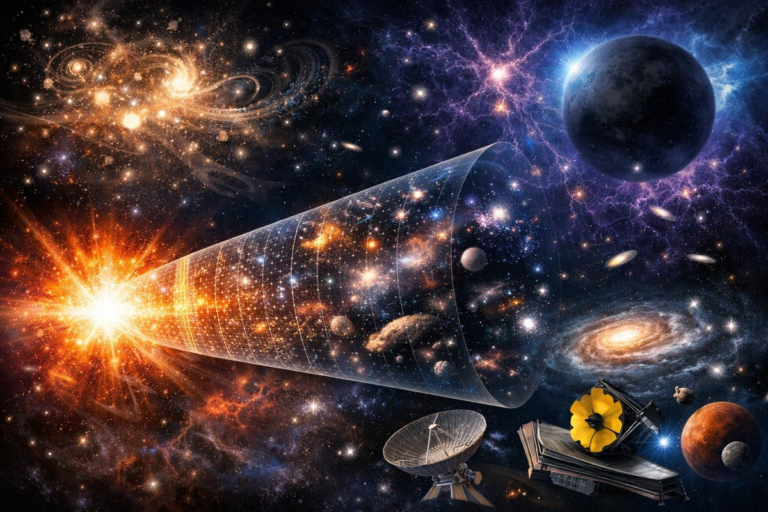
Peering even farther forward, the James Webb Space Telescope is beginning to deliver hints of the universe’s first luminous objects. Though its primary mission is to study star and galaxy formation hundreds of millions of years after the big bang, its infrared vision may eventually uncover signatures of the very first generation of stars, known as Population III. Their explosive deaths would have forged the first heavy elements, kick-starting the chemical evolution that led to planets and ultimately life.
Several next-generation observatories are also in development. A space-based interferometer dedicated to mapping gravitational waves at frequencies too low for ground-based detectors could directly probe inflationary echoes from the big bang’s opening act. Simultaneously, radio telescopes tuned to the dark ages signal-emitted by neutral hydrogen before the first stars-aim to chart the emergence of cosmic structure. Combined with microwave and infrared observations, these instruments will deliver a panoramic timeline of the universe’s earliest phases.
In a striking democratization of cosmic exploration, citizen-science projects are playing an increasing role in the hunt for primordial signals. Amateur astronomers running backyard telescopes equipped with sensitive digital cameras contribute observations of gravitational microlensing events. Volunteer computing platforms process petabytes of data from radio arrays searching for faint cosmological signatures. These grassroots efforts not only accelerate discovery but also foster public engagement with fundamental science.
On the theoretical front, models extending or replacing inflation are gaining traction. Some propose a cyclic universe that undergoes repeated expansions and contractions, sidestepping the need for an initial singularity. Others explore string-theory inspired “bouncing” cosmologies, where a previous cosmic phase collapses before rebounding in a new big bang. These scenarios often predict subtle imprints-novel patterns in the microwave background or distinctive gravitational wave spectra-that could soon be testable.
Beyond pure curiosity, unlocking the physics of the universe’s birth carries potential practical payoffs. The same techniques used to analyze primordial signals-advanced statistical methods, high-precision detectors, and high-performance computing-find applications in medical imaging, climate modeling, and encryption. Insights into quantum gravity and high-energy particle behavior may one day inform novel materials or energy-generation schemes.
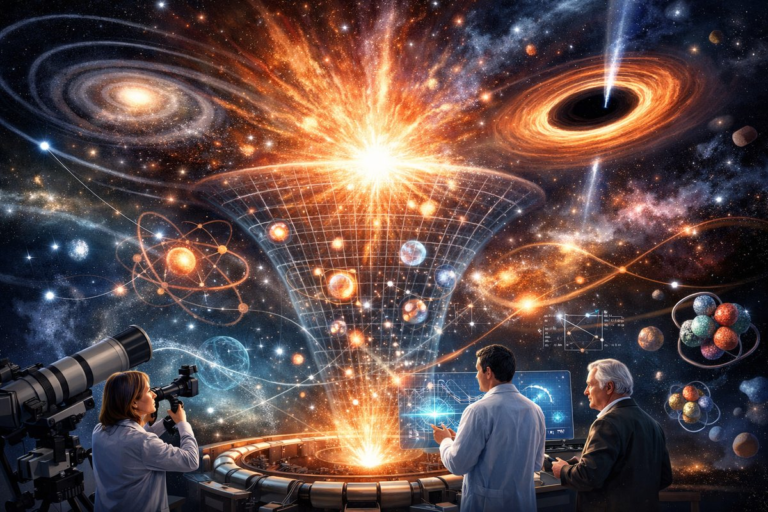
As multiple messengers converge on the universe’s origin story, humanity stands on the brink of a new era in cosmic archaeology. The synergy of telescopes, detectors, and theory is transforming questions that once seemed metaphysical into testable science. With every new data stream-from microwave photons to ghostly neutrinos and ripples in spacetime-the narrative of creation grows richer and more nuanced. The coming decade promises to bring us closer than ever to answering the question we have long asked: how did it all begin?