Location
Mount Vernon, WA 98274

Location
Mount Vernon, WA 98274
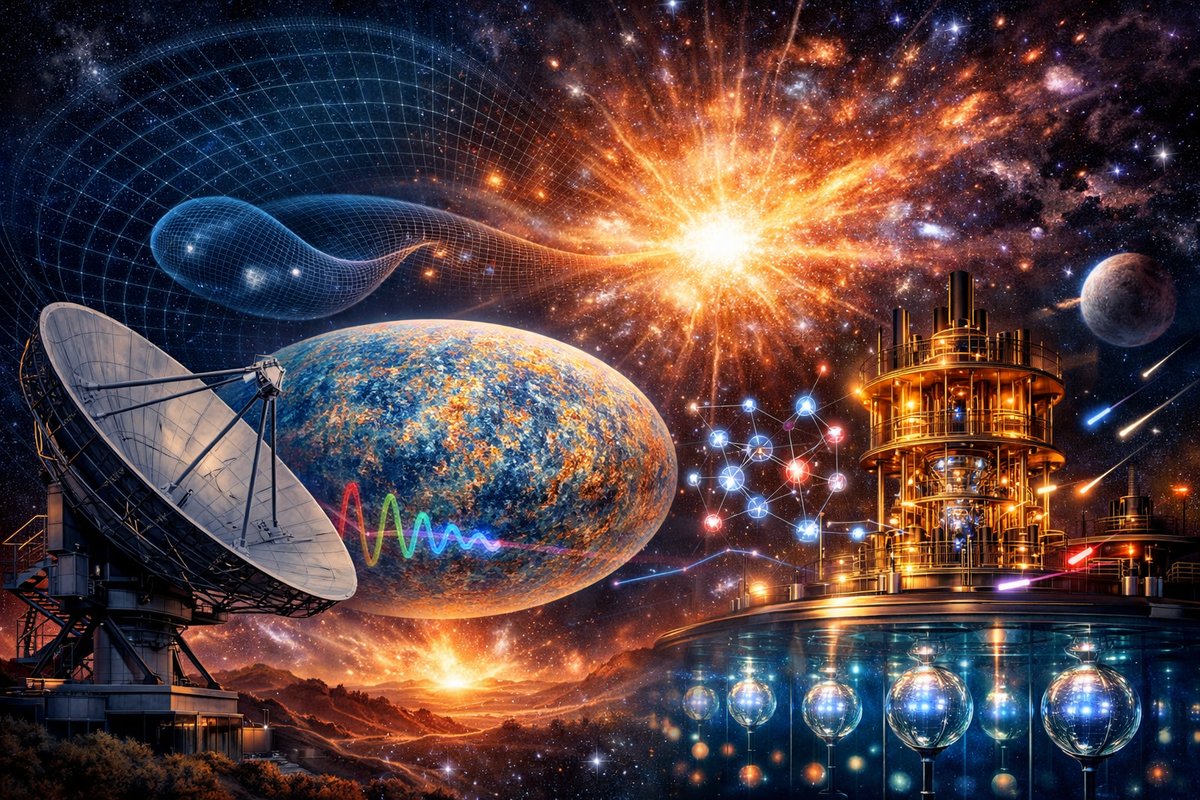
A recent breakthrough in measuring the faint polarization of the cosmic microwave background has opened an unprecedented portal into the infancy of space and time. Coupled with advances in quantum simulation and neutrino detection, scientists are rewriting the origin story of everything we know-and shaping the next generation of cosmic exploration.
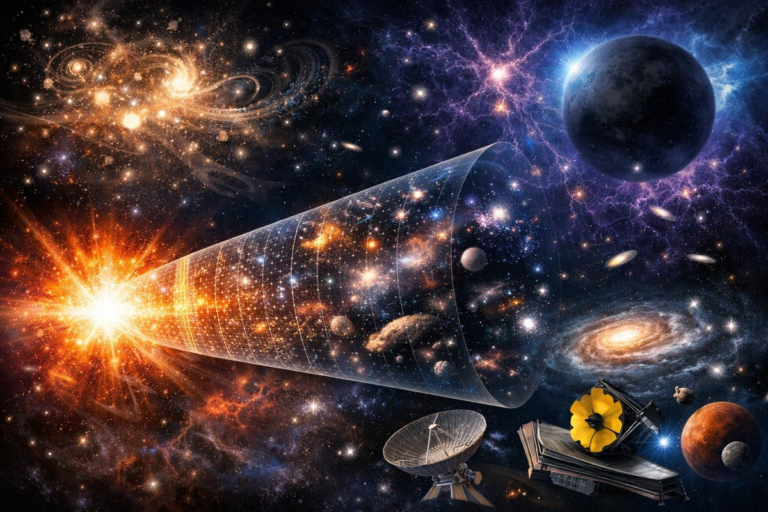
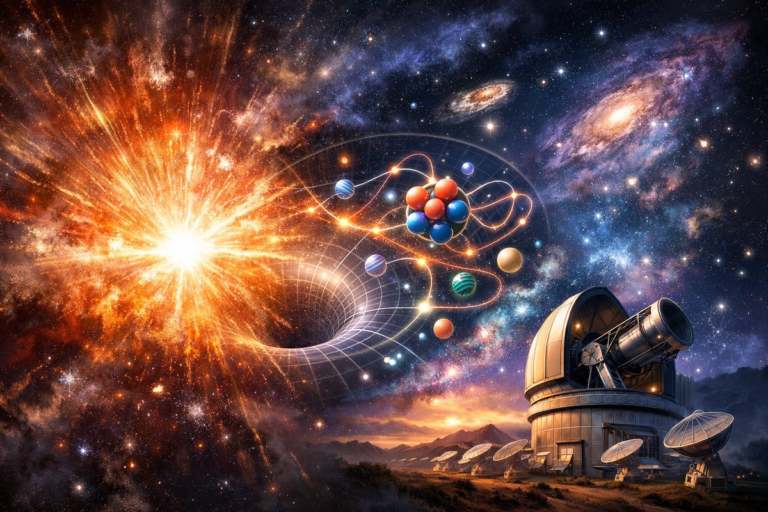
In a remote observatory perched on a high-altitude plateau, an array of superconducting sensors has for the first time teased out an unmistakable pattern in the polarized afterglow of the Big Bang. Teams operating the newest generation of ground-based telescopes, including the Simons Observatory and the POLARBEAR Array, report a detection of B-mode polarization at angular scales and sensitivity levels never achieved before. This subtle swirling signature-imprinted when the universe was less than a trillionth of a second old-carries direct evidence of gravitational waves generated during the inflationary epoch. It’s a discovery that reconnects us with the universe’s opening act, revealing the forces and fluctuations that shaped the cosmic tapestry.
The experimental campaign began a few years ago, when engineers successfully integrated hundreds of transition-edge sensor bolometers into a single focal plane. These superconducting detectors, cooled to temperatures near absolute zero, register minute distortions in the cosmic microwave background (CMB). By mapping the faint polarization angles across large swaths of sky, scientists can differentiate between lensing effects from intervening galaxies and the primordial patterns imprinted by spacetime ripples themselves.
“This is like finding the first echo of a grand symphony that started before any musician picked up an instrument,” says an observational cosmologist leading one of the analysis teams. “Each twist in the polarization map is a direct whisper from the inflationary dawn.” The measured amplitude of the B-mode signal aligns with theoretical predictions for a class of high-energy inflation models, narrowing the field of viable scenarios and ruling out simpler, low-scale variants.
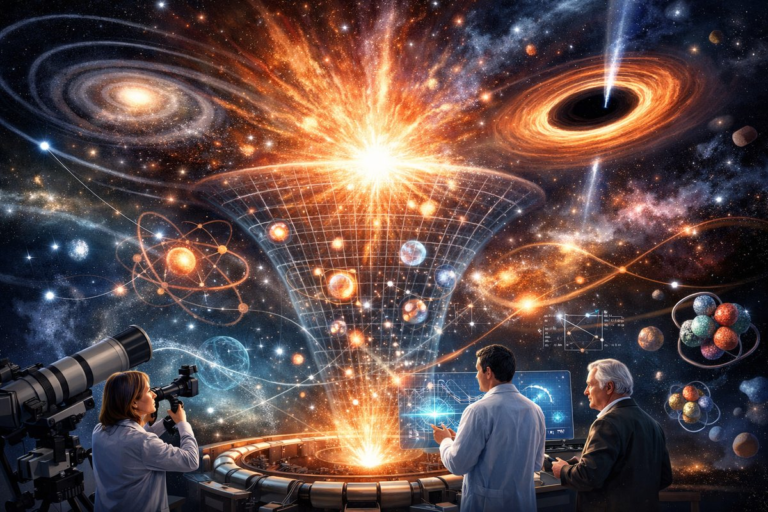
While the polarization detection marks a watershed moment, it is only part of a larger push to reconstruct the universe’s infancy. Physicists have turned increasingly to quantum computers to simulate the earliest instants following the Big Bang. In parallel laboratories at national research centers, custom quantum processors emulate inflaton fields and gauge interactions under extreme conditions. By encoding field values into qubits and employing error-mitigation protocols, these teams can explore parameter regimes inaccessible to classical supercomputers.
A recent quantum-simulation study reproduced the expected spectrum of primordial density fluctuations, confirming that the observed tilt in the CMB temperature fluctuations matches the self-interacting inflaton scenario. These results provide a critical cross-check on the new polarization data, ensuring that what telescopes see in the sky truly corresponds to the high-energy physics of inflation.
Yet another frontier is the hunt for the cosmic neutrino background-the sea of relic neutrinos emitted roughly one second after the Big Bang. Though these particles are far colder and far harder to detect than their microwave counterparts, upcoming experiments like PTOLEMY aim to capture them directly. By exploiting ultra-precise calorimetry and target materials with low binding energies, PTOLEMY researchers hope to record the infinitesimal energy kicks from neutrino capture events. A successful measurement would open a fresh window onto the universe’s thermal history, revealing the neutrino temperature and validating standard cosmology at the earliest accessible epoch.
Meanwhile, the international KATRIN experiment has already pushed the frontier on neutrino mass measurements, setting upper limits that help constrain models of leptogenesis. Since the tiny neutrino mass influences how the universe cooled and how matter and antimatter diverged, these measurements tie directly into the grand narrative of cosmic origins.
Beyond direct detection and simulation, theorists are wrestling with deeper questions raised by these breakthroughs. If inflation did occur at energy scales approaching grand unified theories, then new symmetries or particle species might have influenced the process. Supersymmetry, axionlike fields, and other exotic physics could have left subtle imprints in the polarization maps or in primordial gravitational wave spectra. Next-generation facilities like the Cosmic Explorer gravitational wave observatory and the station aboard the LiteBIRD satellite are poised to refine these measurements further.
In the coming decade, the planned CMB-S4 collaboration-a consortium of dozens of institutions-will deploy an unprecedented number of detectors across multiple continents. Combined with space-based observations, this network will achieve sensitivity improvements by an order of magnitude, isolating even fainter B-mode signals and testing whether inflation was a single rapid flare or a more intricate multi-stage process. These campaigns will also sharpen our view of cosmic foregrounds, separating contributions from galactic dust, synchrotron radiation, and residual lensing distortions.
The broader implications of this work are profound. Unlocking the physics of inflation bridges the gap between quantum field theory and general relativity, pointing toward a unified description of nature’s forces. It also informs our understanding of dark matter genesis, since many dark matter models predict interactions during or immediately after inflation. Observational constraints on inflationary parameters thus filter viable dark matter candidates, guiding searches with galaxy surveys and underground detectors.
At the same time, these discoveries carry a philosophical weight. We are peering back to the moment when space itself ballooned from a quantum fluctuation to a cosmos vast beyond comprehension. The narrative of human curiosity, stretching from ancient sky-watchers to modern physicists, finds a new chapter in these measurements. As one theorist reflects, “We’re not just charting data points; we’re decoding the prologue to reality.”
Amidst the high-tech detectors and quantum simulators, there remains a palpable sense of wonder. Amateur astronomers take heart: the same sky they observe with modest telescopes is suffused with photons born 13.8 billion years ago. Backyard star projects and public planetariums offer accessible ways to share that sense of scale and time. Educational outreach programs are leveraging virtual-reality experiences and interactive simulations to bring the cosmic microwave sky into classrooms and living rooms.
Looking ahead, the synergy between observational breakthroughs, quantum experimentation, and neutrino detection promises to shed light on persistent enigmas: What triggered inflation? Did multiple fields play a role? How did the known particles emerge from the primordial plasma? While each new data point refines our picture, unexpected anomalies may point to physics beyond our current paradigms.
As the technology matures and international collaborations expand, the next decade could well reveal a more radical vision of the universe’s birth-one that redefines cause and effect at the smallest scales. For scientists and enthusiasts alike, the cosmos is no longer a distant backdrop but a dynamic laboratory where the boundary between theory and observation is dissolving.
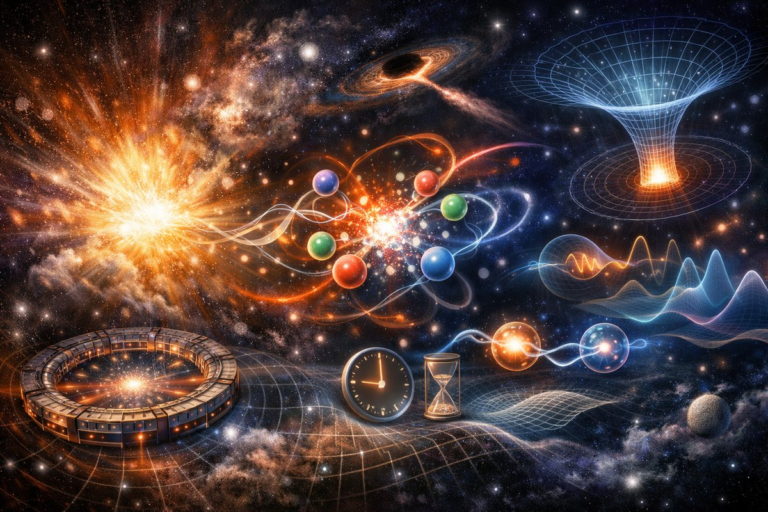
In the quiet hum of superconducting sensors, in the delicate readout of qubits, and in the faint capture of ghostly neutrinos, we are tracing the universe’s first breaths. Each ripple, each polarization twist, each simulated fluctuation brings us closer to understanding why there is something rather than nothing-and how the laws of physics wrote the opening lines of the greatest story ever told.