Location
Mount Vernon, WA 98274

Location
Mount Vernon, WA 98274
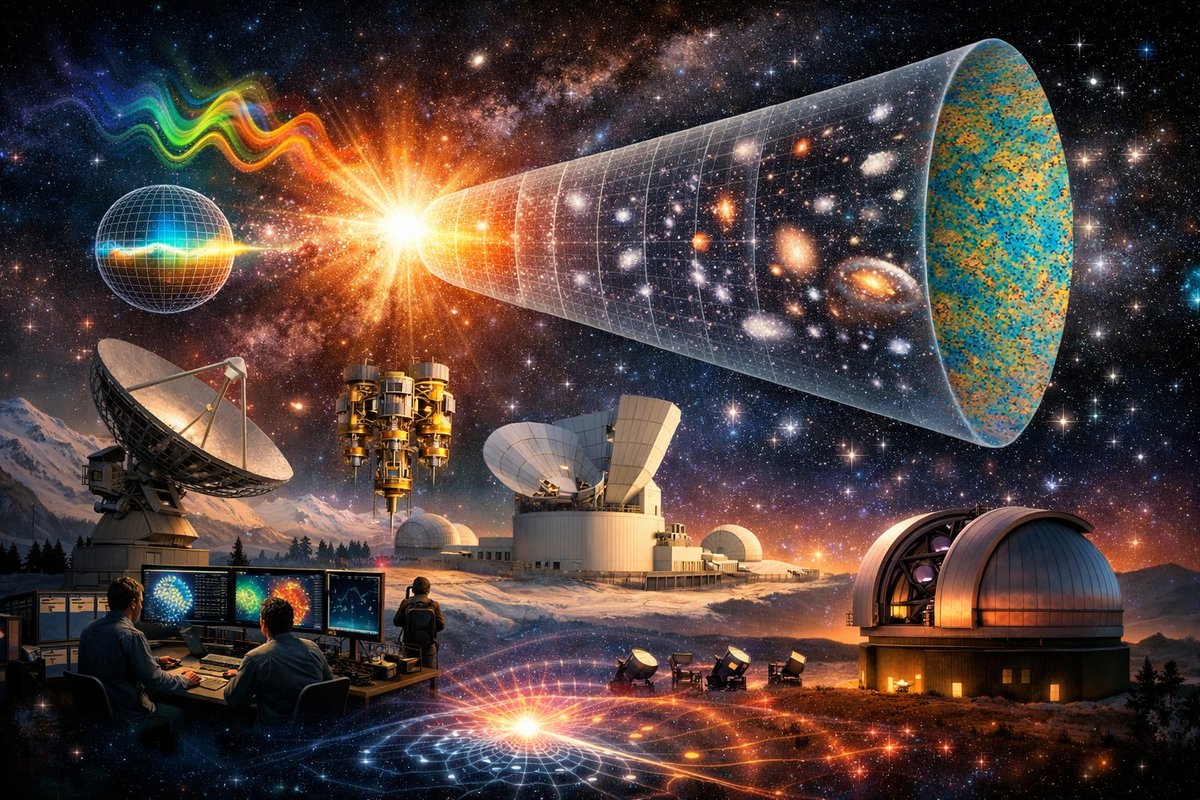
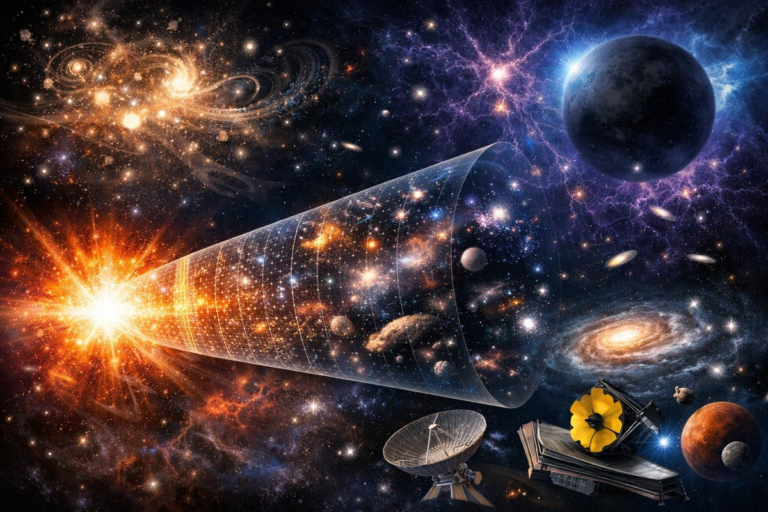
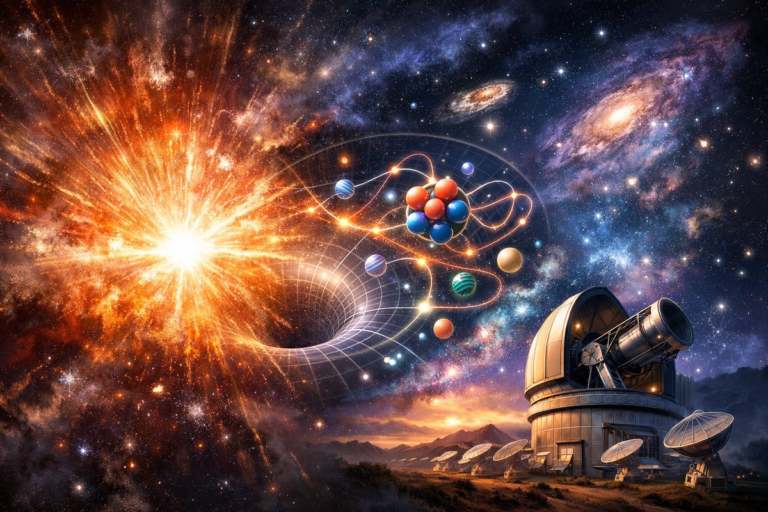
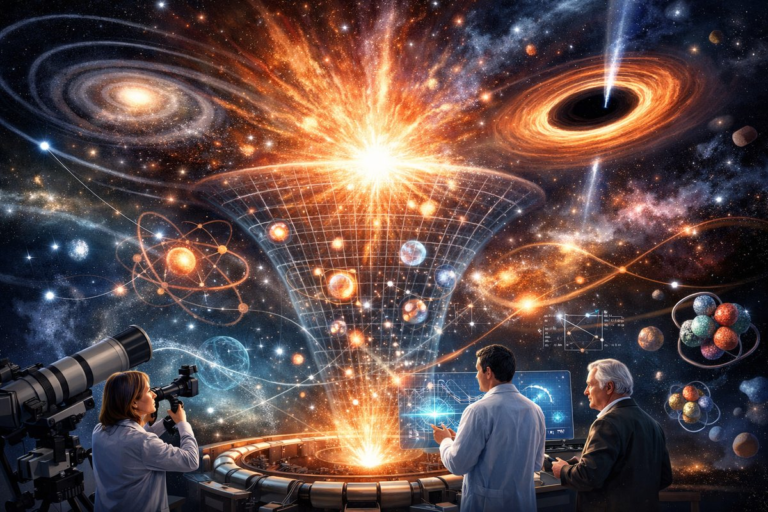
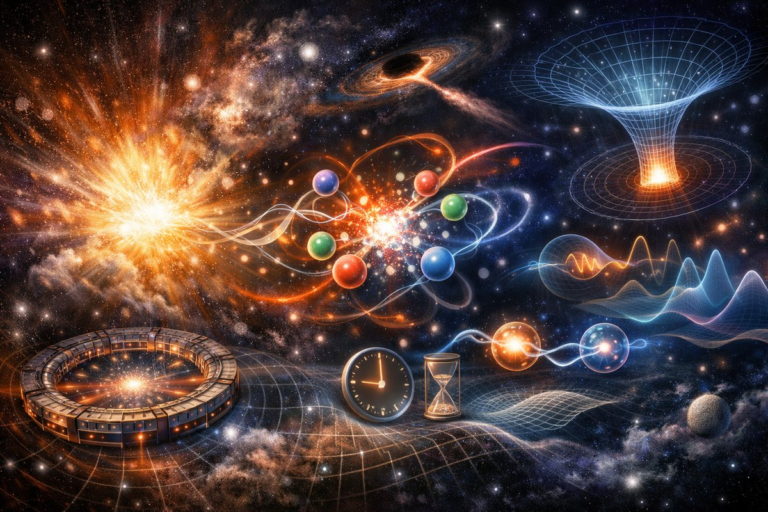
Scientists are deploying advanced sensors and telescopes to peel back the veil on the cosmos' earliest instants, from quantum ripples before inflation to subtle patterns in the cosmic microwave background. Breakthrough experiments and innovative models are reshaping our picture of how space, time, and matter first emerged.
A convergence of cutting-edge experiments and daring theoretical frameworks is ushering in a new era of discovery about the universe’s origin. Researchers are deploying ultra-sensitive quantum detectors, high-altitude balloon arrays, and next-generation ground telescopes to capture signals dating back to fractions of a second after the Big Bang. These efforts promise to confront deep paradoxes-like how distant regions of space reached thermal equilibrium or why the cosmos appears so flat-by unlocking faint whispers from the earliest cosmic epochs.
One frontier involves using superconducting quantum interference devices (SQUIDs) cooled to near absolute zero. Placed in deep underground facilities, these sensors are hunting for the faintest tremors in spacetime: primordial gravitational waves generated by quantum fluctuations during a hypothesized inflationary burst. While large interferometers have yet to see these ancient ripples, the new generation of quantum-enhanced detectors is poised to push sensitivity limits orders of magnitude beyond current capabilities.
Meanwhile, high-altitude balloons carrying sensitive microwave receivers are floating above much of Earth’s atmosphere to map the cosmic microwave background (CMB) with unprecedented clarity. Recent flights over Antarctica have scanned vast swaths of sky, revealing subtle polarization patterns that could encode information about gravitational waves from the universe’s first moments. These tiny B-mode polarization signals, once disentangled from galactic dust, may offer direct proof of inflation or hint at alternative mechanisms that seeded primordial structure.
On solid ground, collaborations are constructing massive arrays of millimeter-wave telescopes in the high deserts of Chile and the polar plateau of Greenland. Known collectively as CMB-S4, these observatories will survey the sky with exquisite angular resolution and sensitivity to temperature and polarization fluctuations. By comparing observations across multiple frequencies, scientists aim to isolate the primordial signal from contaminating foreground emissions, opening a clearer window into cosmic dawn.
Theoretical physicists are racing to interpret these emerging datasets through imaginative new models. Some propose a cyclic universe, bouncing through infinite expansions and contractions rather than a single explosive beginning. Others explore string gas cosmology, where tiny vibrating strings in a higher-dimensional space could have smoothed and flattened the early cosmos without invoking a rapid inflationary phase. Each hypothesis makes distinct predictions about the spectrum of primordial gravitational waves or non-Gaussian patterns in the CMB, putting them within reach of next-generation surveys.
Beyond light and gravity, particle physics experiments are joining the hunt for relics of the primordial era. Ultra-low-background detectors buried in mines are scouring for weakly interacting massive particles (WIMPs) and axion-like particles that could have influenced cosmic expansion rates or seeded dark matter halos. Neutrino observatories are refining measurements of the cosmic neutrino background-ghostly particles that decoupled microseconds after the Big Bang-to test whether extra neutrino species or exotic interactions shaped early thermodynamics.
A provocative avenue of research examines quantum entanglement on cosmic scales. Some theorists posit that the universe’s large-scale structure may reflect entangled quantum information imprinted in the fabric of spacetime itself. Experiments simulating quantum fields in optical lattices and analog gravity systems are beginning to test how entanglement entropy evolves in expanding spaces, hinting at a deeper connection between quantum information theory and cosmology.
Unexpected anomalies in recent data have fueled spirited debate. Slight asymmetries in the CMB’s temperature distribution, coupled with tentative hints of hemispherical power differences, challenge the assumption of perfect isotropy. If confirmed, these anomalies could point to physics beyond the standard inflationary picture-perhaps relics of a pre-inflation phase transition or interactions with parallel “brane” universes.
Efforts to resolve these puzzles are increasingly collaborative and interdisciplinary. Citizen science projects invite astronomy enthusiasts to classify patterns in radio telescope maps, while open-source simulation platforms enable students and researchers worldwide to test alternative cosmological scenarios. This democratization of data and tools accelerates the pace of discovery and fosters a more inclusive scientific culture.
Yet formidable challenges remain. Instrumental systematic errors-arising from tiny variations in detector response or stray thermal emissions-must be painstakingly characterized and removed. Foreground contamination from galactic dust and synchrotron radiation can mimic or obscure the faint signals of interest. And theoretical models must grapple with the balance between mathematical elegance and observational viability, avoiding undue complexity that lacks empirical grounding.
Despite these hurdles, the cosmic origin community is buoyed by recent milestones. The first detections of high-frequency gravitational wave candidates by balloon-borne interferometers hint at a future where multiple experiments cross-validate each other’s findings. Groundbreaking measurements of primordial deuterium abundance in distant gas clouds refine our understanding of baryonic processes moments after the Big Bang. Even null results-such as the absence of a detectable axion signal in a particular mass band-sharpen the boundaries of theoretical parameter space, guiding next steps.
Looking ahead, planned missions like the proposed space-based CMB polarization probe promise full-sky coverage with minimal atmospheric interference. Complementary space telescopes equipped with far-infrared and submillimeter instruments will chart the cosmic infrared background, offering clues about the very first stars and galaxies that illuminated the universe. Combined with deep galaxy surveys and 21-centimeter line tomography, astronomers hope to create a three-dimensional chronicle of cosmic evolution from quantum origins to the present day.
At its core, this enterprise speaks to humanity’s enduring curiosity about where we come from and what lies beyond our cosmic horizon. Each data point, from an elusive gravitational wave to a flicker in the microwave sky, enriches our narrative of creation and expansion. As technology matures and collaborative networks weave tighter, we stand on the brink of answering questions that once seemed forever out of reach: What triggered the Big Bang? Did time itself emerge at that moment? Or is our universe just one chapter in a grander, unknown story?
Whether we ultimately validate inflation, unveil a cyclic reality, or discover an entirely new paradigm, the journey itself reshapes our understanding of physics, philosophy, and ourselves. With every innovative instrument deployed and every quantum paradox unraveled, we inch closer to the profound truth encoded in the cosmos’ first flicker of light.