Location
Mount Vernon, WA 98274

Location
Mount Vernon, WA 98274
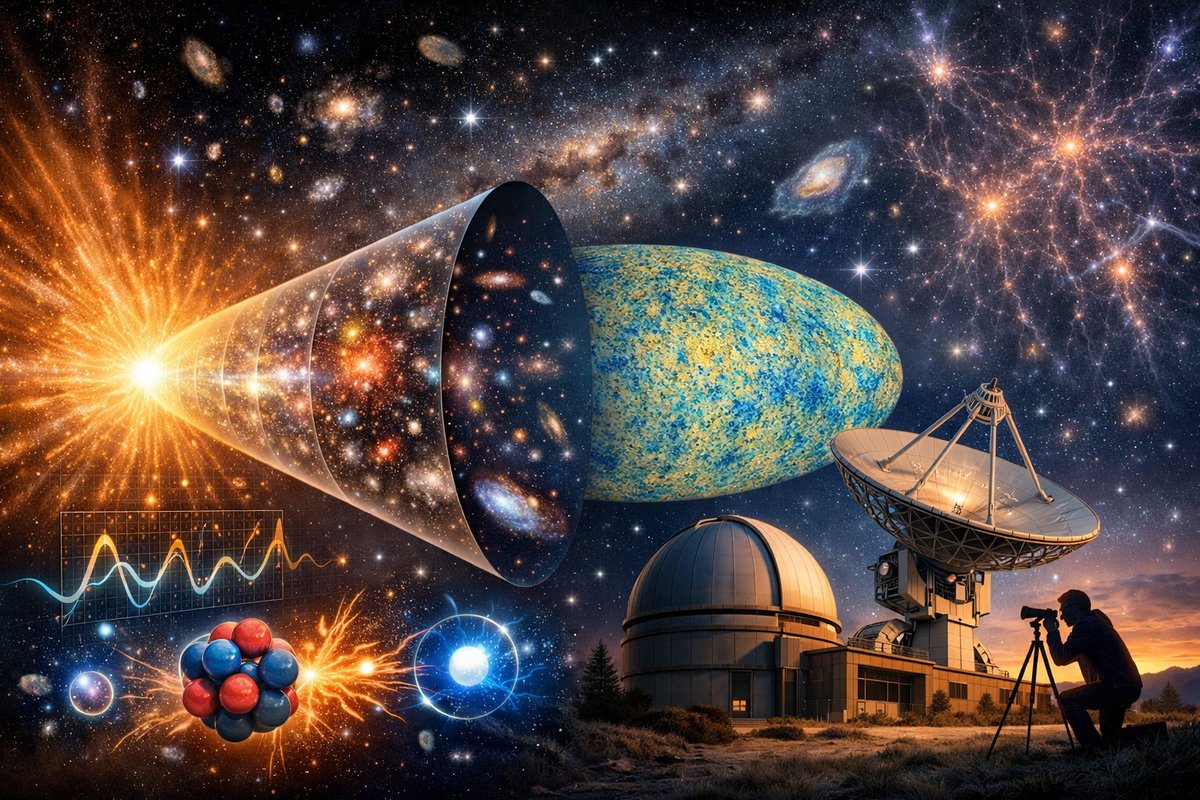
From quantum fluctuations to the glow of the cosmic microwave background, researchers are probing the universe's first instants with ever more sensitive instruments. A new wave of observations and theories is revealing surprising connections between the smallest particles and the grandest cosmic structures, inviting amateur stargazers and lifelong learners to join the quest.
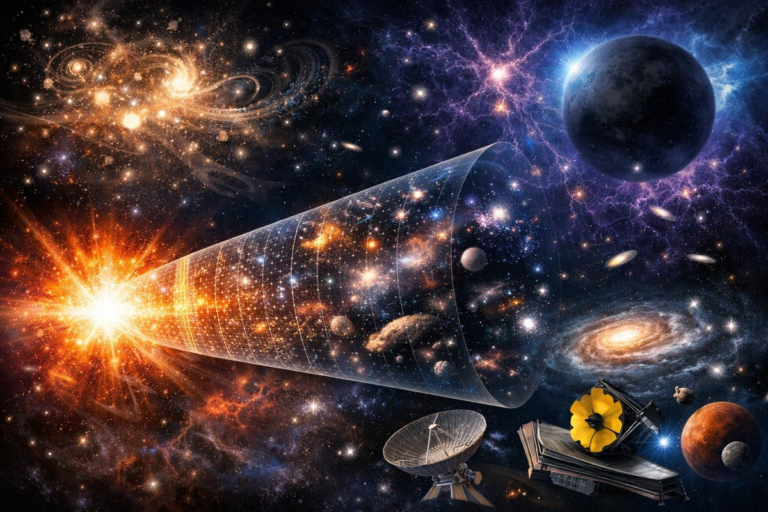
A faint hum persists across the sky, a ghostly afterglow of the universe’s birth. Since its discovery in the 1960s, the cosmic microwave background (CMB) has served as a time capsule, carrying within its fluctuations the story of the cosmos’s infancy. Now, breakthroughs in detector sensitivity, deep-field telescopes and high-energy neutrino observatories are sharpening our view of the universe’s first fractions of a second. As engineers and theorists collaborate on ground-breaking experiments, the boundary between the quantum and the cosmic is shifting.
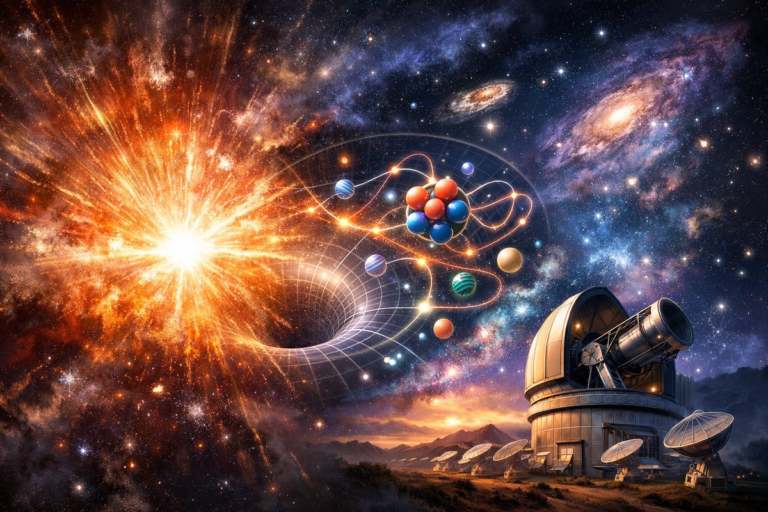
In the high-altitude plateaus of Chile, arrays of microwave antennas scan the southern sky, teasing out subtle temperature differences in the CMB that hint at primordial gravitational waves. These ripples, if confirmed, could offer direct evidence for a rapid inflationary phase that expanded space faster than light itself. Meanwhile, a mirrored network of radio telescopes in Antarctica listens for neutrinos born in the furnace of the Big Bang, particles so elusive they sail unhindered through Earth’s crust, carrying undistorted memories of high-energy processes at the dawn of everything.
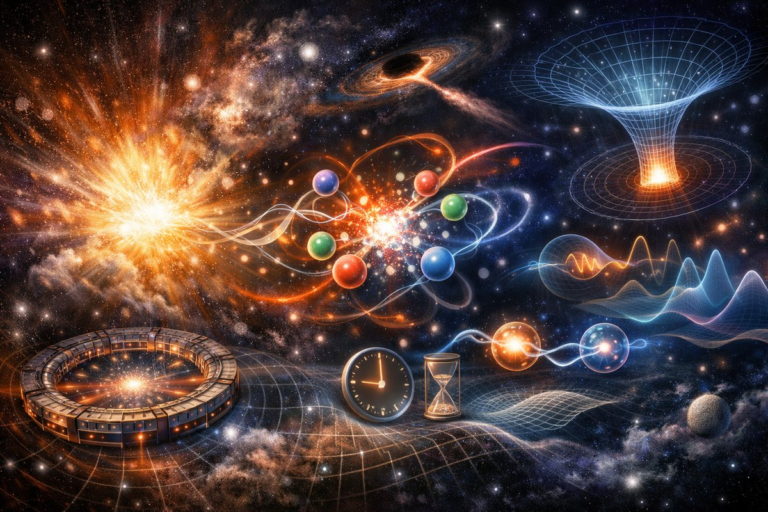
On the theoretical front, cosmologists are revisiting long-standing paradoxes. The horizon problem-why distant regions share the same temperature despite no causal contact-finds new context in proposals that space itself underwent a quantum bounce, replacing the classical singularity with a bridge between cycles. Quantum gravity models rooted in loop and string frameworks suggest a fuzzy, probabilistic origin where space and time emerge from entangled networks of fundamental quanta.
Renewed interest is also growing in a long-overlooked messenger: cosmic rays from the early universe. Ultra-high-energy particles measured by balloon-borne and mountain-top detectors carry imprints of magnetic fields and dark matter interactions from epochs inaccessible to optical telescopes. By tracing their trajectories, scientists hope to reconstruct the magnetic scaffolding that guided galaxy formation and shaped large-scale cosmic web patterns.
Amateur astronomers are feeling the pull of the cosmic frontier. New affordable refractor telescopes equipped with digital integration let backyard stargazers map faint galaxies and nebulae, contributing to citizen-science projects that cross-check professional surveys. Smartphone apps overlay real-time star charts, aligning visible constellations with the locations of high-resolution cosmic maps. This democratization of skywatching is fueling a renaissance of public engagement, as enthusiasts share deep-field photos and help flag transient events like gamma-ray bursts and supernovae.
Beyond optical skies, open-source software is extending virtual observatories to anyone with an internet connection. Researchers are releasing petabytes of raw data from infrared and X-ray missions, inviting curious learners to explore galaxy clusters and ferret out anomalies that might signal new physics. Educational communities are springing up around hands-on tutorials for data reduction and spectral analysis, turning novices into adept cosmic detectives.
This spirit of collaboration extends into particle physics, where desktop cloud-chamber kits let hobbyists visualize the tracks of ionizing radiation. By building their own detectors, learners gain an intuitive grasp of subatomic interactions, from muons raining down from the upper atmosphere to decay chains that hint at hidden particles. These simple home experiments echo the processes at play in massive underground labs, linking everyday curiosity to the grand questions of mass and symmetry in the universe.
Despite these advances, fundamental mysteries remain. Dark matter still evades direct detection, its gravitational influence apparent only in galaxy rotations and cluster dynamics. Dark energy, the force accelerating cosmic expansion, confronts theorists with the ultimate fine-tuning puzzle. Why does this repulsive energy density assume its particular value, precisely calibrated to allow galaxies, stars and life to arise? Some propose that our universe exists within a vast multiverse, one bubble among countless others, each with its own physical constants.
Testing such speculative ideas demands ingenuity. Novel detectors buried beneath the ice or nestled deep in granite tunnels search for fleeting signatures of exotic particles. Laser interferometers spanning continents monitor minute spacetime distortions that could betray collisions between primordial black holes and reveal the universe’s high-energy history. Meanwhile, tabletop quantum experiments harness ultracold atoms to simulate cosmic expansion, using wave functions to mimic space stretching and offering a laboratory glimpse of inflationary dynamics.
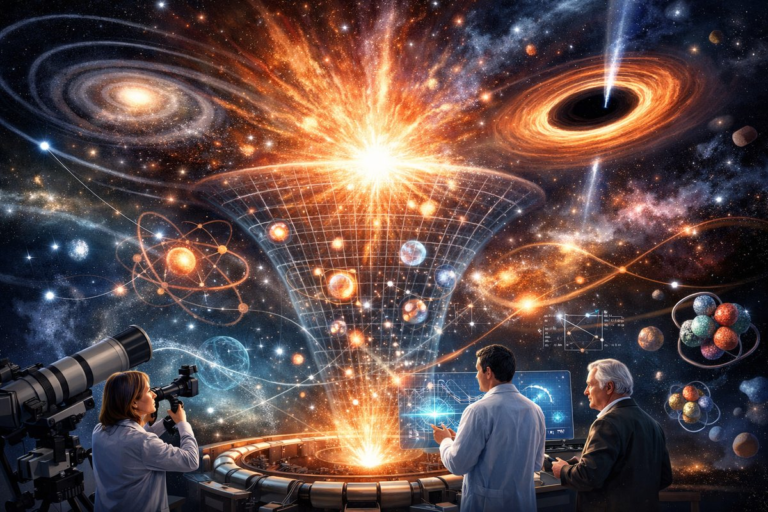
These efforts underscore a profound shift: cosmology is no longer a spectator science confined to telescopes and theory papers. It is a participatory adventure in which enthusiasts, students and professional researchers collaborate across disciplines. Workshops blend art and physics, inviting painters and poets to interpret the cosmic canvas, while classrooms transform into miniature data centers where young learners extract power spectra and angular correlations from real-world measurements.
What emerges from this collective endeavor is more than a narrative of cosmic origin; it is a testament to human curiosity and resilience. Each subtle signal decoded, each anomaly logged, brings us closer to understanding how space, time and matter coalesced from a seething quantum foam. Yet every advance raises new questions, reminding us that the universe’s earliest moments remain a frontier of mysteries to explore.
Whether you gaze up at the night sky through a telescope, analyze open-access data on your laptop or simply ponder the philosophical implications of a quantum beginning, you are part of this unfolding story. The cosmos invites us to listen to its echoes, to trace the faint imprints of creation and to imagine what lies beyond. In that act of imagination, we become co-authors of a grand cosmic saga, bridging the void between now and the instant everything began.