Location
Mount Vernon, WA 98274

Location
Mount Vernon, WA 98274


A convergence of breakthroughs-from refined polarization maps of the cosmic microwave background to underground neutrino detectors and quantum simulators-has begun to peel back the veil on the universe's origin. Researchers are piecing together signals from gravity waves, subatomic relics, and simulated quantum fields to reconstruct the first instants after cosmic birth.

A convergence of advanced observatories, innovative detectors, and theoretical breakthroughs is pushing the frontier of cosmology closer to the universe's origin point. Researchers are piecing together data from cosmic background radiation, gravitational waves, and high-energy neutrinos to probe from the Planck epoch to the first galaxies.

Fresh observations from advanced microwave and gravitational-wave observatories are offering unprecedented insight into how space, time and matter emerged from the cosmic void. Cutting-edge instruments and international collaborations are now converging to illuminate the forces and paradoxes that governed the universe's birth.

A suite of cutting-edge observations from ground-based arrays, balloon-borne detectors, and gravitational-wave observatories is rewriting our understanding of the cosmos's opening chapters. Scientists are untangling paradoxes like the horizon problem and seeking the first whispers of matter, energy, and the quantum forces that forged everything we know.
An international array of telescopes, particle detectors, and theoretical models is rewriting our understanding of the universe's first instants. From fresh anomalies in the cosmic microwave background to the hunt for primordial gravitational waves, researchers are confronting paradoxes that challenge long-held models and spark new questions about the dawn of time.
New data from gravitational-wave observatories, space-based infrared telescopes, and underground particle detectors are converging to illuminate the universe's birth pangs. Scientists are piecing together how ripples in spacetime, nascent galaxies, and elusive dark particles set the stage for everything we know-and everything we have yet to envision.

Scientists are turning deep-field images and particle detectors toward questions that date back to the first fractions of a second after the universe began. This exploration probes forces, paradoxes, and hidden realms that shaped everything we experience-and points the way to mysteries yet unsolved.
Groundbreaking observations of ancient light have revealed subtle anomalies that could reshape our understanding of cosmic inflation and what preceded the Big Bang. As scientists combine data from cutting-edge telescopes and experiments, they're piecing together an origin story more mysterious-and more compelling-than ever imagined.

An influx of recent observations-from gravitational wave ripples to faint whispers of primordial light-has reignited the quest to understand how our universe sprang into being. Scientists are piecing together the forces, particles, and paradoxes that shaped everything we know and everything we've yet to imagine.
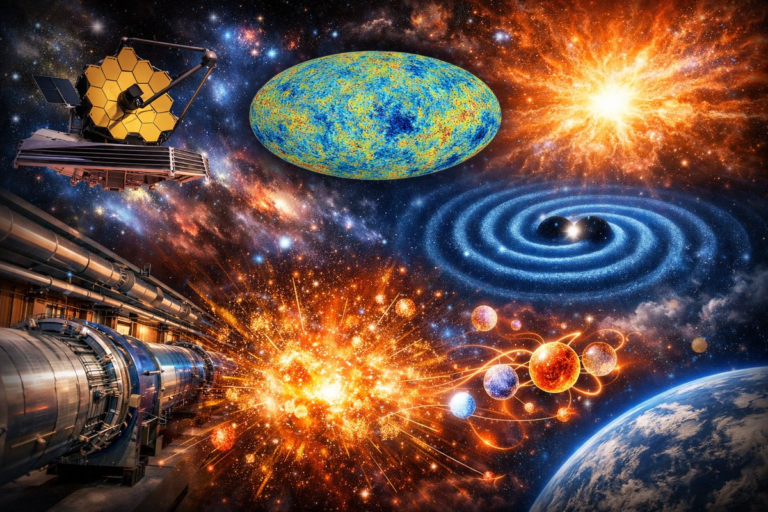
Scientists are combining data from space telescopes, particle colliders, and gravitational wave observatories to trace the forces and particles that emerged in the universe's infancy. New findings-from subtle ripples in the cosmic microwave background to microseconds of quark-gluon plasma-are sharpening our picture of how everything sprang into being.