Location
Mount Vernon, WA 98274

Location
Mount Vernon, WA 98274
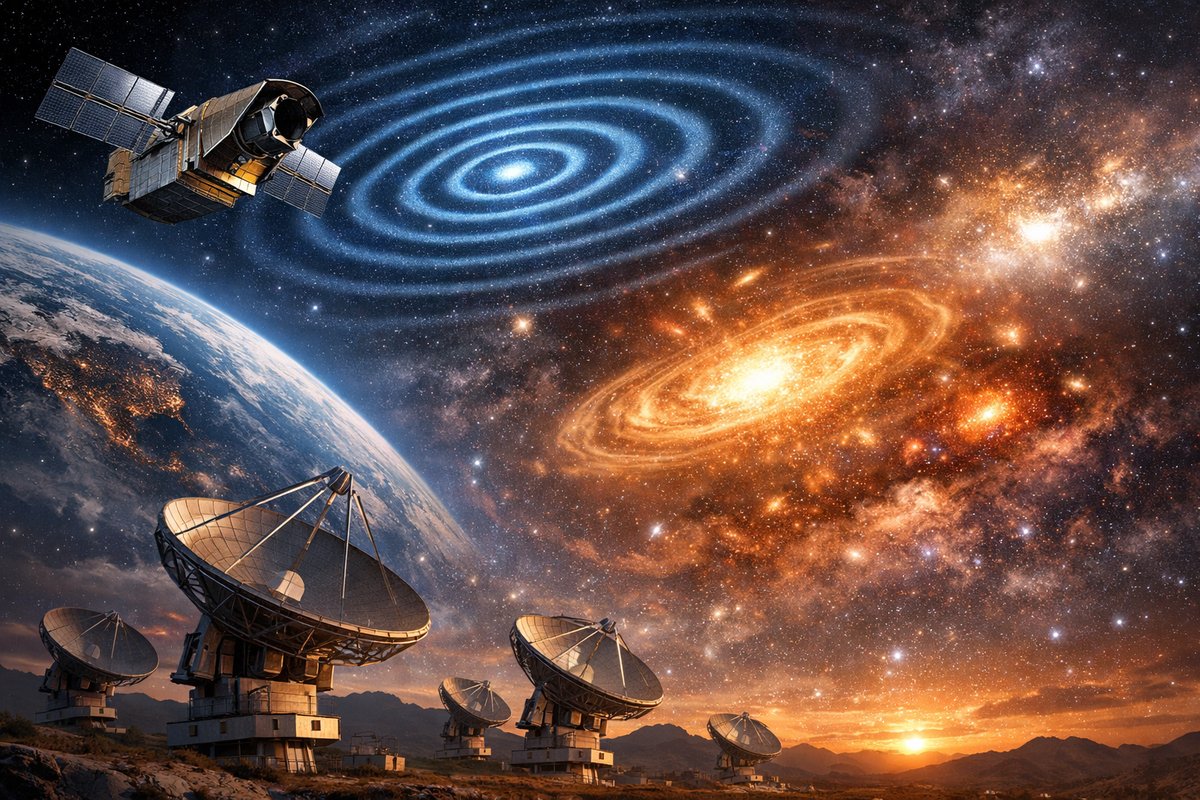
A global network of radio telescopes and spaceborne infrared instruments is revealing unexpected signals from the universe's infancy. New evidence of a gravitational wave background and infrared light from nascent galaxies is reshaping our understanding of cosmic inflation and the mysteries at the dawn of time.
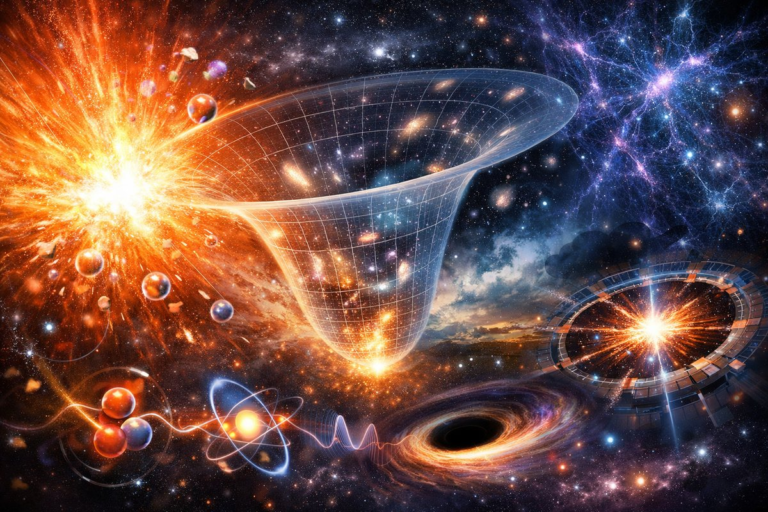
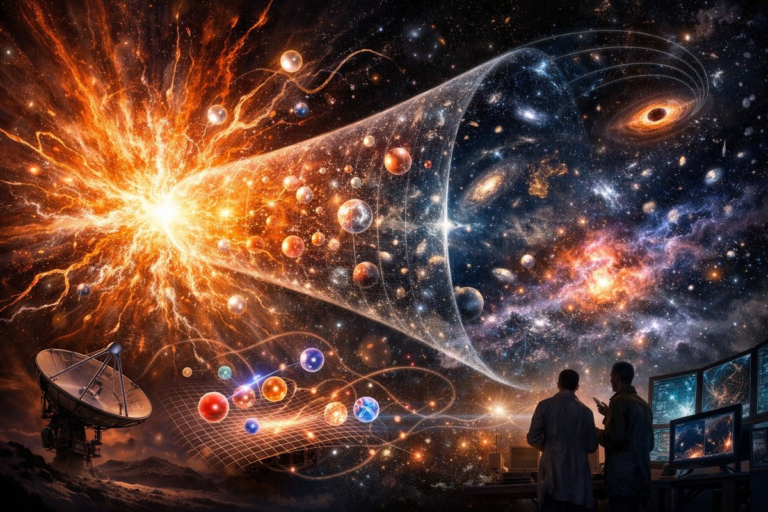
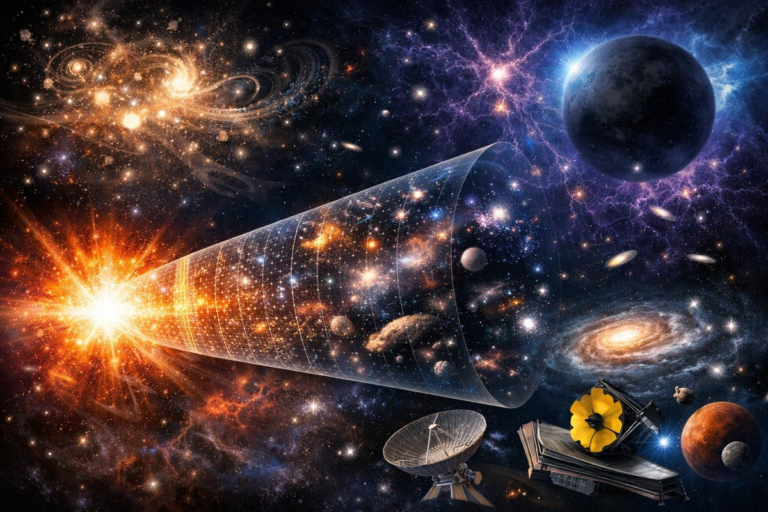
On a crisp night at observatories scattered from the South Pole to remote desert plateaus, astronomers have been tuning into whispers from the universe’s earliest heartbeat. A recently released data set from an international pulsar timing array has captured nanohertz-frequency ripples in spacetime-signals thought to be relics of gravitational waves generated in the first fractions of a second after the Big Bang. At the same time, deep infrared images from a next-generation space telescope have revealed starlight from galaxies that formed barely 200 million years into cosmic history. Taken together, these breakthroughs mark an unprecedented convergence of techniques probing the universe’s primordial era.
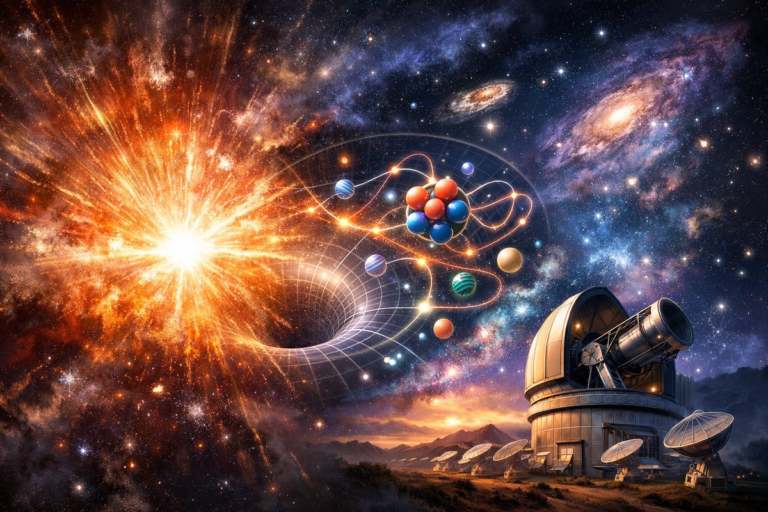
By meticulously monitoring millisecond pulsars-dense, rapidly spinning remnants of collapsed stars-astronomers have turned our galaxy itself into a gravitational wave detector. Tiny mismatches in the arrival times of radio pulses, now confirmed at high statistical significance, suggest a faint but persistent gravitational wave background. While such a background was long predicted by inflationary cosmology, this marks the first time its signal has risen above the noise. Researchers caution that more data are needed to pinpoint the precise source, but initial models point to quantum fluctuations in spacetime that were stretched to cosmic scales during inflation.
The notion of cosmic inflation posits that the universe underwent an explosive expansion in a tiny fraction of a second, smoothing out irregularities and seeding the large-scale structure we observe today. Gravitational waves generated during this blistering expansion would carry a unique spectrum of frequencies. Detecting that spectrum is akin to finding a fingerprint on the walls of the cosmic gallery. The newly reported nanohertz frequencies fill a gap between higher-frequency signals seen by laser interferometers and the ultra-low-frequency range accessible only through careful pulsar timing.
Simultaneously, an infrared space observatory has pushed the frontier of deep-field imaging by collecting light from the earliest known galaxy clusters. Using innovative sensor arrays cooled to near absolute zero, the telescope has isolated the faint glow of newborn stars in environments where the intergalactic medium was still largely neutral. Spectroscopic follow-up has identified key signatures of ionized helium and hydrogen, marking the end of the so-called cosmic dark ages. These observations provide independent confirmation that massive galaxies began assembling at an astonishingly early stage, complementing clues from the gravitational wave background.
Synthesizing these data streams is already challenging prevailing models. The amplitude of the detected gravitational wave background appears slightly higher than many inflation scenarios predict, hinting at more complex dynamics in the ultra-high-energy regime. Meanwhile, the rapid pace of early galaxy formation suggests that primordial star formation physics may differ from classical expectations. Together, they underscore how much remains to be understood about the interplay between quantum fields, gravity, and the contents of the young cosmos.
Moreover, these findings intersect with another outstanding puzzle in modern cosmology: the Hubble tension. Measurements of the universe’s expansion rate today, derived from local distance indicators, disagree with the value inferred from the cosmic microwave background’s primordial imprint. If new physics-whether exotic dark matter interactions or modifications to the inflationary period-is required to resolve that tension, it could also influence the strength and character of the gravitational wave background. Researchers are now exploring joint analyses that combine pulsar timing, infrared deep fields, and cosmic microwave background polarization to build a coherent picture.
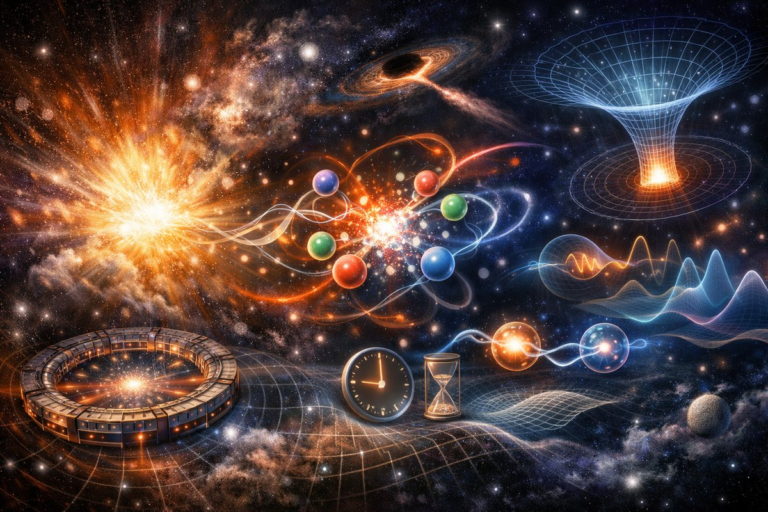
At the same time, theoretical physicists are revisiting long-standing paradoxes tied to the Big Bang singularity. If quantum gravity effects smoothed out the singular origin, as some bounce cosmology models suggest, then the expected gravitational wave spectrum would carry telltale deviations from the simple inflationary template. Upcoming surveys will search for such distortions. If detected, they would revolutionize our understanding of space, time, and the ultimate fate of the cosmos.
Credit for orchestrating these interdisciplinary efforts goes to consortia that span radio observatories, space agencies, and university labs. Coordination across instruments with vastly different capabilities-and timescales for data collection-has demanded novel software pipelines and statistical frameworks. The success of these collaborations underscores the scientific community’s capacity to unite around the grand questions of existence, even while grappling with the immense technical hurdles of observing phenomena billions of years removed from the present.
Looking ahead, a suite of next-generation facilities promises to sharpen this view. Ground-based microwave observatories with ultra-sensitive polarization detectors aim to map the slightest twists in the cosmic microwave background, offering an indirect probe of primordial gravitational waves. On the gravitational wave front, space-based interferometers scheduled for launch later in the decade will cover intermediate frequencies, bridging the gap between pulsar timing and current ground observatories. Together, they will chart the full spectrum of the universe’s earliest vibrations.
For science enthusiasts and students, these developments provide a fresh window onto questions that have echoed through human history: How did something emerge from nothing? What laws governed the earliest instants of reality? And to what extent does the cosmos follow a singular path versus branching into a multiverse of possibilities? Each new data point brings us closer to answers, yet often unveils deeper mysteries lurking in the cosmic tapestry.
Beyond pure curiosity, this research carries practical dividends. Technologies developed for ultrastable timing, cryogenic sensors, and signal processing find applications in telecommunications, medical imaging, and geophysical exploration. The drive to detect one part-per-quadrillion fluctuation in a pulsar’s pulse arrival has spurred innovations in precision engineering-innovations that ultimately benefit a range of industries.
Public engagement has also surged as the narrative of cosmic origins captures imaginations. Planetarium shows, digital visualizations, and interactive online platforms now incorporate the latest data, inviting anyone to embark on a virtual voyage back to the first moments of creation. Educators are seizing on the interdisciplinary nature of the work-blending physics, data science, and engineering-to inspire the next generation of researchers.
As the boundaries of observation expand, so too does our appreciation for the delicate interplay of forces that shaped the cosmos. Quantum jitters that erupted into vast filaments of galaxies, the gradual ionization of intergalactic gas by the first stars, and the faint hum of gravitational waves from the birth of spacetime itself-all these threads weave into a grand narrative of emergence. Each discovery refines our cosmic origin story, turning philosophical speculation into empirical science.
Though definitive answers may still lie over the horizon, the combined power of radio, infrared, and microwave observations has brought us closer than ever to witnessing the universe’s birth pangs. As new telescopes and detectors come online, the faint echoes of creation will only grow clearer. For humanity, this quest is more than an academic exercise: it is a journey to the beginning, an exploration of where we come from and what ultimate laws govern all that exists.
Whether you’re a budding astrophysicist or simply someone who gazes up in wonder at the night sky, the message is clear: the universe still holds secrets written in its first light and primordial tremors. And with each new detection, we turn another page in the chronicle of existence, uncovering chapters that have remained hidden for almost fourteen billion years.