Location
Mount Vernon, WA 98274

Location
Mount Vernon, WA 98274
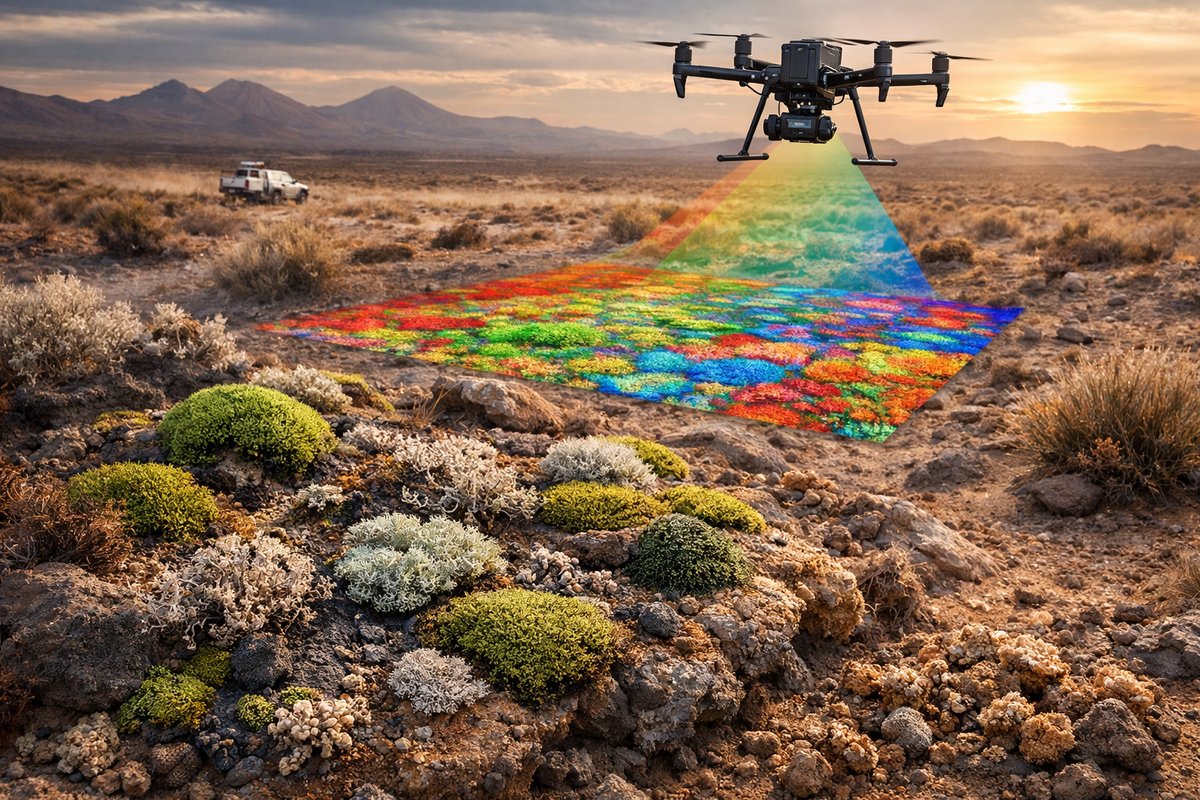
A groundbreaking study deploying hyperspectral drone imaging has revealed the hidden world of biological soil crusts in arid landscapes. These cryptic communities-composed of cyanobacteria, lichens, and mosses-play a pivotal role in carbon and nitrogen fixation, dust suppression, and ecosystem resilience.
In the shimmering heat of desert landscapes, a silent and ancient community thrives beneath our feet. These biological soil crusts-assemblages of cyanobacteria, fungi, lichens, and moss-form a living tapestry across nearly 12 percent of the planet’s drylands. Once thought of as barren sands, deserts are in fact covered by a fragile, living skin that holds the key to soil fertility, dust regulation, and even climate feedbacks.
Until recently, mapping and monitoring these crusts at scale posed an immense challenge. Conventional field surveys were too slow and localized to capture the vast mosaic of desert surfaces. Now, a team of environmental scientists has harnessed hyperspectral imaging drones to paint a continent-wide portrait of these microscopic guardians. Their findings not only redefine our understanding of desert ecosystems but also open novel pathways for land restoration.
The researchers outfitted lightweight drones with hyperspectral sensors capable of detecting subtle wavelength signatures emitted by different crust communities. Flying at altitudes of 50 to 100 meters, each drone surveyed hundreds of hectares in a single mission. Back in the lab, advanced algorithms processed terabytes of data to discriminate between crust types-cyanobacterial mats rich in nitrogen, lichens that anchor fine particles, and patches of moss that thrive in shaded microhabitats.
Surprising Patterns in the Sands
Contrary to expectations, the team discovered that crust diversity peaks not in the driest dune fields but along transitional zones where desert meets semi-arid scrub. There, episodic rainfall and moderate temperatures foster a mosaic of crust patches interlaced with native shrubs. In these buffer zones, nitrogen-fixing cyanobacteria can boost soil fertility, creating nutrient hotspots that sustain plant seedlings.
Farther into hyper-arid regions, crust cover thins out but remains remarkably resilient. Specialized strains of cyanobacteria secrete protective sugars that prevent desiccation and form microchannels to capture scarce moisture. When even a light dew settles in the predawn hours, these microbes awaken, photosynthesizing for a few precious minutes before retreating into dormancy.
Implications for Carbon and Dust Cycling
Biological soil crusts have long been recognized as local nitrogen pumps and erosion brakes, but the new imaging data suggest they also affect broader climate processes. In many deserts, dust storms loft millions of tons of fine particles into the atmosphere each year, influencing cloud formation and the Earth’s radiative balance. Intact crusts serve as natural barriers that bind soil grains, dramatically reducing dust emissions.
The study’s spatial maps indicate that a mere 10 percent decline in crust cover across major desert basins could result in a 25 percent increase in dust flux during peak wind seasons. That uptick carries implications for air quality hundreds of miles downwind, potentially aggravating respiratory ailments and altering regional rainfall patterns.
Moreover, crust photosynthesis contributes to carbon sequestration on par with some grassland ecosystems. While individual crust patches fix carbon at a slower rate than tree canopies, their sheer global expanse makes them significant players in the planet’s carbon budget. The drones’ high-resolution imagery allows scientists to refine carbon models, incorporating crust dynamics under different climate scenarios.
From Mapping to Restoration
Perhaps the most exciting outcome of this work is its direct applicability to land management. Armed with precise maps of crust health and diversity, restoration practitioners can tailor interventions to priority areas. In degraded corridors where crusts have been eroded by overgrazing or off-road vehicles, targeted inoculation of cyanobacteria and lichen spores has shown promise in jump-starting community recolonization.
Field experiments using biodegradable mesh mats impregnated with microbial inoculant revealed new crust growth within weeks under optimal moisture regimes. Combined with gentle surface roughening to trap seeds and dew droplets, these techniques can accelerate recovery by several fold compared to passive restoration.
One pilot project in the northern Sonoran Desert leveraged drone maps to identify erosion hotspots along a washed-out dirt road. After inoculating adjacent slopes and installing small check dams to slow water runoff, local botanists observed marked improvements in soil stability and an uptick in native shrub seedlings within a single season.
Challenges and Future Directions
Despite these successes, desert crusts remain vulnerable to climate extremes. Intensifying heatwaves and shifting precipitation patterns could disrupt the delicate balance these communities require. Prolonged droughts may hinder inoculant establishment, while heavier downpours risk washing away nascent crust layers.
To adapt, researchers are exploring the use of drought-tolerant microbial strains and supplemental fog-harvesting nets that provide critical moisture during dry spells. Meanwhile, next-generation drones equipped with thermal and LiDAR sensors promise even richer datasets-revealing subsurface moisture pockets and microtopography that influence crust distribution.
A Call to Notice the Unseen
As satellites beam back ever more detailed snapshots of Earth, it’s worth remembering that life persists in the smallest of forms. The humble biological soil crust may lack the drama of towering cacti or majestic dunes, but it underpins the resilience of entire desert biomes. By unveiling these hidden communities from above, hyperspectral drones are helping us steward fragile landscapes with unprecedented precision.
In the quiet interplay of light and shadow on a sun-baked crust, there lies a story of survival, cooperation, and renewal-one that teaches us to look closer, tread lightly, and marvel at nature’s ingenuity.