Location
Mount Vernon, WA 98274

Location
Mount Vernon, WA 98274
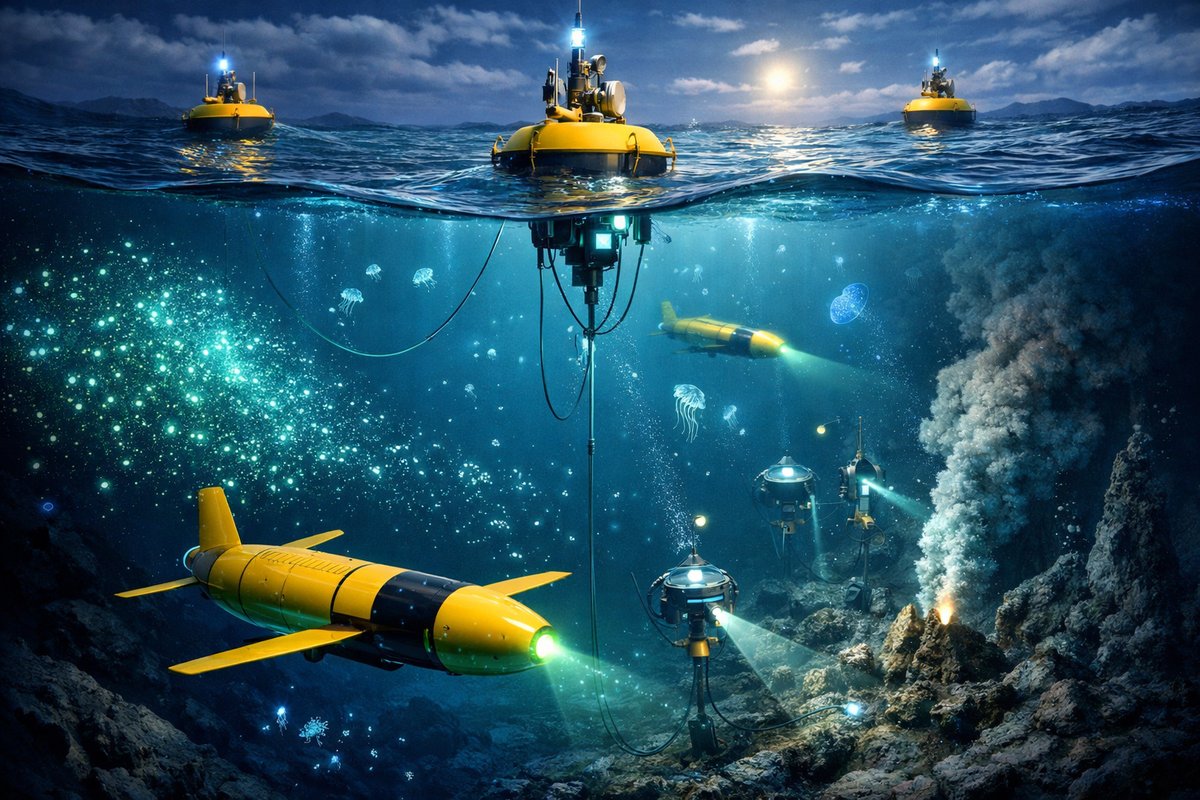
A cutting-edge network of bioluminescent sensor buoys and underwater gliders is transforming our understanding of life in the ocean's darkest realms. By harnessing natural light emissions and advanced optical detectors, scientists are mapping plankton blooms, tracking nutrient flows, and revealing ecological shifts on a global scale.
Marine researchers have long been captivated by the ocean’s twilight zone, the dimly lit layer between 200 and 1,000 meters where sunlight fades and mysteries abound. Until recently, studying this realm required expensive submersibles or deep-water trawls that disturbed fragile ecosystems. Now, a new approach uses swarms of autonomous sensors equipped with bioluminescence detectors to monitor life and chemical gradients in real time, without disrupting currents or creatures.
At the heart of this system are small, floating buoys that drift on the surface, each carrying a quantum-sensitive photodetector tuned to the wavelengths emitted by marine organisms. Below them, a fleet of underwater gliders periodically descends into the twilight zone, recording flashes of bioluminescent light produced by plankton, jellyfish, and other organisms. These mini-flashes, once invisible to conventional instruments, become data points that reveal the distribution and density of diverse species.
The current pilot network spans key oceanic regions known for rapid ecological change. Off the western coast of North America, dozens of buoys and gliders are deployed to monitor the seasonal upwelling that brings nutrients to the surface, fueling plankton blooms that sustain local fisheries. In the Pacific equatorial zone, teams track sudden spikes in illumination that indicate migrating species or shifts in water temperature. Early results have already captured rare bioluminescent displays from deep-sea squid, offering clues about feeding patterns that were previously speculative.
What makes this approach revolutionary is the way it combines natural bioluminescence with artificial intelligence. Machine-learning models analyze the timing, intensity, and spectral profile of each light pulse, distinguishing between different organism groups. This enables researchers to generate species-specific maps of plankton abundances and detect anomalies in near real time. A sudden change in light patterns might signal an algal bloom, oxygen depletion, or even the arrival of invasive species.
Unlike satellite observations that are limited to surface reflections, or ship-based sampling that happens only occasionally, these autonomous platforms provide continuous, high-resolution coverage. They operate for months on end, powered by solar panels on the buoys and thermal energy harvesters on the gliders. Data are transmitted via low-bandwidth acoustic links to a coastal server, then integrated with oceanographic models to forecast changes weeks ahead of traditional methods.
One striking case study occurred last fall in the Gulf Stream. A cluster of bioluminescent sensors detected an unexpected surge of green light emissions at around 300 meters depth. This anomaly coincided with a temperature anomaly measured by an adjacent oceanographic station. By cross-referencing both signals, scientists pinpointed a subsurface pulse of nutrient-rich water that had broken off from the main current. Within days, satellite imagery confirmed a surface bloom of coccolithophores, microscopic algae known for their reflective shells.
Beyond ecological monitoring, the technology is shedding light on fundamental ocean processes. Bioluminescent flashes reveal patterns of vertical migrations, where organisms ascend toward the surface at night to feed and descend by day to avoid predators. These diel movements play a critical role in carbon transport, as creatures consume carbon-rich prey near the surface and release it deeper down. By quantifying these movements, researchers can refine estimates of the ocean’s carbon sequestration potential.
The modular design of the buoys and gliders allows easy customization. Some sensors carry additional instruments, such as microfluidic water samplers that capture tiny volumes for genetic analysis. Others include microelectrode arrays to measure local pH or oxygen levels simultaneously with light detection. This convergence of optical, chemical, and biological sensing offers a multi-dimensional view of underwater ecosystems.
As the network expands, collaborations with fishing communities and conservation groups are fostering new use cases. In East Africa, small-scale fisherfolk have expressed keen interest in real-time plankton maps that can help them predict fish concentrations. By sharing data from nearby buoys, they can adapt their routes and reduce fuel consumption. Similar partnerships in Southeast Asia aim to monitor harmful algal blooms that threaten aquaculture operations.
Ethical and environmental safeguards are integral to the project’s design. All components are built from biodegradable or recyclable materials whenever possible, and power systems minimize emissions. Deployment protocols are standardized to avoid inadvertent harm to marine life, and acoustic transmissions operate at frequencies that avoid disturbing mammals. Open-source hardware and software ensure transparency, allowing coastal nations to participate without licensing barriers.
Scientifically, the system has opened doors to previously inaccessible questions: What triggers synchronized bioluminescent displays during mass migrations? How do light-emitting organisms respond to rising ocean acidity? Can subtle shifts in spectral emissions serve as early warnings of ecosystem collapse? Researchers are already drafting papers that leverage millions of light-pulse records gathered over the past six months, with the first field-validated models expected later this year.
On the technological front, engineering teams are exploring next-generation sensors. By integrating nanophotonic filters, detectors can become even more selective, isolating specific emission lines unique to different bioluminescent proteins. Advances in battery chemistry aim to extend mission durations beyond a year, while improvements in acoustic networking promise seamless coordination among hundreds of units.
Public engagement has also taken an imaginative turn. Artists and data-visualizers are transforming raw light-pulse data into immersive installations that allow viewers to “swim” through virtual bioluminescent clouds. Educational programs for schools invite students to build mini-glider kits, learn programming basics, and contribute their own data to a global citizen-science repository.
The broader implications of these light-driven insights are far-reaching. In a warming world where chemical and temperature regimes are shifting rapidly, continuous, passive monitoring offers a vital early-warning system. By aligning natural phenomena-bioluminescence-with advanced sensing, researchers are forging a new paradigm in oceanography, one where the ocean itself becomes a living, glowing laboratory.
As networks grow to cover polar seas and remote archipelagos, the glimmer of bioluminescent beacons will guide us toward deeper understanding and more responsive stewardship of our planet’s largest biome. In the dance between darkness and light beneath the waves, autonomous sensors are transforming fleeting flashes into enduring knowledge.