Location
Mount Vernon, WA 98274

Location
Mount Vernon, WA 98274
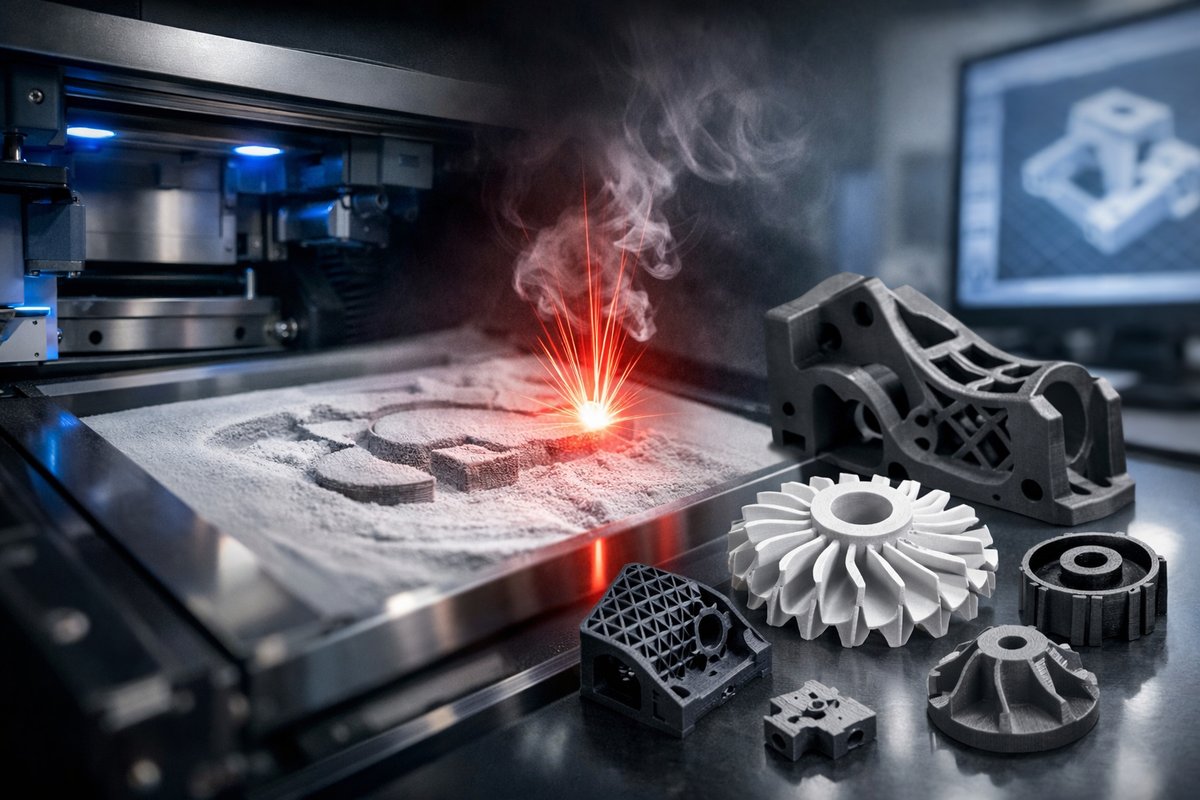
Selective Laser Sintering (SLS) offers an exciting frontier in additive manufacturing, enabling the creation of durable, complex parts without support structures. This guide dives into the technique's essentials, key components, and best practices to empower you to bring intricate digital designs into the physical world with precision and efficiency.
Additive manufacturing continues to revolutionize how we bring digital concepts to life, with a variety of techniques tailored to different materials, resolutions, and applications. Among these, Selective Laser Sintering (SLS) stands out as a powerful method that uses a laser to fuse powdered material layer by layer, creating robust, detailed objects without the need for support structures. This article offers a detailed walkthrough of the SLS process, highlights essential components, and shares practical insights to motivate you to experiment with this versatile technology.
At its core, SLS involves spreading a thin layer of powdered material-commonly nylon or other thermoplastics-across a build platform. A high-powered laser then selectively sinters, or fuses, the powder particles together according to the digital 3D model’s cross-section for that layer. Once a layer is complete, the platform lowers slightly, and a new powder layer is applied. This cycle repeats until the entire object is built.
One of the key advantages of SLS over other additive manufacturing methods like Fused Deposition Modeling (FDM) or Stereolithography (SLA) is that the unsintered powder acts as a natural support for overhangs and complex geometries. This feature allows for intricate designs that would otherwise require additional support material, reducing post-processing effort and material waste.
To get started with SLS, understanding the critical components and materials is essential. The laser system is the heart of the machine, typically a CO2 laser with precise control over power and scanning speed. The build chamber maintains controlled temperature conditions to keep the powder just below melting point, ensuring effective sintering without warping. A recoater mechanism evenly spreads new layers of powder after each pass.
Material choice significantly impacts the final product’s properties. Nylon powders, such as PA12, are popular for their strength, flexibility, and chemical resistance, making them suitable for functional prototypes and end-use parts. Recent advances also include composite powders infused with glass beads or carbon fibers to enhance stiffness and durability. Understanding the powder’s particle size distribution and flow characteristics is crucial for consistent layer deposition and surface finish.
Before printing, preparing the 3D model involves orienting it optimally within the build chamber to maximize space efficiency and mechanical performance. Software tools allow you to nest multiple parts, adjust laser parameters, and simulate the build process to anticipate potential issues like warping or incomplete fusion.
Once printing begins, monitoring the process is vital. Many modern SLS machines feature in-situ sensors to track laser power, temperature, and layer quality, enabling real-time adjustments and reducing failed prints. After completion, the build chamber cools down gradually to prevent thermal stress. The printed parts are then carefully extracted from the surrounding powder, which can often be recycled for subsequent prints, promoting sustainability.
Post-processing steps may include bead blasting or tumbling to improve surface texture, dyeing or painting for aesthetics, and infiltration with resins for enhanced strength or surface finish. These finishing touches allow customization tailored to the part’s intended use.
Experimenting with SLS opens doors to creating lightweight yet strong components for aerospace, automotive, medical devices, and consumer products. Its ability to produce complex lattice structures and internal channels supports innovation in design and function previously unattainable through traditional manufacturing.
For newcomers, desktop-scale SLS machines have become increasingly accessible, offering a hands-on opportunity to explore this technology without industrial-scale investment. Starting with small functional parts or artistic models can build familiarity with machine calibration, powder handling, and post-processing techniques.
In summary, Selective Laser Sintering exemplifies the fusion of precision engineering and creative freedom in additive manufacturing. By mastering its workflow-from material selection to final finishing-you can transform digital blueprints into durable, high-performance objects that push the boundaries of design and application.