Location
Mount Vernon, WA 98274

Location
Mount Vernon, WA 98274
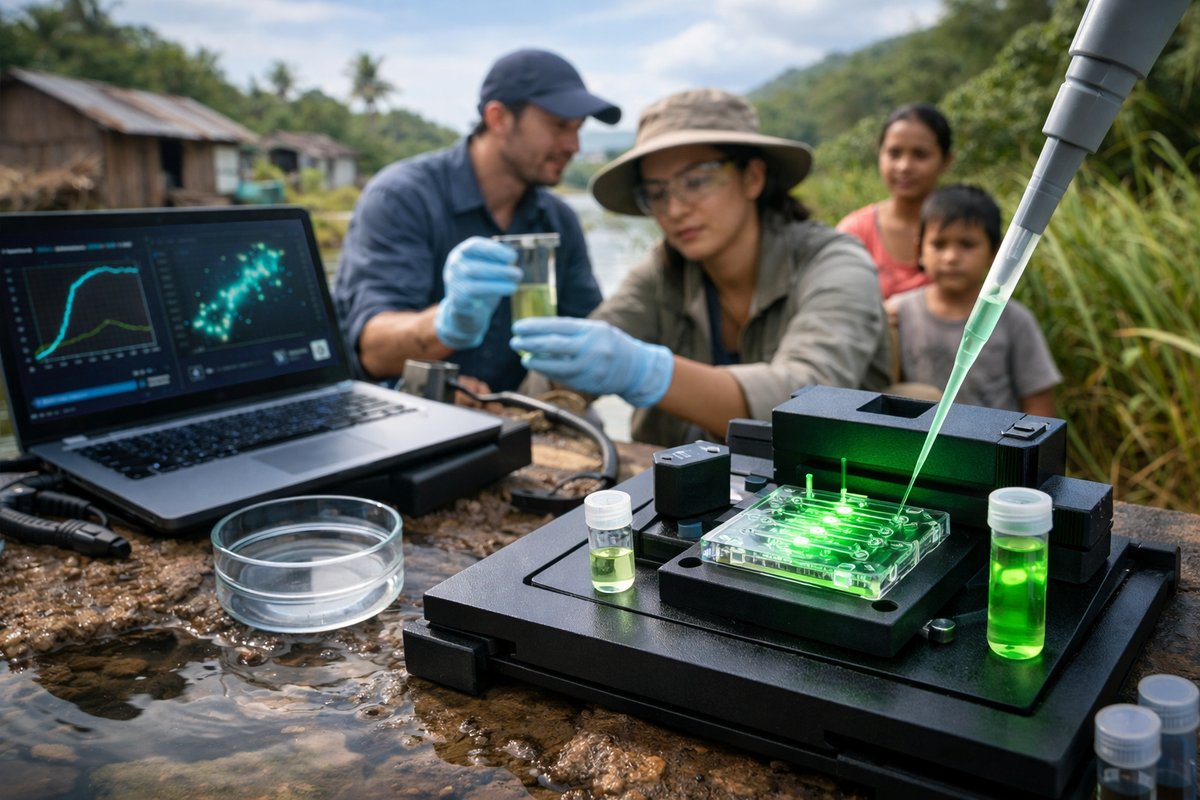
A team of researchers has unveiled a low-cost, 3D-printed microfluidic device that detects waterborne pathogens in under 30 minutes using CRISPR-based fluorescence. Field trials in remote communities demonstrated lab-level accuracy, promising real-time water monitoring for public health and citizen science.
In remote villages, refugee camps and disaster zones alike, access to reliable water testing has long been a barrier to preventing outbreaks of waterborne diseases. Traditional laboratory methods require specialized equipment, trained personnel and hours or days of waiting. Now, a collaboration among engineers, molecular biologists and public health experts has yielded a field-deployable microfluidic biosensor capable of detecting E. coli, Vibrio cholerae and other pathogens in less than half an hour.
The device fits in the palm of a hand and is fabricated on a standard desktop 3D printer using biocompatible resins. At its core, a network of microscopic channels directs a small volume of test water through chambers preloaded with freeze-dried CRISPR-Cas12 reagents. When pathogenic DNA is present, the Cas12 enzyme is activated and cleaves a fluorescence reporter, causing a visible glow under a simple LED excitation source. A smartphone camera captures the signal and, with an accompanying app, quantifies pathogen levels in real time.
To evaluate performance, the team conducted field trials along rivers supplying drinking water to several rural communities. Local health workers collected samples during both dry and rainy seasons, creating a library of results that was cross-checked against conventional polymerase chain reaction (PCR) tests in regional laboratories. The microfluidic sensor achieved 95 percent concordance with lab analysis, detecting contaminant levels as low as ten colony-forming units per milliliter. Most strikingly, the turnaround time from sample to result was under 30 minutes, compared to two days through centralized labs.
Engineers highlight that the cost per test runs under five dollars, factoring in reagents and consumables. The 3D-printed chip itself can be produced in minutes, allowing rapid iteration and customization for different target organisms. Beyond bacteria, the platform has been adapted to detect viral fragments and even microplastic particles by swapping in alternative reagents and channel designs.
Public health officials have long sought effective tools for decentralized water monitoring. In many regions, outbreak response lags behind pathogen spread by days or weeks, owing to logistical hurdles. By equipping local clinics, schools and water committees with a rugged, user-friendly sensor, communities can identify contamination events in near real time and issue boil-water advisories or deploy point-of-use filtration within hours.
Beyond frontline health applications, the microfluidic device has inspired a wave of citizen science initiatives. In one pilot program, student groups in coastal areas used the sensor to map seasonal patterns of E. coli levels in estuaries, contributing geotagged data to an open database. High school biology teachers have incorporated the technology into lab modules on molecular diagnostics, allowing teenagers to manipulate protein-DNA reactions and witness fluorescence signals firsthand.
The research paper detailing the technology has been published in a leading scientific journal, with supplementary materials including CAD files for the chip, Python scripts for analyzing fluorescence data and protocols for reagent preparation. By embracing an open-source philosophy, the team hopes to accelerate adoption and spur innovation. Already, hobbyist makers have adapted the design to run on battery-powered handheld units, complete with built-in LEDs and a rubber gasket that seals the chip against dust and splashes.
Scalability remains a central challenge. While desktop 3D printing works for prototypes and small batches, mass production will require injection molding or roll-to-roll manufacturing to meet demand in large-scale public health deployments. Additionally, reagent stability in varied environmental conditions-high humidity, extreme heat or sub-zero temperatures-calls for further formulation work. Freeze-dried cartridges need to withstand transport without cold-chain support.
Future iterations are already in development. A multipath chip that simultaneously screens for a panel of ten pathogens could cut testing time even further. Integration with solar-powered mobile labs would enable autonomous operation in the field. Researchers are also exploring how the platform could monitor antibiotic resistance genes, tracking the rise of “superbugs” in wastewater effluent.
The push toward decentralized diagnostics mirrors trends across environmental science and healthcare. Advances in microfabrication, synthetic biology and smartphone integration are converging to bring lab-grade tests out of centralized institutions and into hands around the world. If widely deployed, this microfluidic biosensor could help curb cholera outbreaks in coastal regions, halt dysentery before it claims lives in refugee settlements and empower communities to safeguard their own water supplies.
For policy makers, the implications are profound. Investments in centralized labs remain vital, but decentralized tools can serve as a first line of defense, triaging risks and optimizing resource allocation. In a crisis, speed often determines outcomes. A sensor that flags unsafe water within minutes could mean the difference between containment and epidemic.
The emotional resonance of the project shines through in field reports. Health workers describe the relief on villagers’ faces when they learn their borehole water is safe to drink. Teachers recount the excitement of students as they peer into smartphone-linked fluorescence chambers and watch invisible pathogens reveal themselves. Makers share online videos of improvised “lab backpacks” housing batteries, filters and reagent vials-transforming treks into the mountains into mobile diagnostic expeditions.
This microfluidic breakthrough exemplifies a broader ethos: harness curiosity, precision and communal action to address pressing global challenges. For decades, the scientific community has aimed to push boundaries at the quantum or cosmic scale. Here, the frontier lies in translating molecular reactions into actionable data for everyday life.
As the technology matures, partnerships between NGOs, tech incubators and local stakeholders will be key. Training materials in multiple languages, low-cost maintenance tools and community engagement strategies can ensure sustainable use. Ultimately, the success of such a platform will depend not only on its technical merits but on the trust and ownership of the people who wield it.
In a world grappling with pandemics, climate change and infrastructure gaps, equipping citizens with rapid-response diagnostics reshapes the narrative of water security. No longer a distant privilege, safe water testing can become a right upheld by science at the point of need.
The journey from laboratory bench to riverside testing station underscores the power of interdisciplinary collaboration. By integrating microfluidics, gene-editing enzymes and mobile technology into a cohesive system, researchers have opened new pathways for environmental monitoring and public health.
Looking ahead, the vision is clear: a global network of low-cost sensors, feeding real-time data streams into predictive models that anticipate outbreaks before they occur. The microfluidic biosensor is a critical step on that path-a modular, adaptable tool that bridges molecular science and community well-being.
In the near term, pilot programs will expand to new regions, refining protocols and supply chains. With each deployment, lessons learned will inform next-generation designs. Researchers remain mindful that technology alone cannot solve systemic challenges, but when paired with education, policy reform and local leadership, tools like this biosensor can tip the scales toward resilience.
For curious learners, lifelong tinkers and novice administrators alike, the microfluidic biosensor story highlights an essential truth: bold science flourishes when it serves human needs. From the cellular detection of DNA to the societal impact of clean water, this innovation invites us to think deeply, collaborate broadly and act swiftly. As the glow of fluorescence signals in a smartphone app, so too does a beacon of hope for communities around the globe.