Location
Mount Vernon, WA 98274

Location
Mount Vernon, WA 98274
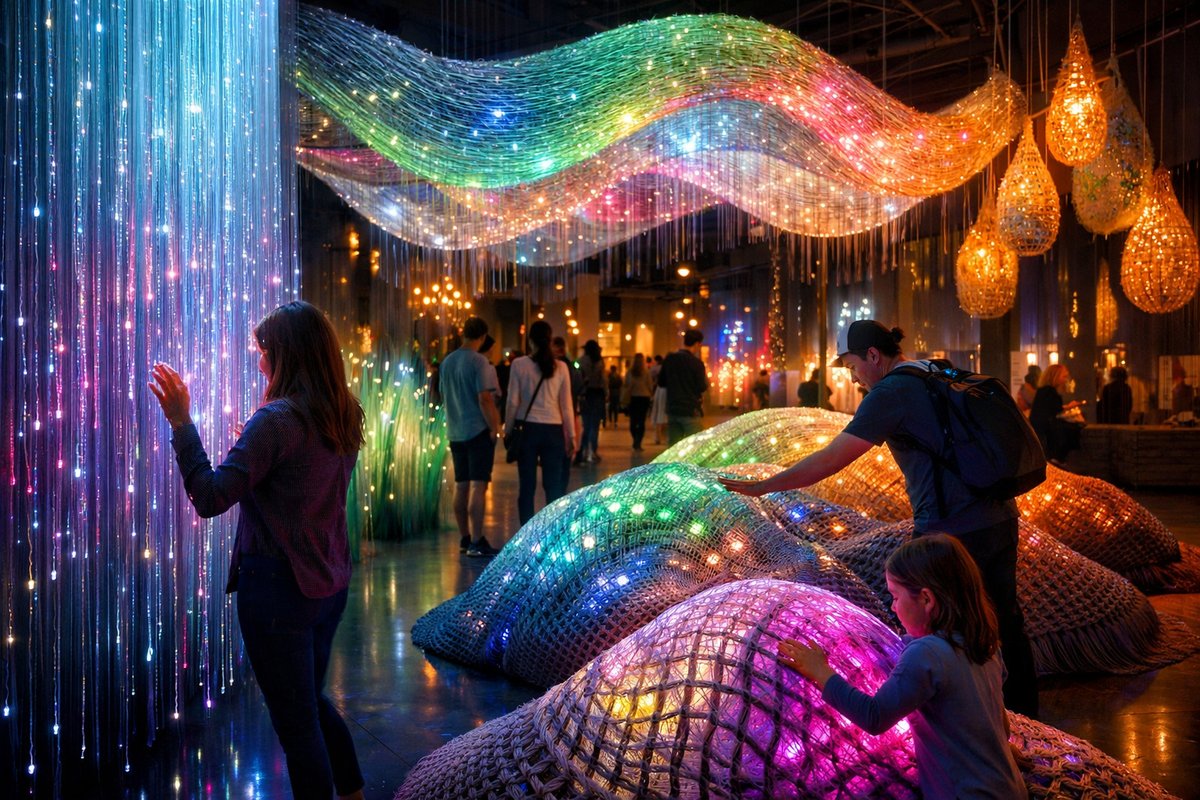
A new wave of interactive fiber installations is transforming public spaces into responsive canvases, blurring the lines between craft and technology. By combining fiber optic yarn, microcontrollers, and sustainable materials, artists are creating tactile environments that pulse, respond, and invite deeper engagement from visitors. This movement redefines both the function of design in communal settings and the philosophy of art as a shared, evolving narrative.
Under the vaulted ceilings of a repurposed industrial loft, strands of glowing thread hang like an otherworldly chandelier. Visitors pass beneath, their footsteps triggering gentle ripples of light and color along strands of fiber optic yarn. Across town, a corporate lobby is outfitted with woven panels that brighten and dim in response to ambient sound levels-transforming the sterile reception area into an immersive performance of texture and illumination. These installations represent more than novel attractions: they emerge from a growing movement in art and design that fuses tactile handcraft with digital interactivity to reshape how we experience public environments.
At the heart of this movement lies a simple yet powerful idea. Traditional fiber arts-loom weaving, embroidery, macramé-have always centered on the tactile qualities of thread, yarn, and cloth. Now, by integrating tiny LEDs, conductive fibers, and microcontroller boards, artists can imbue these time-honored forms with dynamic behaviors. The loom becomes a logic circuit; the tapestry, a sensor array. Visitors’ footsteps, whispers, or even the hum of nearby machinery can be converted into data streams that animate fiber-optic threads and cause patterns to materialize, fade, or morph before our eyes.
Earlier this year, a well-received installation titled “Heartbeat Weave” invited museumgoers to press their palms against a broad textile panel. Underneath the woven surface lay capacitive touch sensors linked to microcomputers. Each pulse of finger to fabric would generate brief flashes moving outward along lines of smart thread, tracing the visitor’s pulse through an ever-evolving design. With every encounter, the installation recorded subtle variations in rhythm and pressure, weaving them into an archive of human-machine collaboration.
Such examples highlight a broader philosophical shift. Instead of seeing art objects as static end products, practitioners emphasize ongoing dialogue between viewer and artwork. The materials chosen become not just carriers of color or form but nodes in a network of sensory feedback. In this context, fiber is no longer merely soft sculpture: it is a living medium that breathes according to our presence.
Equally significant is the commitment to sustainability coursing through these projects. Some studios retrofit salvaged cotton fabric or repurposed denim as base material for lit threads. Others experiment with biodegradable polymers spun into fine filaments, ensuring that their works won’t become long-term environmental burdens. In one public plaza, an eco-conscious pavilion combined recycled hemp rope with off-grid solar panels to power its fiber optic matrix. By foregrounding circular design principles, artists reinforce the idea that interactivity and ecological responsibility need not be separate concerns.
Behind many of these installations lies a toolkit familiar to hobbyists and makers: fiber optic LED yarn, rigid-frame weaving looms, microcontroller starter boards, capacitive touch sensors, and occasional projection units to layer video content atop woven surfaces. Armed with this hardware and guided by a spirit of playful experimentation, small collectives have turned gallery walls into living tapestries and transit hubs into responsive art corridors. Technology libraries and community workshops offer lending programs for specialty equipment, making it possible for non-commercial groups to prototype large-scale pieces without prohibitive investment.
During a recent design hackathon, multidisciplinary teams were challenged to create a fiber-based installation that could respond to fluctuations in local noise pollution. One group installed slender columns of knitted tubing filled with light-diffusing gel and fiber optic filaments. Connected to open-source sound meters, each column glowed brighter as traffic noise increased, then drifted back to soft luminescence when the neighborhood fell silent. Passersby lingered to compare which streets sounded louder, using the columns as intuitive noise gauges.
The communal impact of these works often extends beyond pure aesthetics. In a seniors’ center, volunteers taught residents simple techniques for weaving conductive yarn, encouraging them to create panels that would later be assembled into a larger installation. Not only did participants learn new skills, but they also found renewed social connections, as each individual thread contributed to a collective artwork animating with seasonal changes in daylight and temperature.
Critics have hailed the rise of interactive fiber art as a testament to the ongoing synthesis of craft traditions with digital innovation. Rather than surrendering handmade techniques to mass production, designers are reasserting the value of slow, intentional making-augmented by code and sensors, but still rooted in the rhythms of human touch. This ethos resonates with a broader desire for meaningful engagement in an increasingly screen-bound world.
But challenges remain. Integrating electronics into soft materials raises questions of longevity, weatherproofing, and maintenance. Public installations must endure rain, urban dust, and occasional vandalism. Designers address these concerns by encasing delicate circuits in waterproof sheaths, using modular components that can be swapped out, and designing woven forms that can be taken down and cleaned or repaired with basic tools. These practical considerations underscore the symbiosis of art and engineering at play.
Looking forward, some practitioners imagine truly nomadic installations-lightweight woven structures that can be folded, shipped in mesh bags, then re-energized by solar cells at new sites. Others speculate about integrating haptic feedback so that viewers might feel subsonic vibrations passing through fibers in time with distant seismic data or live orchestral performances. The boundary between textile and electronic hardware continues to blur, inviting fresh questions: can a tapestry tell stories by measuring ambient air quality? Could a hanging net of threads gently pulse in real time with a city’s energy consumption or local heartbeat collects?
For now, interactive fiber art occupies a lively frontier where tradition and technology interlace. It invites both creators and audiences to reconsider what a public artwork can do: to become a living system, a shared instrument, and a collective record. In the hands of designers embracing curiosity and care, the simple act of weaving thread emerges anew as a means of connection-binding us not only to each other but also to the environment and the technologies that increasingly shape our collective experience.
In an era of talkative screens and transient digital notifications, there is a special resonance in art that speaks through texture, light, and slow transformation. When the strands of glowing yarn sway as you walk beneath them, you sense a measured dialogue-one that honors both the ancient craft of weaving and the modern pulse of data-driven interaction. With fiber as the medium, tomorrow’s public spaces may feel less like static stages and more like responsive companions, awaiting each of us to leave our mark in threads of light.