Location
Mount Vernon, WA 98274

Location
Mount Vernon, WA 98274
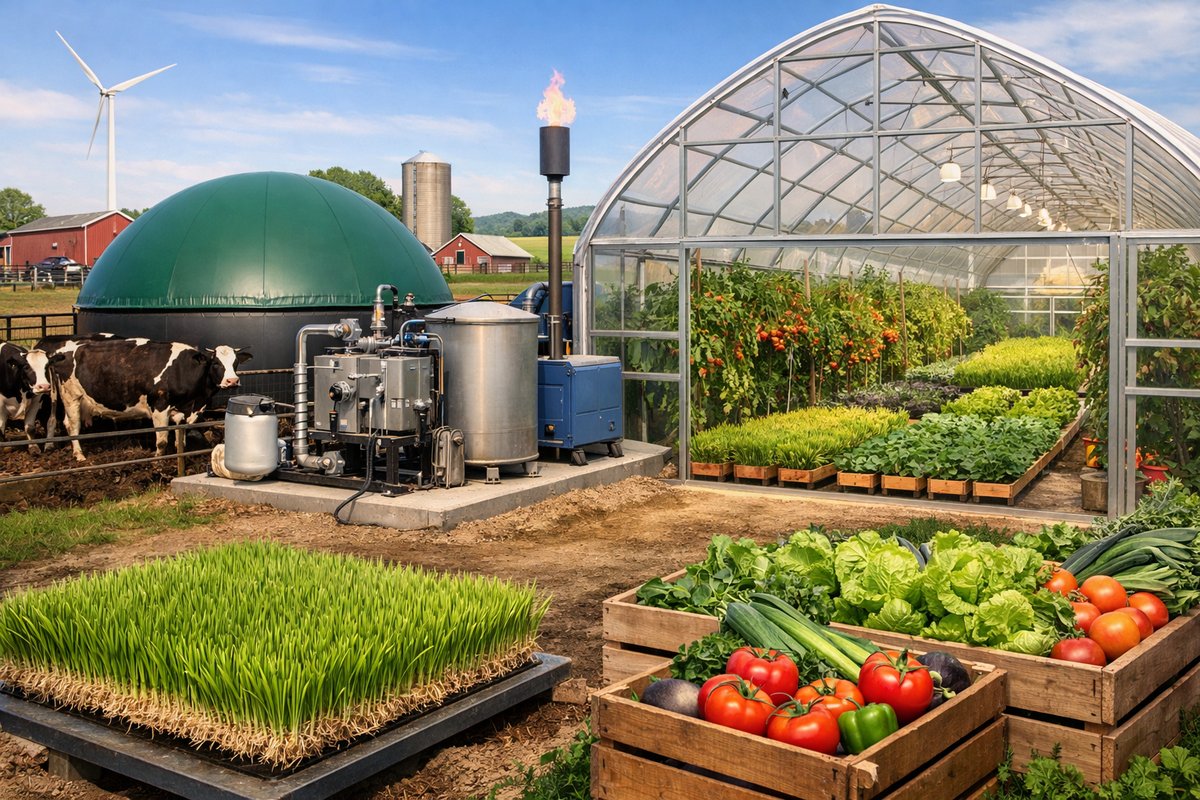
A family-run ranch in Iowa has installed a compact anaerobic digester that turns cow manure into clean biogas, powering a new greenhouse where fodder and vegetables grow year-round. The project cuts methane emissions, reduces energy costs by over 60 percent, and improves livestock nutrition, offering a replicable model for sustainable small-scale farms.
When spring rainfall finally broke a months-long dry spell, the rolling hills of Carroll County, Iowa, glowed emerald from a curious new structure: a 30-by-50-foot greenhouse warmed by biogas derived from cow manure. On the Petersen family’s 350-acre mixed livestock operation, this greenhouse is more than a novelty-it’s the centerpiece of a system that recycles waste, slashes energy bills and delivers fresh fodder even in the depths of winter.
Two years ago, brothers Jake and Will Petersen teamed up with Iowa State University researchers to pilot a compact anaerobic digester on their dairy-cattle operation. The digester, housed in a refurbished steel shipping container, ferments manure in oxygen-free chambers. The process yields biogas-a mixture of methane and carbon dioxide-while producing a nutrient-rich liquid effluent that the family uses as fertilizer.
“We’ve always felt guilty about methane escaping directly from the lagoon,” says Jake, leading visitors through the digester’s monitoring console. “Now we capture roughly 80 percent of that methane, and instead of flare-gas, we have a fuel source to heat our greenhouse and even cook in the farm kitchen.” The digester processes an average of 12,000 gallons of manure per week and generates enough biogas to fuel a 25-kilowatt combined heat-and-power unit.
The greenhouse, installed last autumn, relies on both biogas boilers and energy-efficient LED arrays. While the boilers maintain interior temperatures around 65°F, programmable LED panels extend daylight hours and boost photosynthesis in winter’s low sun. In practice, the system reduces traditional propane and grid electricity use by more than 60 percent during the cold months.
Inside the greenhouse, barrels of freshly cut barley, oat and pea grass sprouts share space with culinary herbs-parsley, chives and oregano-destined for the farm’s small on-site restaurant. Fodder trays stack seven layers high in modular metal racks. Each tray holds ten pounds of grain seed, yielding nearly a hundred pounds of nutrient-dense sprouted fodder within six days.
“Last January, we were hauling in bales from six states away,” Will explains as he harvests a tray of pale-green shoots. “Now, we walk out back and have fresh feed for twenty head of steers and thirty laying hens. It’s a game changer.” Not only does the fodder grow cycle cut transport emissions, but its high moisture content means animals drink 20 percent less water in winter, cutting overall farm water use by an estimated 15 percent annually.
Tech integration was key to success. Soil sensors, originally designed for row-crop farms, monitor relative humidity, temperature and carbon dioxide inside the greenhouse. Data flows to a solar-powered telemetry unit that triggers ventilation fans or adds heat when conditions stray outside preset comfort zones. An open-source dashboard, accessible via smartphone, allows the Petersen brothers to tweak setpoints while on the tractor or even at home.
“We wanted something plug-and-play, not proprietary,” says Will. “That way, if a sensor goes down, we can replace it with an off-the-shelf module. And the students at ISU can help us fine-tune algorithms without paying licensing fees.” The system has kept humidity between 60 and 70 percent most days, reducing mold risks and preserving seed germination rates at around 95 percent.
Beyond operational perks, the greenhouse project has measurable impacts on livestock health and productivity. University trials measuring weight gain in steers fed a 20-percent sprouted-barley ration showed a 12-percent improvement over conventional dry-rolled barley. Laying hens on a mixed-herb-and-oat fodder diet laid eggs with richer yolk color and slightly higher omega-3 levels.
“The preliminary data look promising,” notes Dr. Elaine Kapoor, an agronomy researcher involved in the trial. “You’re seeing faster growth and marginally better feed conversion ratios. Plus, there’s an animal-welfare benefit-fresh greens year-round help reduce boredom and stress.” The researchers are also testing whether biogas-effluent foliar sprays on fodder trays can boost certain micronutrients, but those studies are ongoing.
Environmental gains extend beyond methane capture. The digester’s liquid effluent, once stripped of potent greenhouse gases, flows into drip-irrigation lines beneath nearby pasture paddocks and cover crops. Phosphorus and nitrogen levels in runoff dropped by 30 percent, according to watershed monitors deployed in a drainage ditch downstream of the farm. Local conservation groups hail the system as a model for reducing nutrient loading in the Raccoon River basin.
Economically, the payback period for the digester and greenhouse stacked in under seven years. Federal and state cost-share grants covered 40 percent of the digester’s purchase, while a low-interest cooperative loan financed the greenhouse retrofit. Savings on propane, electricity and purchased feed now amount to roughly $30,000 per year. Jake and Will estimate net positive cash flow in year three, after maintenance and labor costs.
Community impact has followed. The Petersens host monthly open houses for area farmers and 4-H youth, showcasing the system and sharing lessons learned. Plans are in the works for a regional co-op digester, where smaller farms could subscribe to process manure at scale and share heat credits. A local feed mill has expressed interest in buying sprouted-grain pallets during peak season, creating an additional revenue stream.
Looking ahead, the family dreams of adding solar panels to the greenhouse roof, making it net-zero energy when biogas is supplemented by photovoltaic production. They’re also exploring aquaponics trials-raising tilapia or catfish in tanks beneath the greenhouse benches, using effluent water as a nutrient source for both fish and plants.
“At first, this felt like an experiment,” Jake reflects, standing beneath the gentle glow of LED strips. “Now it’s part of our daily routine. We’ve turned what used to be a pollution liability into clean energy and fresh feed. And the cattle seem to like it-who knew grass in January could taste this good?”
As winter recedes, the greenhouse doors will open wider, inviting beams of spring sunshine onto wheatgrass carpets. But the lessons learned will stay in place through the next storm. For farms large and small, this biogas-greenhouse model offers a blueprint for circular resource use, economic resilience and healthier herds-proof that sustainable innovation can sprout from the manure heap.