Location
Mount Vernon, WA 98274

Location
Mount Vernon, WA 98274
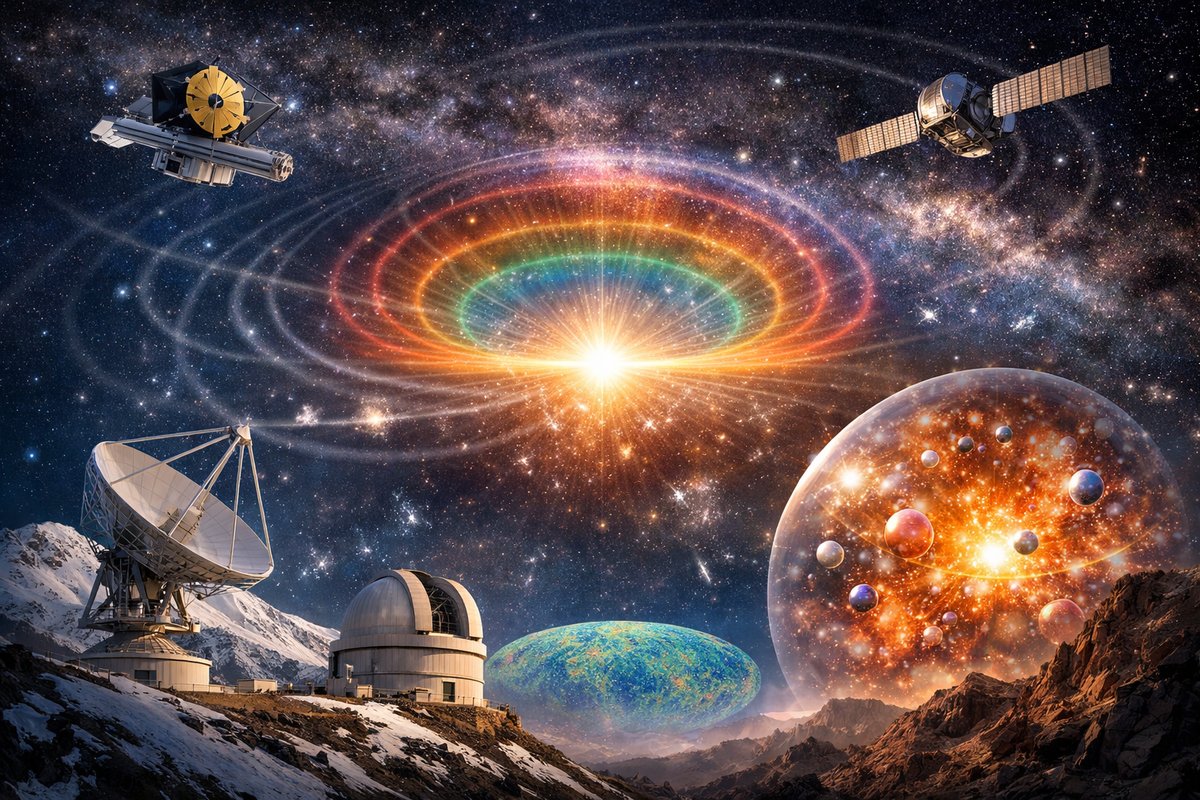
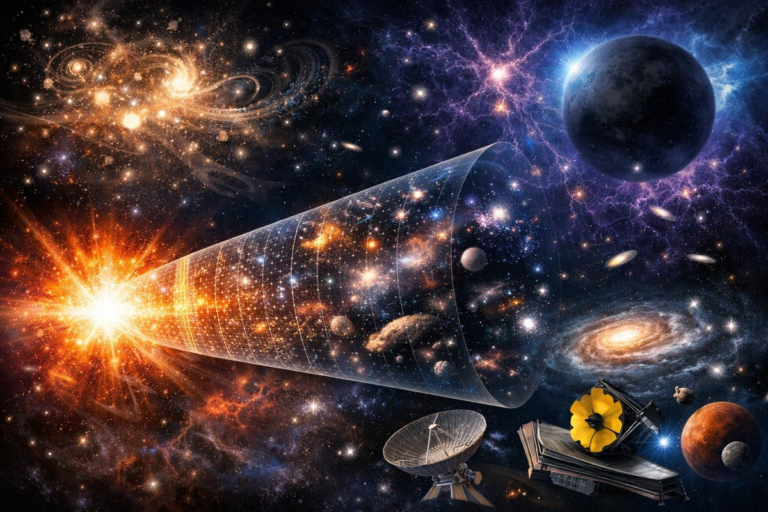
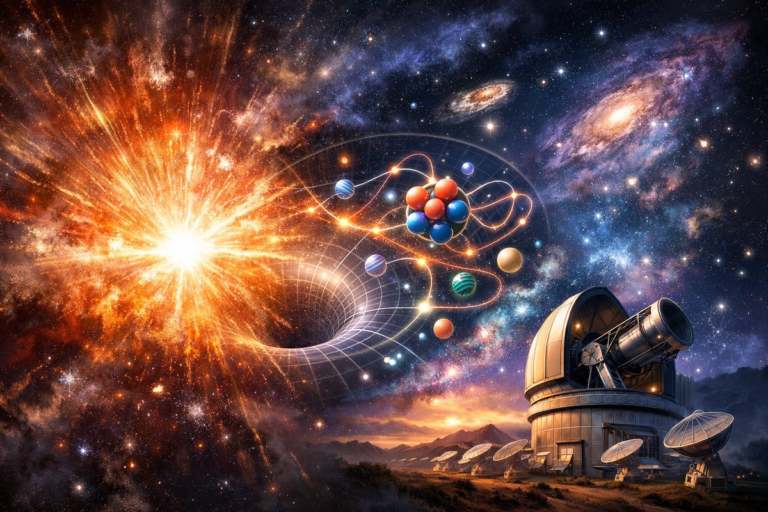
A network of powerful telescopes and detectors is converging on the universe's first heartbeat, capturing whispers of inflationary ripples and the birth of matter. From high-altitude observatories to spaceborne instruments, researchers are piecing together a portrait of creation that challenges long-held assumptions and hints at deeper mysteries.
From the frozen South Pole plateau to the vacuum of space, an international fleet of observatories is tuning into the universe’s opening symphony. In the last year, the Simons Observatory in Chile achieved unprecedented sensitivity in measuring the cosmic microwave background’s faint polarization patterns, while balloon-borne experiments circled the stratosphere to hunt for the spectral fingerprints of the earliest light. These complementary efforts have begun to tease out the primordial “B-mode” signals that inflationary theory predicts-swirls in the CMB that carry the echo of gravitational waves generated a fraction of a second after the Big Bang.
The inflationary paradigm has long promised answers to age-old puzzles: why regions of the cosmos share nearly identical temperature despite being causally disconnected, why space appears so exquisitely flat, and why magnetic monopoles are conspicuously absent. In the inflationary picture, a sudden exponential expansion stretched quantum fluctuations into macroscopic density variations, seeding galaxies and clusters. Gravitational waves from that era would leave a unique imprint on the oldest light: a twist in polarization that cannot be mimicked by later astrophysical sources. Detecting this “smoking-gun” signature has become the holy grail of observational cosmology.
At the heart of the ground-based push lies the Simons Observatory’s large-aperture telescope and array of small telescopes operating at millimeter wavelengths. Perched at 5,200 meters on the Atacama Plateau, the facility has just released its first polarization maps, revealing patterns at angular scales never before resolved. These early results already tighten constraints on the energy scale of inflation, lowering the upper limits on how violently space could have expanded.
Meanwhile, at the geographic South Pole, the BICEP Array has upgraded its receivers with state-of-the-art superconducting sensors that reduce instrumental noise by nearly half. By combining data from multiple observing seasons, the collaboration refined its search for B-modes at angular scales corresponding to the horizon size at inflationary times. Although a definitive detection still eludes researchers, the absence of contaminating foregrounds-such as polarized dust in our own galaxy-marks a significant mitigation of systematic uncertainties.
Spaceborne observatories continue to provide crucial context. Decades after COBE first mapped the microwave sky and WMAP refined the global parameters of our universe, the Planck satellite delivered the most detailed all-sky picture of temperature anisotropies. Now, preliminary analyses of archival Planck polarization data are being reprocessed with new algorithms that correct for instrumental polarization leakage. This revival has improved sensitivity at low multipoles, where the inflationary signal is strongest, and has guided ground-based experiments in optimizing frequency coverage.
While microwave observatories peer into the afterglow of creation, the James Webb Space Telescope has started revealing candidate galaxies at redshifts beyond 12-light emitted less than 400 million years after the Big Bang. These infant galaxies appear surprisingly massive and metal-rich, suggesting that star formation might have ignited even earlier than models predicted. Reconciling these observations with the timeline set by CMB measurements is a new frontier: do first-generation stars form in brief, intense bursts or through more gradual fragmentation of primordial gas? The answer may hinge on the interplay between dark matter halos and radiative feedback in the cosmic dark ages.
In parallel, the cosmos presents more puzzles than it solves. Dark matter, which outweighs ordinary matter by a factor of five, remains undetected in laboratories despite decades of searches for weakly interacting massive particles (WIMPs). The cosmic neutrino background, a relic sea of ultra-low-energy neutrinos, still lies beyond direct measurement even as terrestrial experiments like KATRIN pin down neutrino masses with ever greater precision. And dark energy, driving the accelerated expansion of space, defies any simple explanation within known physics. These shadowy components are woven into the narrative of origins but resist any single theoretical framework.
On the particle physics front, advanced collider data and underground detectors are closing in on light relic particles-axions and sterile neutrinos-that could leave subtle imprints on the universe’s thermal history. The CERN Large Hadron Collider’s high-luminosity upgrade is scheduled to begin delivering data that may reveal new symmetry-breaking processes relevant to baryogenesis, the mechanism that tipped the balance toward matter over antimatter. Any confirmation of these theoretical schemes would retroactively illuminate how the first atomic nuclei formed and survived as the universe cooled.
Looking to the horizon, next-generation missions aim to sharpen our view even further. The PIXIE concept for a spaceborne spectrometer would map the CMB spectrum with ten times the sensitivity of COBE-FIRAS, hunting for energy injections from decaying relic particles or primordial turbulence. Japan’s LiteBIRD satellite, scheduled for launch within the next decade, plans a full-sky polarization survey specifically designed to detect inflationary B-modes with unprecedented control of systematic errors. And CMB-S4, a proposed network of ground-based telescopes in both hemispheres, promises to push sensitivity to near the cosmic variance limit.
These observational breakthroughs are sparking fresh theoretical exploration. String cosmology scenarios suggest that multiple inflationary stages or colliding branes might leave distinctive non-Gaussian signatures in the CMB. Loop quantum gravity offers a “bouncing” cosmology in which a previous contracting phase avoids a true singularity, replacing it with a quantum bridge. Each framework makes specific predictions for the spectral shape of primordial ripples, motivating new statistical analyses of existing data.
Beyond the equations and detectors lies a deeper question: what does “nothing” mean? In many inflationary models, the universe emerges from a quantum vacuum fluctuation, yet this vacuum is anything but empty-it teems with virtual particles and fields subject to uncertainty principles. If spacetime itself is quantized at the Planck scale, then geometry may dissolve into probabilistic foam. Our quest to reach the universe’s birth thus becomes a journey to the limits of reality, where physics and philosophy intertwine.
As multi-messenger cosmology takes shape, the synergy between photons, neutrinos and gravitational waves will enrich the narrative of creation. Future detectors may pick up a background of primordial neutrinos or detect nanohertz gravitational waves from cosmic strings. Combined with precise measurements of galaxy clustering and reionization history, these diverse probes will stitch together a coherent timeline from inflation through the cosmic dawn to the rise of the first stars.
We stand at a watershed moment in our understanding of the cosmos. Where once we had only a broad outline of the Big Bang, we now glimpse the subtlest imprints of the universe’s opening act. Each new map, each tightened constraint, draws us closer to a portrait of creation both awe-inspiring and unsettling. The next decade promises not just incremental progress but the potential for paradigm-shifting discoveries that will reshape how we conceive of beginnings-and what lies beyond them.