Location
Mount Vernon, WA 98274

Location
Mount Vernon, WA 98274
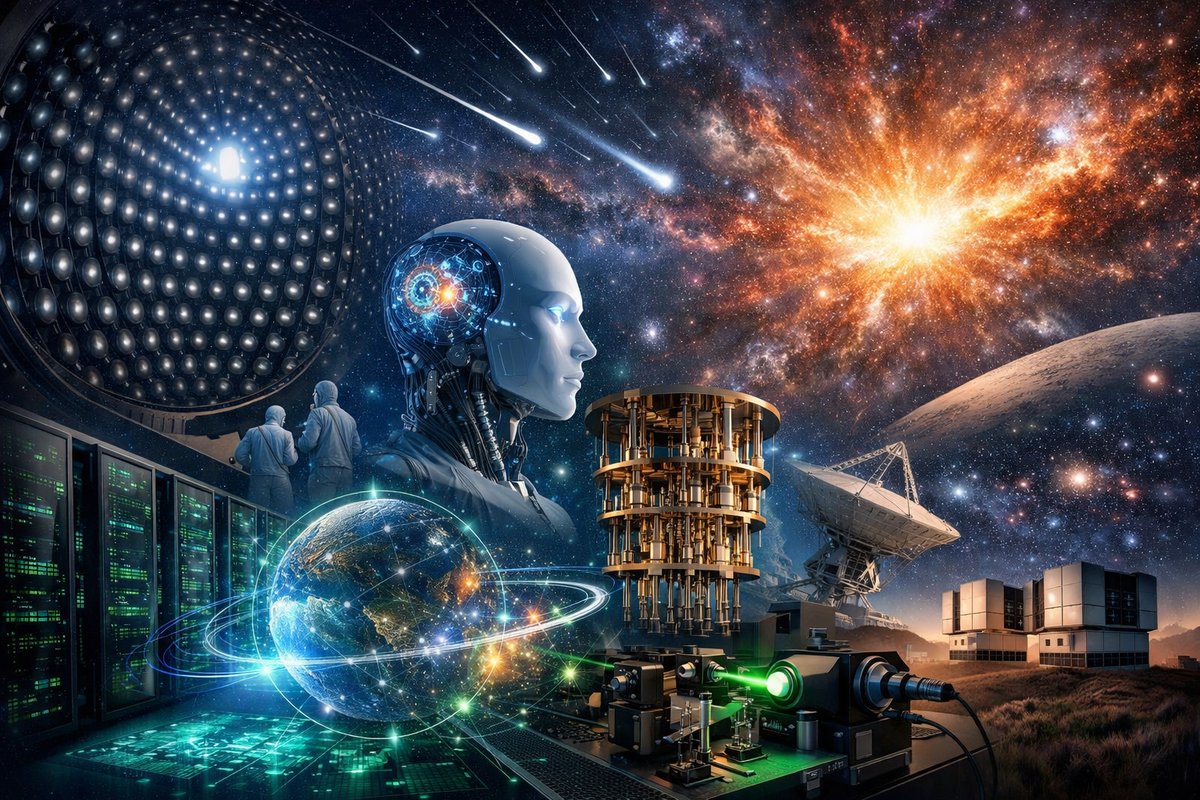
From elusive cosmic neutrinos to AI-powered analysis and quantum sensors, researchers are piecing together the universe's earliest epochs. This article explores breakthroughs in neutrino detection, large-scale sky surveys, sustainable supercomputing, and quantum instrumentation that promise to illuminate the dawn of time.
The quest to decipher the origins of the cosmos has reached a pivotal moment thanks to parallel breakthroughs in neutrino detection and large-scale sky surveys.
For decades, cosmologists have pursued traces of the cosmic neutrino background predicted by the Big Bang, but its signals have remained hidden beneath a sea of noise.
Enter the PTOLEMY collaboration’s prototype detectors, deployed near a deep underground laboratory. These instruments use tritium capture to register low-energy neutrinos streaming from the universe’s infancy.
Simultaneously, next-generation observatories like the Vera C. Rubin Observatory are embarking on a comprehensive census of galaxies spanning billions of light-years.
By mapping the distribution of visible matter across cosmic time, astronomers can infer the subtle gravitational footprints of dark matter and even constrain the imprints of primordial fluctuations.
This cosmic cartography has revealed unexpected patterns in the large-scale structure, hinting at anomalies that challenge the simplest models of inflation.
Observations of galactic clusters show slight tension with microwave background measurements, deepening the so-called Hubble tension and suggesting new physics may be at play.
Some researchers propose that a component of early dark energy, which briefly altered the expansion rate, could reconcile these discrepancies without overhauling the inflationary paradigm.
Meanwhile, high-fidelity simulations running on exascale supercomputers have begun to model the interplay between neutrinos, dark matter, and baryonic processes.
The ExaStar project has generated virtual universes that evolve from fractions of a second after the Big Bang to the present day, exposing subtle effects of particle interactions.
One surprising outcome involves primordial magnetic fields, which may have seeded galaxy formation earlier than previously thought, offering a new lens on cosmic dawn.
Closer to home, tabletop cloud chamber detectors have become a popular educational tool for visualizing radioactive decay and cosmic ray showers in real time.
These simple physics kits allow students and enthusiasts to witness particles streaking through vapor trails, bridging the gap between astronomical phenomena and hands-on experiments.
On the theoretical front, efforts to unify quantum mechanics and general relativity continue to wrestle with paradoxes like singularities and information loss around black holes.
Proposed frameworks-ranging from loop quantum gravity to algebraic holography-offer tantalizing glimpses of how space and time might emerge from fundamental quantum bits.
Experimentalists are now seeking indirect evidence for these frameworks by searching for deviations in the cosmic microwave background’s polarization patterns.
Instruments such as advanced bolometers cooled to fractions of a degree above absolute zero are scanning the sky, hunting for the faint B-mode signals predicted by inflationary gravitational waves.
A recent flight of a balloon-borne observatory achieved unprecedented sensitivity, plucking hints of these primordial ripples from the microwave sky.
If confirmed, these gravitational wave imprints would provide the first direct probe of inflation’s energy scale and the shape of the inflationary potential.
Yet many mysteries remain: Why is matter so much more abundant than antimatter? How did the first heavy elements form in the first few minutes?
Nucleosynthesis models suggest precise reaction rates between protons, neutrons, and light nuclei, but small uncertainties lead to big questions about elemental abundances.
New laboratory measurements of nuclear cross sections, using ion traps and laser-cooled atoms, are narrowing these gaps and tightening our view of the early chemical evolution.
Looking ahead, space missions like CMB-S4 and Euclid promise to deliver sharper maps of the cosmic web and deeper insights into dark energy’s nature.
At the same time, ground-based neutrino observatories are expanding their detection arrays, hoping to capture both neutrinos from the cosmic neutrino background and those emitted by nearby supernovae.
These overlapping strategies, combining cosmic surveys, particle experiments, and theoretical innovation, form a unified campaign to peel back the universe’s deepest layers.
The success of this campaign depends not only on cutting-edge technology but on fostering collaboration across disciplines and continents.
Open data initiatives and international partnerships are now the norm, enabling astronomers and physicists from around the world to analyze the same datasets.
Citizen science platforms have also emerged as vital tools, enlisting volunteers to sift through petabytes of images and identify rare cosmic phenomena.
As these efforts converge, we edge ever closer to addressing the fundamental question: How did everything we see emerge from a hot, dense origin?
Whether it is through the echo of neutrinos, the bending of light by dark matter, or the whispers of primordial gravitational waves, the universe is offering new clues.
Each discovery reshapes our narrative of cosmic genesis, inviting us to imagine even more exotic possibilities beyond our current horizon.
By weaving together observations, experiments, and theory, scientists are charting a path back to the very first moments of existence-and perhaps beyond.
AI-driven analysis tools have proved indispensable in managing the staggering volume of data generated by modern surveys and detectors.
Machine learning algorithms can flag subtle anomalies in sky maps, sift through particle collision results, and even predict optimal configurations for future experiments.
These intelligent systems accelerate discovery by highlighting unexpected patterns that might elude conventional analysis pipelines.
Equally important is the drive toward sustainable computing: large-scale simulations and data centers now prioritize energy efficiency and carbon-neutral operations.
Collaborative efforts are underway to power supercomputing clusters with renewable energy sources, aligning our quest for cosmic knowledge with the imperative of planetary stewardship.
Outreach programs have leveraged virtual reality and immersive experiences to bring the early universe to life for students and the public.
Interactive exhibits allow participants to navigate simulated cosmic epochs, witness galaxy formation, and explore the interplay of fundamental forces firsthand.
This blend of education and inspiration nurtures the next generation of scientists, ensuring that diverse perspectives continue to propel cosmological research.
As we push the frontiers of knowledge, we also confront profound philosophical questions: What is the nature of reality? Could our universe be one of many in an expansive multiverse?
Hypotheses about bubble universes and cosmic membranes tantalize our imagination, though empirical tests remain challenging.
Nevertheless, experiments like precision spectroscopy of distant quasars and atomic clocks in space offer glimpses into possible variations of fundamental constants across time and space.
Such measurements could reveal subtle shifts in coupling strengths or particle masses, opening a window onto the underlying architecture of reality.
Meanwhile, advances in quantum sensor technology are enabling ultra-sensitive measurements of tiny fields and forces, from detecting minuscule gravitational gradients to mapping faint magnetic imprints from the early cosmos.
Devices based on nitrogen-vacancy centers in diamond, atomic interferometers, and superconducting qubits are transitioning from laboratory curiosities to practical research instruments.
In tandem with classical detectors, these quantum tools promise to probe the frontier between quantum theory and gravity, a realm still shrouded in mystery.
Ultimately, the odyssey to the universe’s origins is a testament to humanity’s intrinsic curiosity and collaborative spirit-a journey that melds cutting-edge hardware, open data, imaginative theory, and public engagement.
Each answer begets new questions, ensuring that the story of cosmic beginnings will continue to unfold for generations to come.