Location
Mount Vernon, WA 98274

Location
Mount Vernon, WA 98274
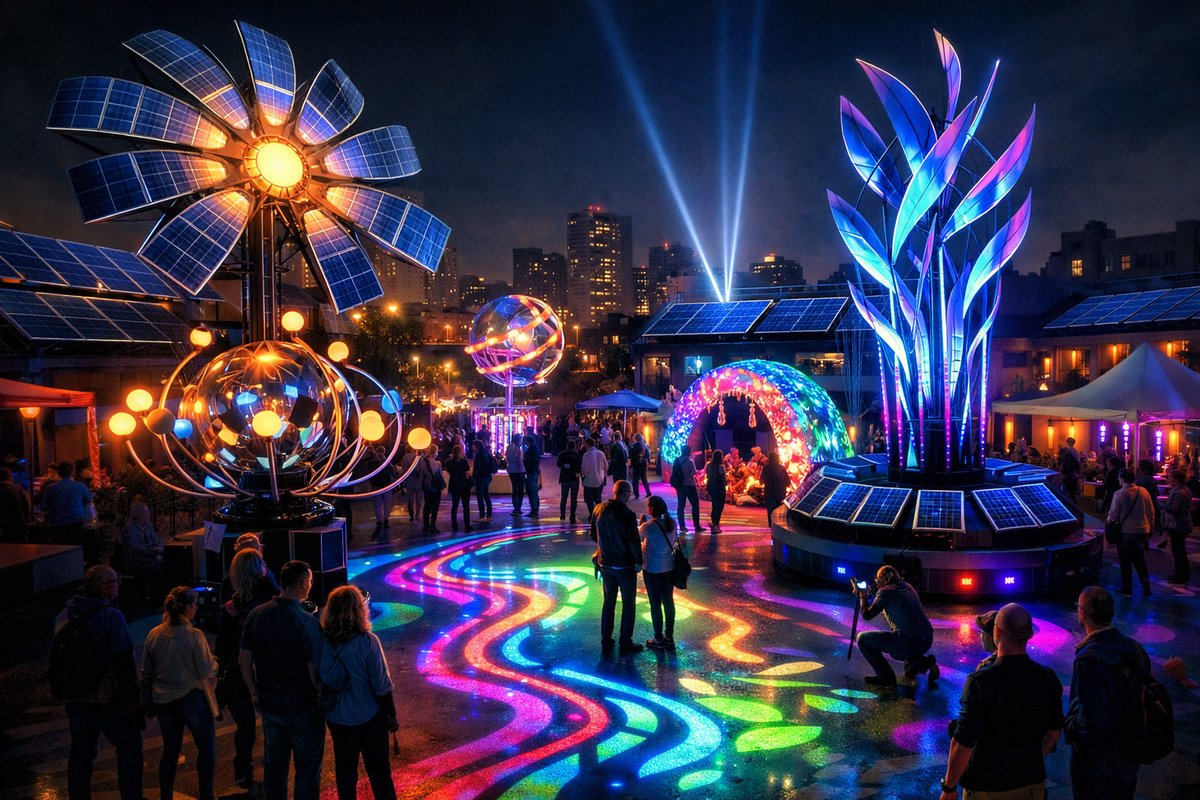
A new wave of public art is emerging where kinetic sculptures powered by rooftop solar arrays and UV-reactive pigments transform city streets into luminous galleries. At the recent Sun Chasers Festival, artists unveiled sun-tracking installations that generate and store energy for interactive light displays, sparking fresh conversations on sustainability, technology, and collective creativity in urban spaces.
As dawn broke over the historic plazas of Valencia, a cluster of towering sculptures began to pivot, each panel rotating purposefully to catch the first rays of sunlight. By midday, these gleaming forms had drawn curious crowds, their solar cells humming softly as they absorbed energy. When night fell, the same sculptures-adorned with programmable LEDs and UV-reactive coatings-erupted in gently shifting patterns of color, casting the cobblestones in a kaleidoscope of living light. This was the inaugural Sun Chasers Festival, a bold experiment in sustainable public art that marries kinetic engineering, renewable energy, and immersive design.
At the heart of the festival stood “Helio Bloom,” a series of twelve flower-like columns whose petals, crafted from transparent polycarbonate, tilt and twist on ball-bearing pivots. Each petal houses a compact photovoltaic module linked to a microcontroller board hidden at the base. By day, Helio Bloom tracks the sun’s arc, optimizing energy capture. As the shadows lengthen, thousands of addressable LEDs blossom across the petals. Patched code sequences ripple organic animations in real time, responding to ambient temperature and wind speed. Viewers can even influence the light choreography via a smartphone interface, compelling the installation to bloom faster or shift hues toward cool blues and violets.
The festival’s centerpiece emerged from months of collaboration between environmental engineers, software developers, and local artisans. Lead designer Marina Pérez describes the process as an exercise in balance. “We wanted a structure that feels alive but grounded in sustainability,” she explains. “By integrating flexible solar panels and bi-stable petals, we create a sculpture that adapts its form to nature’s cycle. At night, it gives back energy in the shape of art.” Her team employed an open-source microcontroller platform to orchestrate the lighting effects, customizing real-time scripts that synchronize battery charge data with color transitions. “It’s not just decoration,” Pérez insists. “It’s a live dialogue with the sun.”
Elsewhere in the plaza, a companion piece called “UV Pulse” showcased a more tactile approach. Constructed from locally sourced canvas panels infused with UV-reactive fabric paints, it invites passersby to leave their mark. Festival facilitators supply participants with brushes and glow-in-the-dark pigments; once sunlight hits the artwork, hidden fluorescent layers flush into view. Walkers encounter evolving murals that only reveal themselves as the sun climbs higher. The participatory spirit extends beyond painting: embedded capacitive touch sensors trigger subtle vibrations when a hand brushes certain areas, delivering an unexpected sensory cue.
Technical ingenuity permeates even the simplest elements. Embedded MPPT (Maximum Power Point Tracking) controllers regulate current from the solar modules, storing excess in a compact battery bank concealed beneath cobblestones. A wireless telemetry network beams performance metrics-voltage, charge cycles, energy output-to public displays scattered around the square. Visitors can watch live graphs showing how much sunlight each sculpture has harvested and how many kilowatt-hours have been redirected to power streetlights later. For many, these dashboards provide the “aha” moment when art and infrastructure converge.
The Sun Chasers Festival stands as a milestone in an evolving trend: art that generates its own power while highlighting environmental imperatives. In recent years, sun-responsive design has spread from niche galleries to urban corridors, driven by affordable electronics and growing climate awareness. Public institutions have begun commissioning solar pavilions that double as charging stations for bicycles and smartphones. Private foundations sponsor workshops where students construct mini kinetic models out of conductive paint, piezoelectric sensors, and flexible photovoltaic strips. Whether in Mediterranean squares or North American college quads, these solar-sculpture initiatives aim to spark dialogues about resource consumption and collective responsibility.
For city planners, the festival offers more than aesthetic spectacle. Urban designer Rafael Moretti, who attended the opening, points to the potential for integrated art-lighting networks. “Imagine bus stops with kinetic roofs that harvest sunlight by day and illuminate shelters by night,” he suggests. “These modular installations could replace conventional fixtures and cut municipal energy bills. They also bring communities together around a shared sense of wonder and stewardship.” His team is already in talks to pilot a neighborhood-scale deployment, pairing solar-art modules with smart benches and air-quality sensors.
Public response in Valencia has been overwhelmingly positive. Local residents, initially skeptical of yet another temporary event, found themselves enchanted by the sculptures’ gentle rotations. Children chased after rotating petals, while older attendees lingered under soft, color-shifting canopies. Street vendors reported longer foot traffic after sunset, drawn by the festival’s ambient glow. Photographers and social-media influencers spread images of luminous flowers emerging from medieval stones, creating a ripple of interest well beyond Spain’s borders.
Behind the scenes, the festival organizers tracked environmental impact meticulously. Over the span of four days, Helio Bloom alone generated enough energy to power 200 LED streetlamps for an hour each night. UV Pulse’s interactive canvas consumed negligible electricity, relying mostly on passive pigments charged by daylight. Even the data displays ran on small solar arrays affixed to their frames. By the closing ceremony, the net carbon footprint of the festival’s lighting elements was effectively zero, a fact celebrated in a closing infographic animation projected onto the city hall facade.
This embrace of solar kinetics points to broader shifts in how artists conceive public engagement. Where once a mural or sculpture stood static, now dynamic installations invite collaboration, teaching audiences about renewable energy in visceral ways. Recent innovations have even skipped solar entirely, using wind-harvesting rotors or piezoelectric floor panels to power light sculptures with human footsteps. Yet the sun remains the most abundant source, lending an intuitive elegance to day-night cycles and biological metaphors of growth and decay.
Looking forward, organizers plan to refine the festival’s toolkit into a traveling exhibition kit. Future editions may include modular joint connectors that snap panels together without tools, or plug-and-play software modules to adapt lighting scripts for different climates. Workshops will teach communities how to repurpose scavenged solar cells from decommissioned devices, stressing circular economy principles. By democratizing the tech behind sun-responsive art, the project aspires to spark grassroots creativity from Manila to Montreal.
Ultimately, the Sun Chasers Festival underscores a potent idea: sustainability isn’t a constraint but a creative catalyst. By foregrounding renewable energy as both medium and message, kinetic sculptures become living ambassadors for a greener future. They remind us that art need not wait for powered grids; it can generate its own spark, illuminating not just public squares but collective imaginations.
As the festival’s final pieces rested silently under starlit skies, organizers already envisioned the next horizon. Solar-driven art, once a fringe niche, is poised to illuminate our streetscapes and shift our relationship with natural resources. Every rotating petal, glowing mural, and telemetry graph signals a recalibration: art that feeds on sunlight, powered by curiosity and conscience, can guide cities toward more luminous tomorrows.