Location
Mount Vernon, WA 98274

Location
Mount Vernon, WA 98274
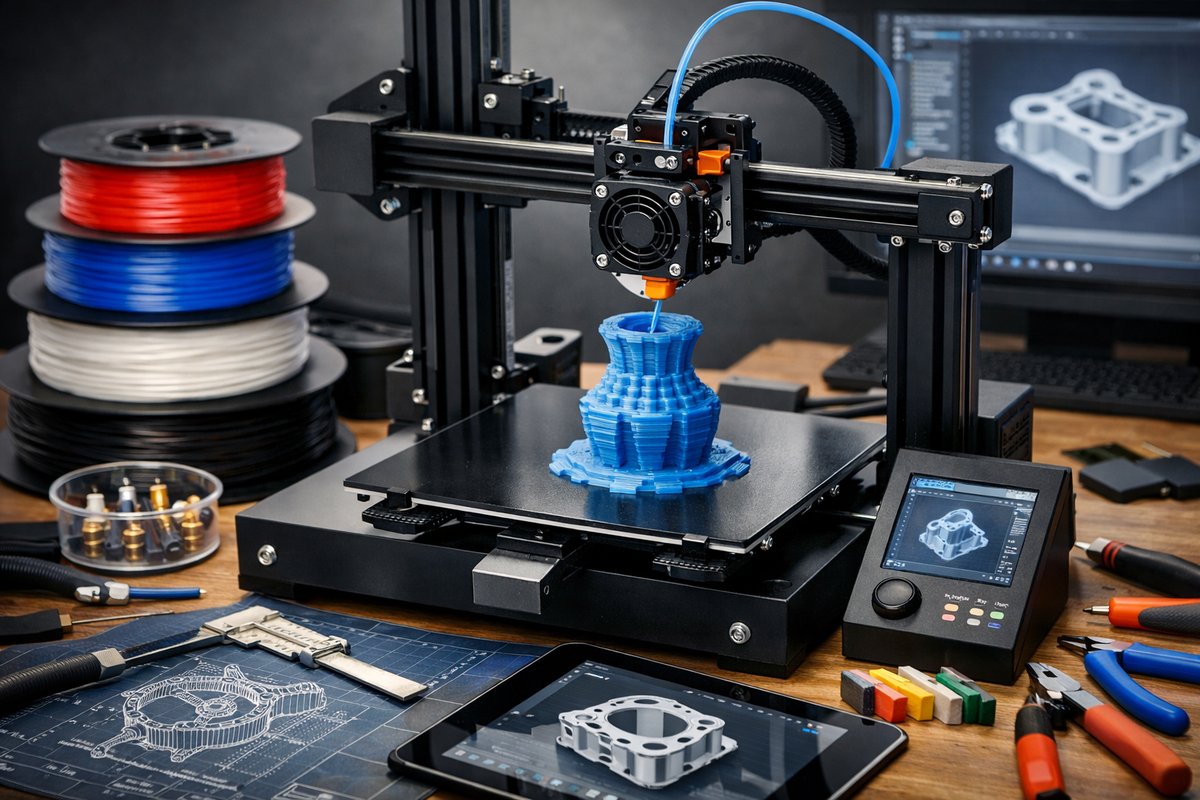
Fused Deposition Modeling (FDM) is one of the most accessible and versatile additive manufacturing techniques, ideal for hobbyists and professionals alike. This guide explores the essentials of FDM, from printer selection and filament choices to optimizing print settings, empowering you to bring your digital designs into the physical world with precision and creativity.
Additive manufacturing has revolutionized the way we design and fabricate objects, with Fused Deposition Modeling (FDM) standing out as one of the most popular and approachable techniques. FDM works by extruding thermoplastic filament through a heated nozzle, depositing material layer by layer to build up a three-dimensional object. This method’s accessibility, affordability, and material versatility make it a favorite among makers, educators, and engineers.
Getting started with FDM printing requires understanding several key components and processes. First, the choice of printer is foundational. Desktop FDM printers have evolved considerably, offering a range of build volumes, nozzle sizes, and features such as heated beds and enclosed chambers. These features influence print quality, material compatibility, and ease of use. For instance, a heated bed helps prevent warping by maintaining adhesion during printing, especially with materials like ABS.
Next, the filament material itself plays a crucial role in the final object’s properties. Common filaments include PLA (Polylactic Acid), ABS (Acrylonitrile Butadiene Styrene), PETG (Polyethylene Terephthalate Glycol), and TPU (Thermoplastic Polyurethane). PLA is popular for its ease of printing, biodegradability, and smooth finish, making it ideal for beginners and general-purpose models. ABS offers greater strength and heat resistance but requires more controlled printing environments to avoid warping and fumes. PETG strikes a balance between PLA and ABS, offering durability and flexibility with less odor. TPU is a flexible filament suited for applications needing elasticity.
Optimizing print settings is a blend of art and science. Layer height affects surface smoothness and print time; finer layers yield more detail but take longer. Infill percentage determines internal density, influencing strength and material use. Print speed, nozzle temperature, and bed temperature must be calibrated for each filament type to ensure good adhesion and layer bonding. Many slicer software packages provide presets for popular filaments, which serve as excellent starting points.
Beyond hardware and materials, preparation and maintenance are vital. Ensuring the print bed is level and clean improves adhesion and reduces failed prints. Regular nozzle cleaning prevents clogs that can degrade print quality. Post-processing techniques such as sanding, painting, or vapor smoothing can enhance the aesthetic and functional qualities of printed parts.
One of the exciting aspects of FDM printing is its versatility. From rapid prototyping to custom jigs, educational models, and even functional parts, the possibilities are vast. Users can experiment with multi-material prints, combining rigid and flexible filaments, or incorporate embedded components by pausing prints. The open-source community around FDM printing offers countless designs and modifications, fostering continuous innovation.
Safety considerations should not be overlooked. Proper ventilation is important, especially when printing with materials like ABS that emit fumes. Handling heated components with care and using the printer in a stable, well-ventilated area ensures a safe environment.
In summary, mastering Fused Deposition Modeling involves selecting the right printer and filament, fine-tuning print parameters, and maintaining equipment. With patience and practice, users can unlock the power to transform digital ideas into tangible, functional objects. Whether crafting intricate prototypes or personalized gifts, FDM printing invites creativity and problem-solving in a hands-on way. Embracing this technology opens doors to innovation and sustainable manufacturing practices by enabling localized, on-demand production with minimal waste.