Location
Mount Vernon, WA 98274

Location
Mount Vernon, WA 98274
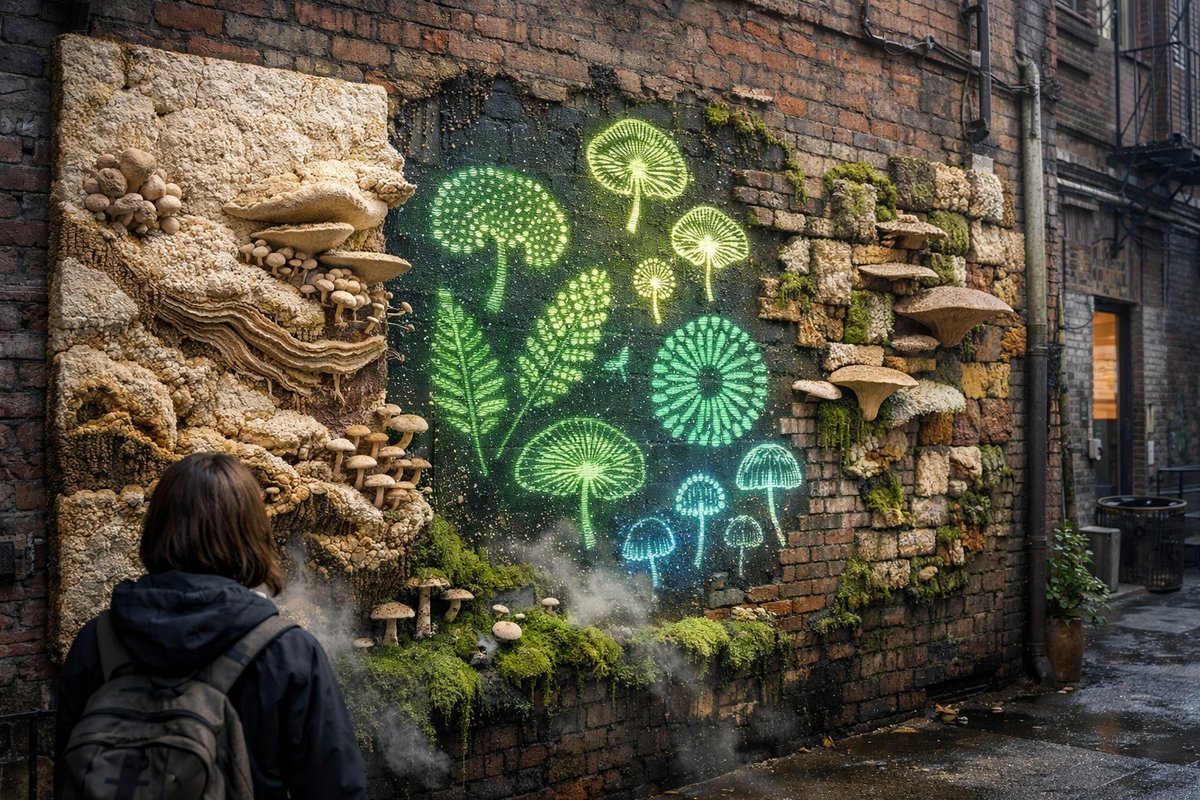
Emerging at the intersection of biotechnology and street art, mycelium-based installations are transforming city walls into living mosaics. From humidity-responsive fungal panels to glowing spore prints, artists and designers are pioneering sustainable expressions that grow, adapt, and decompose on demand.
On an unassuming alley in Berlin’s Kreuzkölln district, a mural seems to shift with every passing cloud. Its muted sepia tones deepen beneath midday sun but lighten into pale taupes when humidity spikes. Look closer, and you’ll discover that this wall is not painted at all, but grown: a patchwork of mycelium panels cultivated directly onto biodegradable mats and interlaced into existing brickwork. Dubbed “Organica Transit,” the installation exemplifies a growing movement in urban art – one that replaces synthetic pigments with living networks of fungal threads, or mycelia, to create dynamic, ever-evolving murals.
Once confined to laboratory petri dishes, mycelia are now at the forefront of design experimentation. Their ability to bind organic substrates, self-heal small tears, and break down safely at end of life positions them as formidable alternatives to plastics and synthetic paints. And as climate-conscious curators and municipalities search for greener methods to animate public spaces, bio-responsive mosaics are emerging from research studios into cityscapes worldwide.
The concept hinges on pairing fungal species with tailored substrates – agricultural waste, sawdust, or hemp hurd – molded into modular tiles. After inoculation, panels incubate in dark, humid chambers until they form dense, pale networks. Once sufficiently robust, they’re pressed onto walls treated with a thin layer of adhesive, then slowly colonize the surface. Artists intervene at key stages, sculpting relief patterns, incorporating natural dyes, or embedding simple electronics that monitor temperature and moisture.
Collaborations between mycologists, architects, and street artists are accelerating innovation. In London’s Shoreditch neighborhood, a collective known as Urban Mycology unveiled “SporeCity” last summer: a 20-meter mural that pulses with bioluminescent bacteria living symbiotically within the fungal structure. At night, tiny pinpricks of light trace geometric patterns, responding to shifts in sound. Microphones mounted at street level feed ambient noise into microcontrollers, which modulate LED brightness and bacterial fluorescence through nutrient releases embedded in the mycelium scaffolding.
“It’s a conversation between biology and urban life,” explains the installation’s lead designer. “We tap into fungal intelligence – its capacity to sense chemicals and moisture – and overlay digital signals so the wall itself becomes a living interface.” The project drew critical acclaim for its novel marriage of open-source electronics and regenerative materials, inspiring municipal arts councils in Rotterdam and São Paulo to commission similar prototypes.
Behind every mycelium mosaic is a toolkit that merges artisanal craft with digital fabrication. Essential components include:
Most community labs now provide starter kits combining these elements, making it possible for novice makers to pilot small-scale urban installations. Workshops are sprouting up in art schools and hackerspaces, where participants learn to mix grain spawn with sawdust, monitor colonization rates, and troubleshoot issues like bacterial contamination or uneven growth.
In Rotterdam, a disused parking garage recently received a green makeover courtesy of a design studio specializing in bio-materials. The façade comprises 400 triangular panels, each housing a distinct strain of Ganoderma lucidum or Pleurotus ostreatus. As rainwater seeps through gutters into concealed channels, it trickles over the tiles, prompting color shifts that range from creamy white to chestnut brown. Underneath, a network of capillary wicks directs moisture to drier areas, creating fluid gradients reminiscent of watercolor washes.
Visitors can scan QR codes to track which species perform best in different microclimates, and the studio publishes live data on spore density and panel integrity. Over two months, researchers observed that panels shaded by nearby trees retained moisture three times longer than those in full sun, influencing decisions about optimal panel placement in future projects.
Despite the promise, integrating living installations into public environments carries challenges. High pedestrian traffic introduces abrasion risks, while air pollution can hinder fungal respiration. Temperature extremes may slow growth or cause dormancy. Long-term maintenance demands periodic inspections; technicians sometimes apply nutrient sprays or replace panels after extensive weathering.
Regulatory hurdles also loom. Public health authorities require safety assessments to ensure fungal spores don’t exacerbate allergies or invade unintended surfaces. Developers must secure special permits for installations that release microbes, no matter how benign. Some cities have even mandated annual bio-audits to track microbial community changes around the site.
Research labs aren’t stopping at neutral tones. Scientists are exploring genetic and chemical methods to coax fungi into producing pigments – indigo blues, saffron yellows, rusty reds. Cyanobacteria co-cultures can impart green hues, while luminescent strains developed through safe gene-editing produce ghostly glows visible at dusk.
Designers anticipate future façades that shift color based on air quality, alerting passersby to pollution spikes or pollen counts. By integrating e-ink panels seeded with spores, walls could function as giant living dashboards, displaying real-time environmental data through subtle chromatic shifts.
As sustainability continues to dominate architectural and urban planning agendas, bio-responsive installations point toward a paradigm where art, design, and ecology converge. Mycelium mosaics exemplify a broader trend in “living design,” where dynamic materials replace static counterparts and communities play active roles in maintenance and data sharing.
Next year, a biennial slated for Singapore will feature floating pavilions carved from compressed fungal blocks, fitted with irrigation networks and rainwater harvesting. Attendees will be invited to shape these structures through workshops, leaving imprints that guide subsequent growth. Similar concepts are in development for refugee camps, where rapidly deployable fungal panels could provide temporary shelter skins that sequester carbon and degrade harmlessly when no longer needed.
In every case, these initiatives foreground values of circularity, curiosity, and emotional intelligence – treating walls not as inert backdrops, but as responsive partners in urban life. By cultivating art from living matter, designers are forging connections that blur the lines between built environments and natural systems, inviting viewers to witness the delicate choreography of growth, decay, and renewal.
Whether graffiti artists of tomorrow will swap spray cans for petri dishes remains to be seen. But one thing is clear: the frescoes of the future may very well breathe on their own.