Location
Mount Vernon, WA 98274

Location
Mount Vernon, WA 98274
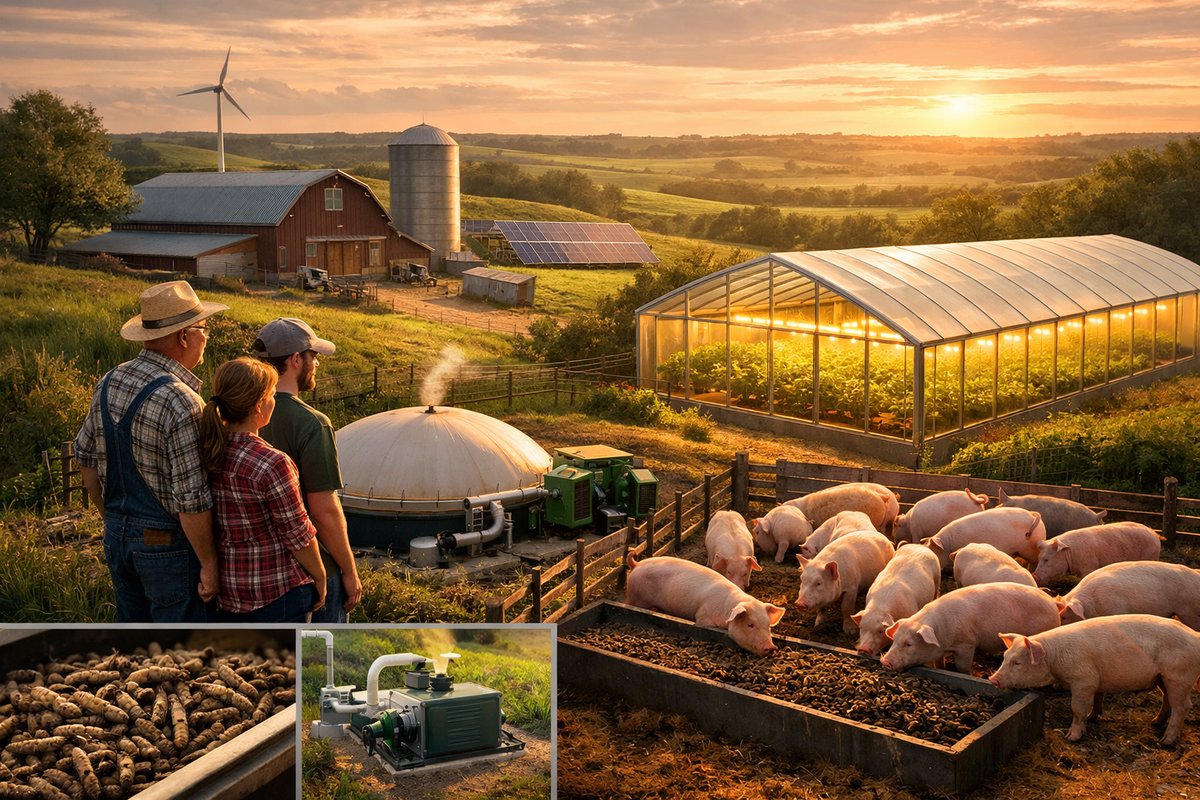
A family-run farm in the rolling hills of central Kansas has turned waste into wealth by cultivating black soldier fly larvae to feed its pigs while generating biogas for greenhouse lighting. Their innovative, closed-loop approach offers a roadmap for other livestock operations seeking energy independence and reduced feed costs.
In a landscape where rising feed prices and energy bills threaten small-scale livestock operations, one Kansas family has found an unlikely solution in the form of a humble insect. At Meadowbound Acres, the Johnson family integrates black soldier fly larvae (BSFL) rearing with a home biodigestion system and LED-lit greenhouse to transform manure and vegetable scraps into protein feed, heat, and lighting. This holistic model has not only slashed costs but also fostered soil health, animal welfare, and carbon transparency.
The venture began three years ago when farm owner Clare Johnson noticed that even after expanding rotational grazing acres, feed purchases for her heritage pigs were cutting deeply into the monthly budget. “We rotate pasture, grow cover crops, and save grain where we can,” she says. “But there was still a gap. On top of that, heating the barn in winter and running grow lights for seedlings in early spring meant higher electricity bills.”
A seed of inspiration came from a research paper profiling urban insect farms that turn kitchen waste into protein. The Johnsons dove into BSFL operations and realized their hogs would happily devour the larvae. They built a series of shallow bins lined with breathable mesh, where a steady mix of manure, vegetable peelings, and spent brewery grains creates the perfect breeding ground. Within two weeks, the larvae reach harvest size, ready for feeding.
By replacing 30 percent of commercial feed with larvae, Meadowbound Acres cut monthly feed costs by nearly 20 percent. But they didn’t stop there. Separating the remaining residue-known as frass-fed into a small, plug-and-play biodigester borrowed from a regional cooperative. Over several weeks, the organic material breaks down anaerobically, producing biogas. Johnson installed a low-profile generator that burns the gas to power a bank of spectrum-tunable LED fixtures in a nearby greenhouse.
“We can’t always rely on grid power when severe weather knocks out lines,” she explains. “But with the biogas system, we started running seedlings under LEDs through March and April without tapping the grid. It’s about resilience as much as economics.” Tomatoes for the summer CSA, lettuce for fall salad mix, and herbs for local restaurants all get their start in that biodigester-fueled canopy.
Beyond cost savings, the system delivers environmental benefits. Using insects to process manure reduces methane emissions compared to open manure piles, and capturing biogas prevents it from escaping into the atmosphere. Early monitoring suggests Meadowbound Acres has cut its on-site greenhouse gas output by nearly 40 percent. The farm also applies the digested effluent-a nutrient-rich liquid-to pasture edges and cover crop beds, boosting soil carbon and microbial diversity.
Employee wellbeing and animal welfare have improved as well. The Johnsons report fewer respiratory issues in staff now that manure no longer sits in uncovered piles. And the pigs-allowed daily portions of live larvae-show more robust growth rates and healthier coats. “They get a bit excited at feeding time,” says farmhand Marco Ramirez with a laugh, “and we love that it enriches their natural foraging behavior.”
Meadowbound Acres has become a living classroom. Visitors from community colleges and neighboring farms come to tour the installation. Last month, the local extension office hosted a workshop on insect farming fundamentals and biodigester maintenance. Johnson sees this knowledge sharing as essential for scaling sustainable practices in the region’s livestock sector.
The next frontier for the farm is integrating soil moisture and nutrient sensors around pasture rotations. By tracking moisture levels and soil health metrics, they hope to refine irrigation schedules and cover crop mixes, making the entire ecosystem smarter and more responsive. Plans also include installing solar panels on barn roofs to power the biodigester pumps, edging closer to energy self-sufficiency.
This blend of low-tech biological processes and strategic sensor deployment stands in contrast to heavily capitalized, tech-driven models. Johnson emphasizes that anyone with a modest budget, basic carpentry skills, and a willingness to experiment can replicate the system. “You don’t need million-dollar drones or blockchain networks to innovate,” she notes. “Sometimes the tiniest creature brings the biggest change.”
As pressures mount on farm finances and environmental regulations tighten, Meadowbound Acres offers a beacon for other livestock operators. By turning waste streams into feed and energy, they’ve built a resilient loop that benefits animals, staff, and the planet. Their story underscores a larger shift: sustainability doesn’t always require cutting-edge gadgetry-it can thrive on curiosity, collaboration, and a dash of insect ingenuity.