Location
Mount Vernon, WA 98274

Location
Mount Vernon, WA 98274
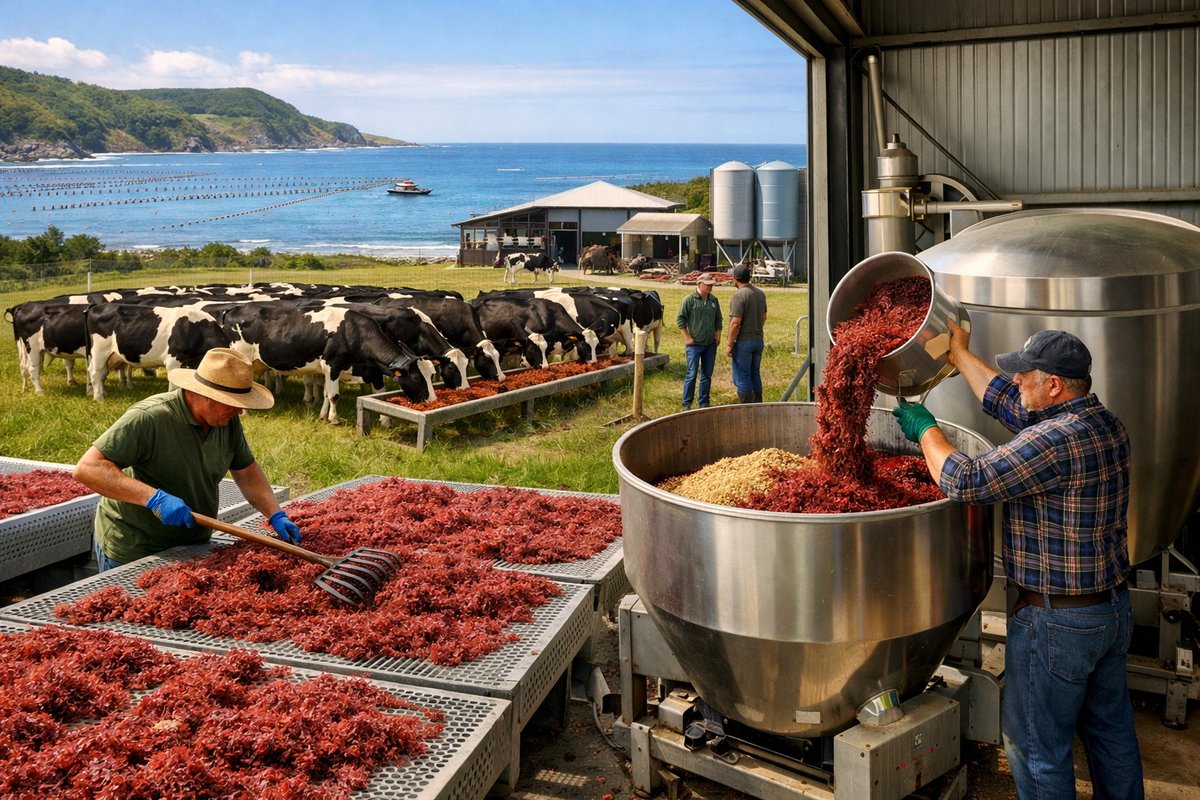
A pioneering collaboration on the coast has brought aquaculture and dairy farming together to trial red seaweed feed supplements, reporting up to a 50 percent reduction in enteric methane emissions while improving herd health. Through on-farm drying and mixing facilities, local producers are turning a marine crop into a scalable tool for sustainable livestock management.
On a windswept stretch of shoreline where lobster boats and lobster traps define the scenery, a novel partnership between seaweed growers and dairy farmers is rewriting the story of livestock emissions. In a quiet barn just inland from rocky coves, a group of producers is adding finely milled red seaweed to cow rations, aiming to curb one of agriculture’s most persistent challenges: methane from enteric fermentation.
The trial began with a handful of progressive dairy operations seeking ways to meet consumer demand for climate-friendly milk. Researchers have known for years that certain species of red seaweed, especially Asparagopsis, contain bioactive compounds capable of inhibiting methane-producing microbes in the rumen. Early studies in controlled settings showed emission cuts of 50 to 90 percent. But translating those results into a working farm system demanded fresh ideas, local investment, and a willingness to work with a slippery sea vegetable.
Local seaweed harvesters had long considered small volumes of Asparagopsis a specialty crop for culinary markets. Yet fluctuations in restaurant demand and logistics challenges left harvesters hunting for new uses. When a regional dairy cooperative reached out with funding, small aquaculture outfits leaped at the chance. Together they built a prototype processing shed just yards from the saltwater tanks, outfitted with moisture-controlled dryers, milling equipment, and blending stations.
Farmers load daily seaweed harvests into racks warmed by low-energy fans. Over eight short hours, moisture content falls to below five percent, yielding a brittle, dark red powder. At mixing stations, the mill’s output is combined with grain, hay pellets and molasses to create a feed block that can be dropped directly into mangers or mixed into conveyor-fed rations. On the first full week of feeding, technicians fitted cows with methane-monitoring masks and recorded a 45 percent drop in emissions per animal, while milk yield and body condition scores held steady.
“The cows didn’t bat an eye,” said one herd manager, her voice echoing in the metal barn. “We worried about palatability, but it’s like a salty treat. They go after it faster than a bag of candies.” Lab tests confirmed there were no adverse effects on milk composition. In fact, some farmers reported a subtle uptick in butterfat content and improved coat brightness, suggesting secondary health benefits.
Inside the newly commissioned on-farm lab, technicians run daily checks for spore counts, pH levels and trace minerals. The goal is to maintain consistency in the seaweed powder, which can show seasonal nutrient swings. “A autumn harvest has slightly different iodine and fiber levels than a spring harvest,” explained a technical director. “We blend batches from across the year to keep a standard profile.” Achieving uniformity at scale is the next challenge, but automated moisture sensors and remote data logging have cut quality-control time in half.
Environmental advocates and farm groups alike have taken notice. A recent regional greenhouse gas inventory showed that the trial farms collectively shaved more than 400 metric tons of carbon dioxide equivalent from their annual emissions. That’s the same impact as planting over 6,000 new trees. Local extension agents are now drafting outreach programs and planning demonstration days, while policymakers eye incentive schemes to offset initial equipment costs.
Still, questions remain over regulatory approvals for feeding unprocessed seaweed and labeling requirements for “seaweed-fed” dairy. Some food safety inspectors are scrutinizing heavy metal levels in marine crops, and farmers must maintain strict records of harvest locations and growing water quality. To address consumer concerns, the cooperative is planning an open-farm day where visitors can tour drying rooms, observe feed trials, and sample cheese made with seaweed-fed milk.
Beyond dairy, other livestock sectors are taking note. Swine producers are interested in off-label feeds that might boost growth rates, and beef ranchers in more temperate regions are testing locally grown kelp species. Researchers at a nearby university are sequencing ruminal microbiomes to map how different seaweeds sculpt microbial communities, potentially unlocking new feed formulations that deliver similar benefits in different climates.
Back on the coast, a sense of excitement fills the salt-sprayed air. Fisher families who once depended solely on shellfish markets have diversified into what some call “blue-green agriculture,” marrying aquaculture and livestock in a cycle of mutual gain. One innovator envisions an adjacent greenhouse where dairy waste fertilizes on-site vegetables, while spent seaweed solids enrich compost piles for row crops.
More farmers across the region are in discussions to replicate the model, forming buying groups to negotiate bulk seaweed harvests and shared processing facilities. Several entrepreneurs see opportunities to produce packaged feed blocks for beyond the coast, shipping containers of dried powder to dairy belts in the Midwest and beyond.
It’s a far cry from conventional grain-based rations, but for these coastal pioneers, the blend of saltwater crops and barn-yard dairy embodies the next frontier of sustainable farming. If their seaweed supplement trials continue to deliver on yield, animal health, and emission reductions, their approach may serve as a blueprint for livestock systems worldwide, proving that answers to some of agriculture’s biggest dilemmas may lie just offshore.
As the sun dips below the horizon, fishermen haul in nets while dairy trucks rumble out past the processing shed. Soon, seaweed-fed milk will flow from these farms into nearby creameries, arriving on store shelves under a promise of lower carbon and brighter futures. In the quiet dusk, the tide comes in, carrying with it the hope that human ingenuity, guided by nature’s own bounty, can chart a more sustainable course for food production.