Location
Mount Vernon, WA 98274

Location
Mount Vernon, WA 98274
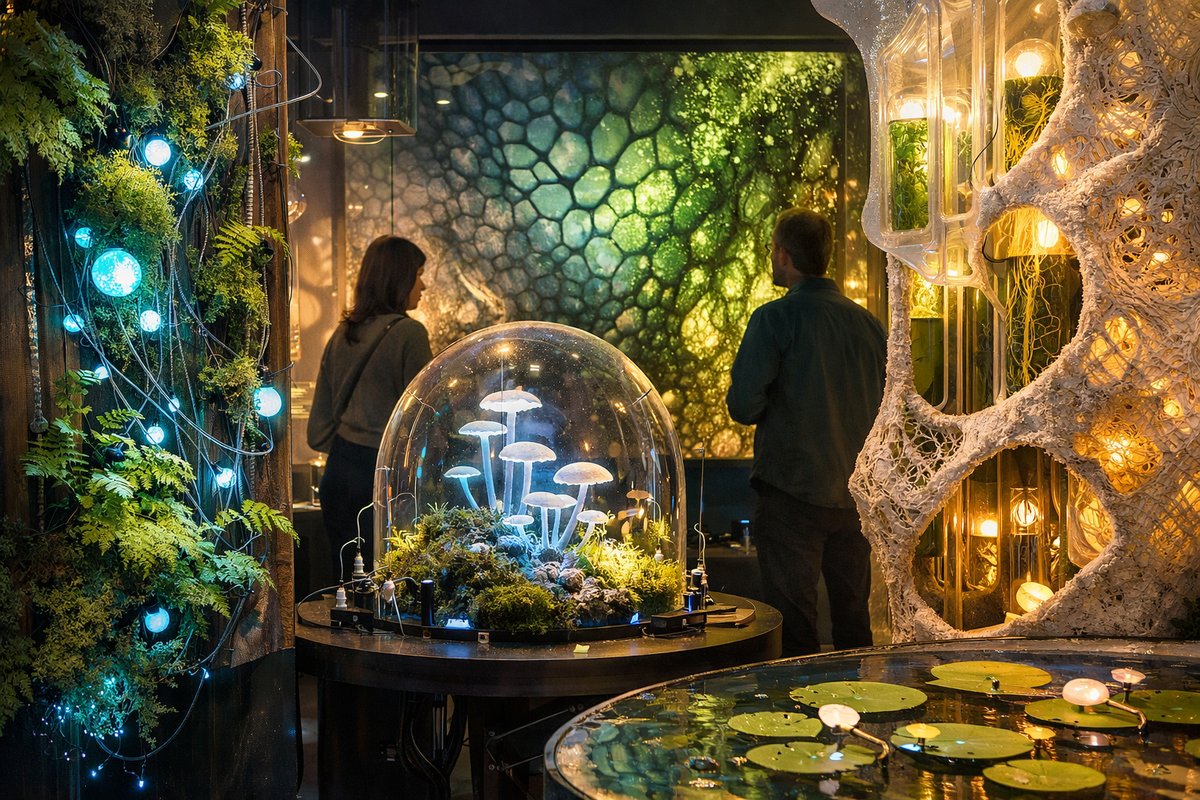
At a recent biodesign showcase, artists and engineers revealed installations that blend living organisms, sensor networks, and sustainable materials into immersive visual experiences. These works challenge our definitions of canvas and code, inviting audiences to witness art that grows, adapts, and sometimes even heals itself.
In a spacious converted warehouse on the edge of the city’s creative district, visitors gather around a long table supporting an array of petri dishes, each glowing with pale, pulsing light. Bioluminescent algae drift in softly illuminated swirls, tracing organic patterns in miniature oceans. Nearby, a low, curved wall coated in moss shifts hue in response to ambient air quality monitors, from deep forest green to a sickly chartreuse. This is the latest presentation from a collective of designers and biologists who reject static canvases in favor of living matter as their palette.
Over the past year, a curious convergence has taken shape where art, design, and synthetic biology collide. Galleries and public plazas are hosting works that rely on bacteria, fungi, and sensor networks to produce ever-changing visuals-and to spark larger conversations about sustainability, privacy, and the boundary between human and nonhuman collaborators. In these environments, every inhalation of carbon dioxide, every fluctuation in humidity, and every heartbeat of a visitor can ripple through an installation, transforming color, texture, and sound in real time.
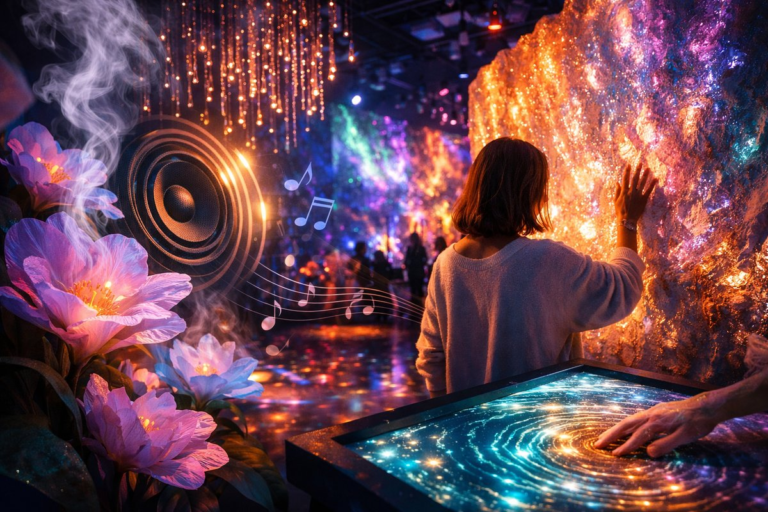
One of the most talked-about pieces at the showcase is “Symbiosis Wall,” a living mural created by an interdisciplinary studio founded by a bioengineer and a visual artist. The base layer is a mold of mycelium-threadlike fungal structures-that provides a textured, breathable surface for paint infused with conductive graphite powder. Embedded within the wall are compact air sensors and a microcontroller board. As pollution levels rise, the wall’s embedded LEDs flicker in patterns designed to mimic fungal bioluminescence recorded in forest ecosystems. At the same time, moisture sensors trigger mycelial growth turning faint streaks of the wall into soft, velvet-like ridges, reminding viewers that life is never truly inert.
In another alcove, a set of custom-designed headbands equipped with electroencephalogram (EEG) sensors registers the attention levels of participants as they gaze at a rotating sculpture made from 3D-printed biopolymers. When concentration peaks, the sculpture’s internal light engine brightens and shifts through a spectrum of colors; when focus wanes, the piece responds with slower, dimmer pulses. The interplay offers a gentle prompt to consider the feedback loop between human cognition and material form. Some guests report feeling more present, while others delight in the surreal choreography of mind and object.
These installations are more than gimmicks. They illustrate a broader movement toward ecological awareness and emotional intelligence in visual expression. By using living substrates and renewable pigments-often derived from algae, leftover fruit waste, or non-toxic bacterial cultures-artists are also experimenting with closed-loop systems. One featured project repurposes wastewater from a small-scale brewery to nourish vats of pigment-producing bacteria, which are then printed onto biodegradable textiles. At the end of exhibitions, those fabrics can be composted, returning nutrients to soil and minimizing landfill waste.
At the heart of these works is a philosophy that art should be a dialog, not a monologue. Traditional static pieces speak with one voice; living installations speak back. They demand ongoing care-tuning sensors, pruning fungal growth, regulating light cycles-and in doing so invite participants into a co-authorship. Workshop sessions held alongside the showcase taught basic skills in sterile lab technique, safe handling of microbial cultures, and simple circuit design. Novice visitors left with the conviction that they, too, could cultivate an evolving work of art in their own homes or community centers.
Behind the scenes, developers of interactive media platforms are racing to create more intuitive tools for bioartists. Graphical programming environments now offer nodes for “cell culture,” “humidity control,” and “biotic feedback,” while hardware manufacturers are releasing sensor modules specifically calibrated for greenhouse and laboratory conditions. Although much of this technology traces its roots to agricultural automation and environmental monitoring, it is being repurposed for creative ends-turning farmland instrumentation into expressive media controllers.
There are challenges, of course. Maintaining living installations requires strict protocols to prevent contamination, and not every venue is equipped for climate and biosafety standards. Some city regulations restrict the public display of genetically modified organisms, prompting artists to rely on wild-type strains or entirely non-GMO cultures. Others must navigate ambiguities in intellectual property law when it comes to living materials. Is a mycelial substrate patentable? Who owns the rights to a bacterial pigment that replicates itself? These legal and ethical puzzles add another layer of complexity to the practice.
Yet the risks have not stifled enthusiasm. Public funding agencies and sustainability-minded philanthropies have begun to support research in living media as part of larger green design initiatives. Museums are initiating residencies for bioartists alongside architects and urban planners, envisioning future city streets lined with responsive moss facades that regulate air pollution or shaking public squares where foot traffic powers LED pathways woven into biodegradable resin.
Critics suggest that these works could veer into techno-utopian spectacle if not grounded in genuine ecological impact. But many creators insist that the real value lies in fostering empathy-for microbes, for ecosystems, and for our own bodies. When a visitor watches their breath swirl through a cloud of engineered yeast spores, they confront the microscopic communities that sustain every human life. The result can be awe, discomfort, or a renewed sense of responsibility-an emotional spectrum rarely evoked by traditional abstract painting or sculpture.
As the exhibition drew to a close, one final work offered a glimpse of the future. In a darkened chamber, a vast installation of bioengineered algae shifted from emerald green to electric blue with the beat of an ambient soundtrack. Motion detectors picked up every step, nudge, or mouse-like shuffle, sending ripples across the living carpet. The effect was hypnotic, a reminder that we are seldom separate from the living world. Even our smallest gestures reverberate through it.
Whether these installations will become a fixture in mainstream galleries or remain a niche at the intersection of art and biotech is still unfolding. But one thing is clear: art that literally breathes, pulses, and evolves challenges us to rethink the materials we take for granted. It asks us to imagine creativity not as a human monopoly, but as an emergent property of all life. In that conversation, we may find new pathways to sustainability, new modes of self-awareness, and perhaps a deeper sense of shared stewardship for the living planet.